Mogadishu's new airport, port and other planned projects
Tusmada
- Summary
- Where Xidig members may contribute
- Possible services, research, supplier or collaboration roles
- Who may find this useful
- The twelve proposals that name Mogadishu
- What is already moving in Mogadishu
- Geographic context
- Dependencies and implementation constraints
- Risks and unknowns
- Questions members should verify before acting
- What is confirmed, and what isn't
- Relevant next steps
- More about the source
- Notes on figures
- Related reports
- About this report
- Sources
What is moving on Mogadishu's new airport, port, stadium and industry plans, where members could take part, and the twelve government proposals that name the city.
Not investment advice. Independent analysis of a government publication and other public sources. It is not an offer or a tender notice, and the Government of Somalia has not endorsed it.
Summary
Mogadishu is named in more of the government's 37 proposals than any other place, and several of its projects have moved on since the list was published. The biggest, a new airport and a new port north of the city, seem to be moving through arrangements of their own: the airport is in a feasibility study, and the port authority says it is planning the port. Smaller projects in poultry, eggs, edible oil, PET, recycling, waste services and the stadium are closer to the scale at which members could take part directly.
What Xidig found:
- New airport: a foundation stone was laid in June 2025, and a World Bank-funded feasibility study began in February 2026. Reported costs range from US$650M to US$800M and do not agree.
- New port: the port authority says it is planning a new port about 35 km north of the city. Xidig found no dry dock or ship-repair yard in Mogadishu today.
- Stadium: matches returned with a national tournament from 29 December 2023, and a foundation stone for a fuller rebuilding was laid in October 2024.
- Industrial land: Xidig found no operating industrial park or special economic zone law in Mogadishu.
- Power: tariffs were put at US$0.25–0.55 per kWh using 2017 field data, so solar, storage and maintenance for businesses facing high tariffs is one opening.
The government's list names Mogadishu in 12 of its 37 proposals, seven of them sited only in or near the city. All are labelled pre-feasibility, though two sheets also tick later stages; the full list, with costs and links to Xidig's detailed reports, is in the table below.
Where Xidig members may contribute
Learning and collaboration openings, not confirmed contracts or tenders:
- Engineers and planners: follow the airport and new-port studies, which will need environmental, social and technical review.
- Waste and recycling: collection, sorting and recycling businesses (see Plastic recycling and PET in Mogadishu).
- Food processing: poultry, eggs and edible oil, where the sheets are small and private.
- Sports and youth: facility management, coaching and events at the stadium.
- Power: solar, storage and maintenance for businesses facing high tariffs.
Possible services, research, supplier or collaboration roles
- A members' tracker of the airport, port and economic-zone plans north of the city, updated as documents are published.
- Supplier groups for the smaller private proposals (poultry, PET, recycling).
- Research: where the "existing industrial zones" named in the government's proposals are, and what utilities they offer.
Who may find this useful
- Diaspora members from Mogadishu and Banadir.
- Civil, aviation and port engineers.
- Environmental and social specialists.
- Food and manufacturing entrepreneurs.
- Sports and youth organisers.
The twelve proposals that name Mogadishu
The government's investment list names Mogadishu in 12 of its 37 proposals: seven sited only in or near the city, and five shared with other towns. Costs are as printed and are not approved or funded budgets. Each links to Xidig's detailed report.
| Proposal | Code, pages | Cost as printed | Mogadishu only? | Detailed report |
|---|---|---|---|---|
| Construction of New Mogadishu Airport | AV-02, pp.26–27 | $656M | Yes | New airport |
| Integrated Waste Management for Mogadishu | EV-01, pp.90–91 | $133 M | Yes | Waste management |
| Construction of Dry Dock at Mogadishu | LI-06, pp.61–62 | $112.2 M | Yes | Seaports and dry dock |
| Cooking Oil Extraction and Refining Plant | MF-01, pp.92–93 | $10 M | Near the city | Edible oil and PET |
| Rehabilitation of Mogadishu Stadium | SP-01, pp.69–70 | $9.787.217 M¹ | Yes | Stadiums |
| Poultry: Commercial Broilers and Layers Farming | AG-05, pp.21–22 | $5.4M | Yes | Farm-to-market |
| PET Manufacturing (preforms) | MF-02, pp.94–95 | $4.5 M | Yes | Edible oil and PET |
| HFO Power Plant, 100 MW (with Kismayo, Garacad, Bosaso) | EN-03, pp.33–34 | $450M for four | Shared | Electricity |
| Fisheries Processing Hubs (with Kismayo, Bosaso) | FI-02, pp.46–47 | $12.6M for three | Shared | Fisheries |
| New Fishing Ports (with Kismayo, Garacad) | FI-03, pp.48–49 | $20.7M for three | Shared | Fisheries |
| New Deep Seaports (with Hobyo, Barawe) | LI-03, pp.55–56 | $ 1,008.3 B² for three | Shared | Seaports and dry dock |
| New Trade Corridors: industrial cluster (with Hobyo, Kismayo) | LI-02, pp.53–54 | $1,209 B² for all corridors | Shared | Roads and trade corridors |
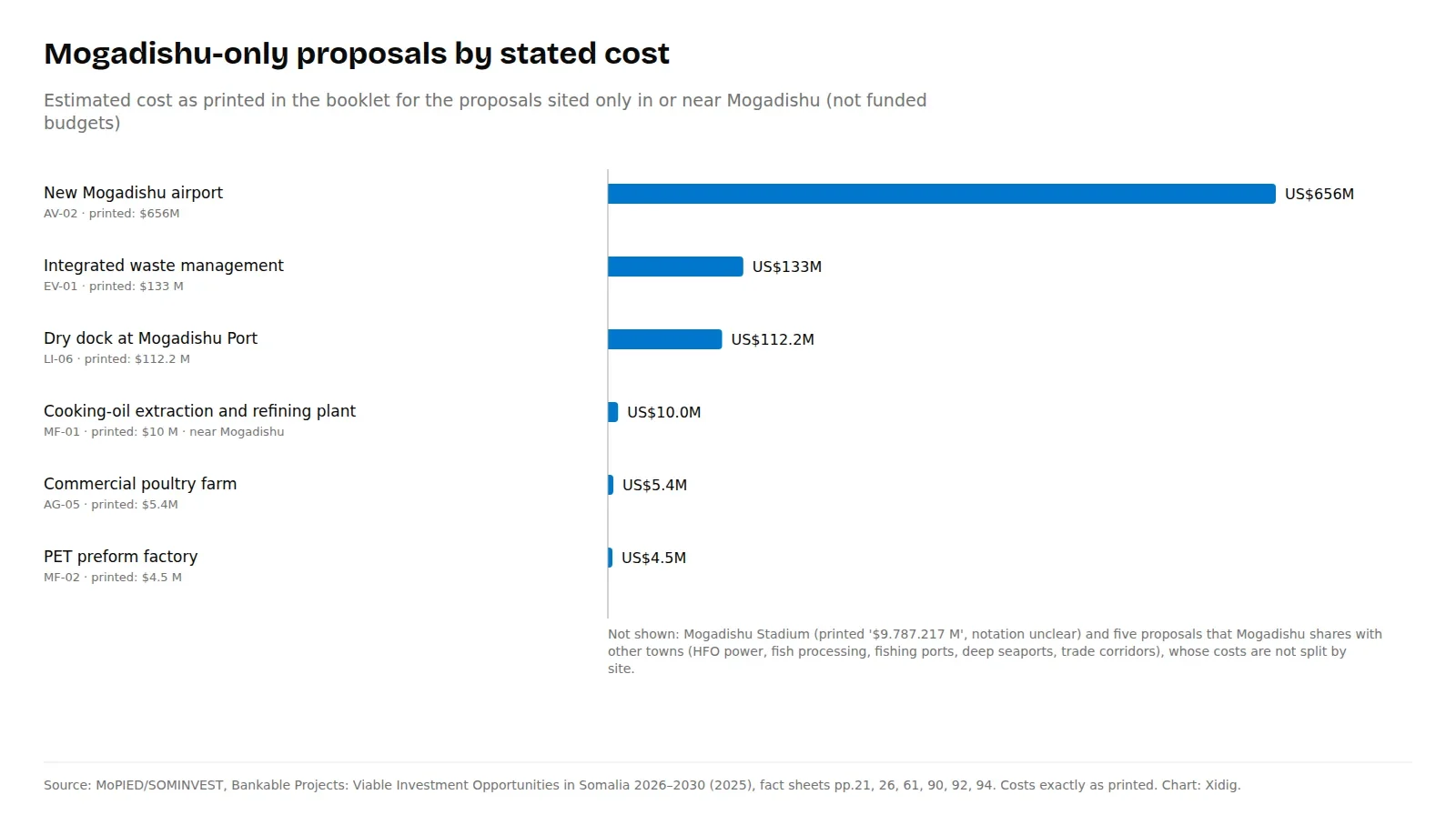
Stated costs of the proposals sited only in or near Mogadishu. The airport accounts for most of the total. The stadium is not shown (note 1), and shared proposals are left out because their costs are not split by site.
What is already moving in Mogadishu
New airport (AV-02). The government proposes "a new international airport in Mogadishu to meet growing passenger and cargo demand".
- Foundation stone: laid by the President at the end of June 2025 in Middle Shabelle (Passenger Terminal Today). Garowe Online reported that "the $800 million facility" would be completed "Within the next five years". Reports place the site at Haawaay (Garowe Online) and in the Maaxaay area (UNOPS).
- Feasibility study: in February 2026, UNOPS announced "the formal commencement of the feasibility study". The study covers a master plan, preliminary design and environmental assessment, funded under the World Bank's SHIIP project (extended to December 2027); its procurement plan estimates the study at about US$2.5M (see A new Mogadishu airport). UNOPS places the site "approximately 30 km north of Mogadishu", in the Maaxaay area.
- Promoter: a developer that describes itself as "a public–private partnership" promotes the airport on its website, giving "$714M+" and "Two 4,000m runways". UNOPS names the Ministry of Transport and Civil Aviation as the government counterpart; Xidig has not confirmed the developer's role in the government-led project.
- Costs: the reported figures (US$656M in the government's proposal, about US$650M, US$714M and US$800M elsewhere) do not agree.
New port and dry dock (LI-03, LI-06).
- Port operator: the Mogadishu Port Authority says the port runs "in partnership with the Turkish Albayrak Group".
- New port plan: the authority says it "is planning a new, state-of-the-art port facility approximately 35 km north of Mogadishu".
- Capacity: in November 2025 the ports minister told TRT Afrika that capacity had risen "from 150,000 TEU to 180,000 TEU" that year, with a target of 250,000 TEU. The port authority's website already gives 250,000 TEU. The minister said a new port would be built "in Mogadishu" starting in 2026.
- Dry dock: Xidig found no dry dock or ship-repair yard in Mogadishu today.
- Fit with the government's proposals: the government's deep-seaport sheet does not say whether it refers to this plan (see Somalia's seaports and a proposed Mogadishu dry dock).
Stadium (SP-01). The government proposes an upgrade with "seating, lighting, community spaces, and sports equipment".
- Matches: a national tournament opened at the stadium on 29 December 2023. AP reported in January 2024 that "thousands poured into the stadium", after three decades in which it was closed by war.
- Rebuilding: in October 2024 the Prime Minister laid a foundation stone for a fuller rebuilding. The state news agency said it would be "invested by a company belonging to the youth". Xidig found no cost or contractor.
Waste, oil and PET (EV-01, MF-01, MF-02).
- Waste: Mogadishu's waste rules changed in 2026 (see Mogadishu's proposed integrated waste management).
- Refinery: Xidig found no confirmed edible-oil refinery in Somalia (see Edible oil refining and PET preforms in Somalia).
- Industrial zones: the oil and PET sheets both cite "existing industrial zones" or "Industrial zones". Xidig found no operating industrial park or special economic zone law in Mogadishu. SOMINVEST lists economic zones only as an investment category. The same developer advertises a planned "New Mogadishu Special Economic District", linked to the new airport and port.
Power (EN-03).
- Supplier: the booklet itself says the Banadir Electricity Company (BECO) "owns and operates most of the electricity transmission & distribution systems in South Central Somalia" (p.38). BECO has run an 8 MWp solar plant in Mogadishu since 2020 (SONNA).
- Tariffs: a 2021 World Bank project document, using 2017 field data, put Mogadishu tariffs at US$0.25–0.55 per kWh (see Why electricity costs so much in Somalia).
Urban programmes.
- World Bank urban programme: the second phase of the World Bank-funded urban resilience programme (SURP II), which includes Mogadishu, has a total grant of US$253.5M and closes at the end of 2026.
- Drainage: the World Bank says Mogadishu's trunk drainage, designed under it, will be built under the recently approved Stairs2Jobs programme.
Population. No census has been published since 1975 (African Cities Research Consortium).
- 2014 survey: the 2014 population survey put Banadir at 1,650,227.
- Recent estimates: the African Cities Research Consortium cites "population estimates ranging from 1.7 million to 2.9 million".
- Displaced people: a November 2023 verification counted 1,247,669 displaced people in 1,979 sites in Kahda and Daynile districts, on the city's outskirts.
What this means.
- Scale: Mogadishu has the government's most expensive single-site proposal, the new airport.
- Airport and port: the new airport and a new port now seem to be moving through arrangements the government's proposals do not describe.
- Smaller proposals: the smaller proposals, such as the poultry farm, PET preforms, waste services and the stadium, are closer to the scale at which members could take part directly.
Geographic context
The seven Mogadishu-only proposals are all in or near the city. The government's proposal gives the stadium's location as Abdi Aziz district. The new airport (about 30 km north, per UNOPS) and the planned new port (about 35 km north, per the port authority) are reported to lie north of today's city. The airport site is reported to be in Middle Shabelle, outside Banadir. NMDC links its advertised economic district to both but gives no location. No map is included here because the booklet does not give sites for most proposals.
Dependencies and implementation constraints
- Concessions: the port and airport already have operators; new facilities would need to fit their agreements.
- Land: the new airport and port sites are outside the current city.
- Power and water for any industrial proposal.
- Security: construction and operations depend on it.
Risks and unknowns
- Cost figures: reported airport costs range from US$650M to US$800M.
- Unclear notation: printed costs for the stadium, deep seaports and trade corridors¹ ².
- Overlap: the government does not say how its airport and port proposals relate to the plans now under way.
- Displacement: large numbers of displaced people live on the city's edges, where new infrastructure is planned.
Questions members should verify before acting
- Is the government's airport proposal the same as the project now in feasibility study?
- Which authority is leading the new-port plan, and who will finance it?
- Where are the "existing industrial zones" the manufacturing sheets refer to?
- Has the stadium rebuilding finished, and who manages it?
- Which smaller proposals already have private sponsors?
What is confirmed, and what isn't
Confirmed
- The 12 proposals, their printed costs and their stated stages.
- The start of the World Bank-funded airport feasibility study (UNOPS, February 2026).
- The port authority's stated plan for a new port north of the city.
- The return of matches to the stadium (national tournament from 29 December 2023).
- SURP II's grant amount and closing date.
Our interpretation
- The large airport and port proposals are moving through separate arrangements.
- The smaller private proposals are the most accessible for members.
Not yet verified
- The cost, financing and timetable of the new airport and port.
- Whether an industrial zone or economic-zone law exists.
- Current passenger and cargo figures for Aden Adde airport.
Relevant next steps
- Follow UNOPS and the World Bank for the airport feasibility study and consultations.
- Follow the Mogadishu Port Authority for the new-port plan.
- Mogadishu members: share what you know about industrial land, power costs and the stadium's use through Xidig.
More about the source
The government's investment booklet, Bankable Projects 2026–2030 (MoPIED / SOMINVEST), is one of the sources for this report. The twelve proposals that name Mogadishu are listed in the table above, under The twelve proposals that name Mogadishu.
- Primary source: MoPIED / SOMINVEST, Bankable Projects 2026–2030, posted 19 Nov 2025. Twelve fact sheets, listed in the table above, plus p.38 (BECO).
- Promoters: SOMINVEST with the relevant federal ministries for each sheet. The poultry sheet (AG-05) names a private sponsor.
- Stage: pre-feasibility on all twelve sheets. The HFO sheet's tick box says "Feasibility Started" and the PET sheet's says "Feasibility Completed".
Notes on figures
¹ Printed as "$9.787.217 M" (Mogadishu Stadium, PDF p.69). The figure contains two decimal points, so it cannot be read as written. It may be intended as US$9,787,217 (about US$9.8 million). Xidig has not changed it; it should be confirmed with the Ministry of Youth and Sports.
² Printed as "$ 1,008.3 B" (deep seaports, PDF p.55) and "$1,209 B" (trade corridors, p.53). The booklet gives its other costs in millions ("M"). Read literally, each would be more than a thousand billion US dollars, so they are most likely formatting errors, possibly for US$1.008 billion and US$1.209 billion. Xidig has not changed the figures; they should be confirmed with the Ministry of Public Works, Reconstruction and Housing.
Related reports
- Somalia's Bankable Projects 2026–2030, explained
- Somalia's seaports and a proposed Mogadishu dry dock
- Mogadishu's waste: collection, recycling and waste-to-energy
- Edible oil refining and PET preforms in Somalia
- Why electricity costs so much in Somalia
- Plastic recycling and PET in Mogadishu
- A new Mogadishu airport: the study, the site and the open questions
- Stadiums and youth sport: Mogadishu's rebuild and new regional venues
About this report
By Xidig members and collaborators.
Project codes. Codes such as EN-04 or AG-05 are Xidig's own shorthand for the booklet's fact sheets, by sector; the booklet itself does not number its projects.
How we researched it. We read the full 97-page booklet and checked every figure, page reference and quotation used here against it. We then compared the booklet's claims with the official, international, academic and news sources listed below, and we say where they differ. We did not interview anyone for this report.
Corrections. If you spot an error, please tell us using the correction link on this page.
Sources
Primary
- MoPIED / SOMINVEST, Bankable Projects 2026–2030, PDF pp.21–22, 26–27, 33–34, 38, 46–49, 53–56, 61–62, 69–70, 90–95: https://sominvest.gov.so/bankable-projects-in-somalia-2026-2030/
Supporting
- UNFPA / Federal Government of Somalia, Population Estimation Survey 2014: https://somalia.unfpa.org/sites/default/files/pub-pdf/Population-Estimation-Survey-of-Somalia-PESS-2013-2014.pdf
- African Cities Research Consortium, "Mogadishu" (2021, updated 2024): https://www.african-cities.org/mogadishu/
- UNHCR Operational Data Portal, "IDP Site Verification results for Banadir, November 2023" (24 Jan 2024): https://data.unhcr.org/en/documents/details/106266
- Garowe Online, "Somalia launches construction of new $800 million airport near capital" (30 Jun 2025): https://www.garoweonline.com/en/news/somalia/somalia-launches-construction-of-new-800-million-airport-near-capital
- Passenger Terminal Today, "Somalia breaks ground on Mogadishu airport" (3 Jul 2025): https://www.passengerterminaltoday.com/news/construction-architecture/somalia-breaks-ground-on-mogadishu-airport.html
- UNOPS, press release on the kick-off of the new Mogadishu International Airport design (3 Feb 2026): https://content.unops.org/documents/libraries/press-releases/2026/en/Press-release-Somalia-Kick-off-meeting-for-the-new-Mogadishu-International-Airport-design.pdf
- World Bank, SHIIP procurement plan (P173119, Oct 2025): https://documents1.worldbank.org/curated/en/099101625064031429/pdf/P173119-38c05740-a12e-421e-a088-5b5e80b2060b.pdf
- GBC, "Somalia unveils New Mogadishu development initiative" (19 Dec 2024): https://gbc1.net/index.php/2024/12/20/somalia-unveils-new-mogadishu-development-initiative/
- New Mogadishu Development Corporation, airport, port and economic-district pages: https://www.nmdcinvest.com/projects/airport/ · https://www.nmdcinvest.com/projects/port/ · https://www.nmdcinvest.com/projects/sez/
- Mogadishu Port Authority: https://mpa.gov.so/
- TRT Afrika, interview with the ports minister (27 Nov 2025): https://www.trtafrika.com/english/article/01d07b549e62
- Dawan Africa, "Somali president discusses plan for new Mogadishu port" (29 Jul 2026): https://www.dawan.africa/news/somali-president-discusses-plan-for-new-mogadishu-port
- Albayrak Group, "Mogadishu Alport": https://www.albayrak.com.tr/en/sectors/logistics/mogadishu-alport-limani/
- AP via Christian Science Monitor, "Shut down by war, Somali stadium revives as soccer fans return" (26 Jan 2024): https://www.csmonitor.com/World/Africa/2024/0126/Shut-down-by-war-Somali-stadium-revives-as-soccer-fans-return
- SONNA, "Prime Minister Hamza lays the foundation of rebuilding Mogadishu Stadium" (Oct 2024): https://sonna.so/en/prime-minister-hamza-lays-the-foundation-of-rebuilding-mogadishu-stadium/
- SONNA, "BECO builds 8 MWp solar power plant in Mogadishu" (7 Jun 2020): https://sonna.so/en/beco-builds-8-mwp-solar-power-plant-in-mogadishu/
- World Bank, PAD4224, Somali Electricity Sector Recovery Project (15 Nov 2021), Table 1: https://documents1.worldbank.org/curated/en/989971641921723162/pdf/Somalia-Somali-Electricity-Sector-Recovery-Project.pdf
- SOMINVEST, manufacturing sector page: https://sominvest.gov.so/key-sectors/manufacturing/
- Ministry of Public Works, Nagaad (SURP II) project background: https://nagaad.mpwr.gov.so/project-background/
- World Bank, "Building resilient cities and creating jobs in Somalia" (11 Jun 2026): https://www.worldbank.org/en/results/2026/06/10/building-resilient-cities-and-creating-jobs-in-somalia
Source notes
- Recent passenger and cargo figures for Aden Adde airport were not found.
- The developer's figures are its own and are undated.