Somalia's fisheries: vessels, processing and landing sites
Tusmada
- Summary
- Where Xidig members may contribute
- Possible services, research, supplier or collaboration roles
- Who may find this useful
- Somalia's fisheries today, and what is already being built
- Geographic context
- Dependencies and implementation constraints
- Risks and unknowns
- Questions members should verify before acting
- What is confirmed, and what isn't
- Relevant next steps
- More about the source
- Related reports
- About this report
- Sources
A long coast, a small catch and heavy losses after landing. What is already being built, where members' skills fit, and the four fisheries proposals on the government's list.
Not investment advice. Independent analysis of a government publication; not a tender, job or funding notice.
Summary
Somalia has a long coast but a small domestic catch. Fishing is mostly small-scale, using gillnets, handlines and traps, and the World Bank estimates post-harvest losses at 25–40% and says value chains are limited by poor landing infrastructure, handling and processing. That gap is where members fit: cold chain, boat and engine skills, processing hygiene, cooperatives and data.
What Xidig found:
- Work is already under way. A US$55M World Bank project, BADMAAL, is building small-scale fishing infrastructure at a minimum of 12 sites, including cold stores, ice production and processing. By April 2025 feasibility studies were done for two sites and design was under way for six more.
- Other partners are active. FAO and Japan are renovating Mogadishu's Lido fish market, a joint Somali–Turkish fisheries company was reported in March 2026, and the fisheries ministry discussed training support with Turkey's aid agency in August 2026.
- The figures disagree. Estimates of the domestic and sustainable catch vary widely, and even the coastline length differs by source, so better catch and price data is itself a useful contribution.
The government has also listed four early-stage fisheries proposals, for vessels (US$24.75M), three processing hubs (US$12.6M) and two sets of landing sites printed at US$20.7M each; details are under More about the source.
Where Xidig members may contribute
These are skills, service and collaboration opportunities: plausible needs, not confirmed contracts or jobs.
- Skills: refrigeration and ice-plant maintenance, solar power for cold chain, marine engine repair, safe handling and hygiene, and boat building and repair.
- Service: food-safety and export-standards advice, cold-chain logistics, and small-business support for fish traders.
- Collaboration: cooperatives. The vessel proposal includes "establishing cooperatives", and BADMAAL names "cooperatives and MSMEs" as main beneficiaries. Members with cooperative or microfinance experience could help groups organise.
- Research: better catch and price data. The official figures disagree.
Possible services, research, supplier or collaboration roles
- Supplying and servicing ice machines, cold rooms and solar systems for landing sites. Validate demand with operators first.
- Hygiene and quality training for fish handlers.
- Community consultation support for new landing sites. BADMAAL's appraisal warns that a new Mogadishu site "will imply a drastic change for fishers, processors and consumers".
- Independent monitoring of catch and prices.
Who may find this useful
- Fishers, fish traders and processors in coastal towns.
- Refrigeration, electrical and marine technicians.
- Food scientists and quality specialists, including those in the diaspora.
- Cooperative organisers and NGO staff.
- Students in marine science and fisheries.
Somalia's fisheries today, and what is already being built
A large coast, a small domestic catch.
- Coastline: the government's proposals cite a 3,330 km coastline. The World Bank's BADMAAL documents use "approximately 3,333 kilometers". In August 2026 President Hassan Sheikh Mohamud said the coastline is "more than 3,800 kilometres".
- Current catch: estimates vary widely. The World Bank's 2024 project documents put domestic catch at 30,000–50,000 tonnes a year, with foreign fleets catching around 100,000 tonnes. FAO's Somalia office cites 25,000–30,000 tonnes.
- Potential: estimates of the sustainable catch vary widely. The World Bank's BADMAAL appraisal gives a range of about 600,000–835,000 tonnes a year. FAO's Somalia office cites an "estimated potential of about 800,000 MT". The US International Trade Administration, quoted in the project's environmental framework, gives a lower figure: the country "could harvest well over 200,000 metric tons of fish per year". Each should be quoted with its source.
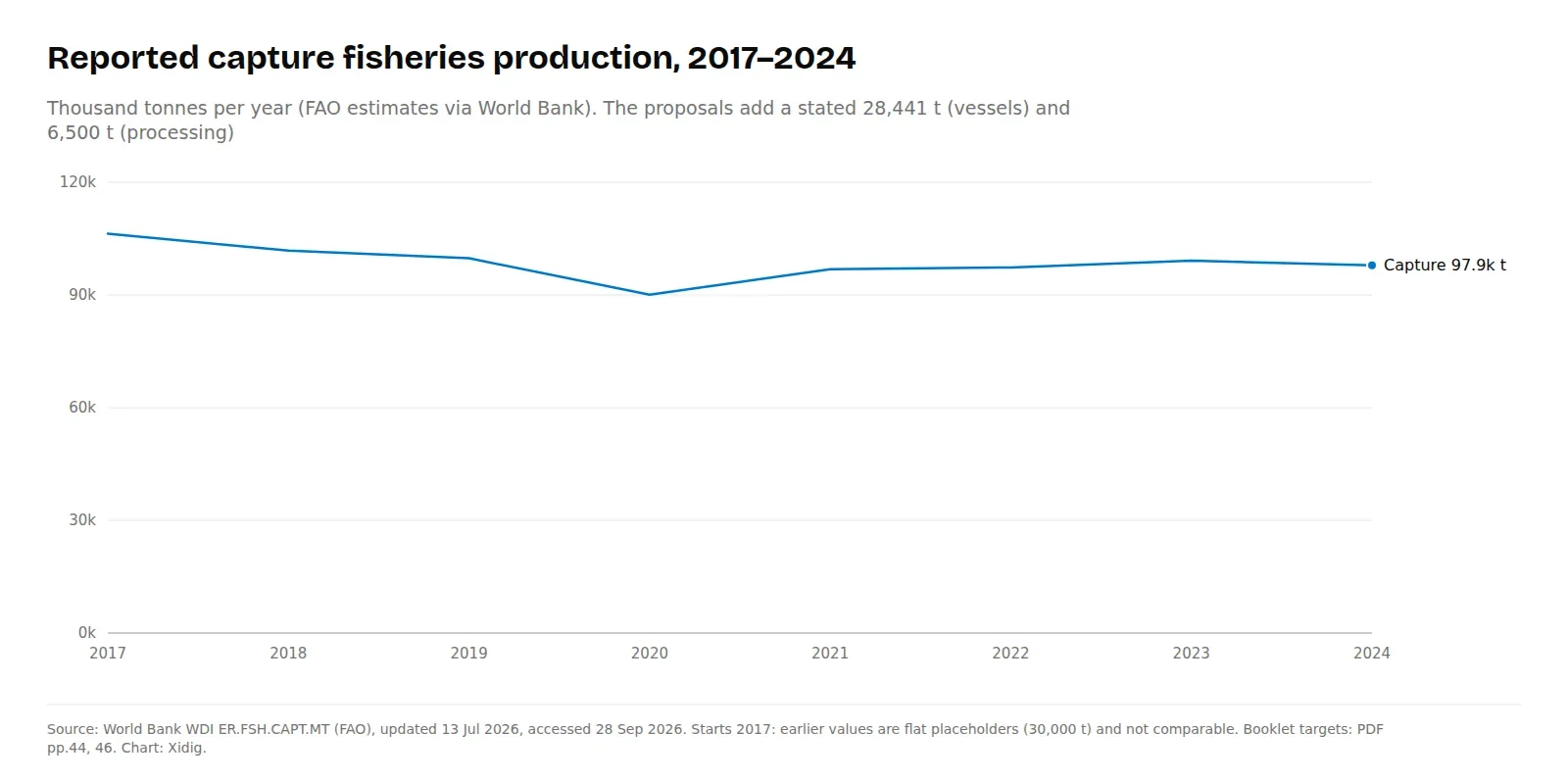
Reported capture production (FAO via World Bank) has been close to 100,000 tonnes a year since 2017. That figure appears to include more than domestic small-scale catch, so compare it with other estimates carefully.
What limits the sector. The World Bank's 2024 appraisal says the domestic sector is "largely small-scale and primarily using gillnets, handlines and traps". It adds that value chains are "limited by poor landing infrastructure, handling and processing facilities and equipment". Its project information document estimates post-harvest losses at "between 25% and 40%", and it counts "approximately 122 fish landing sites" along the coast.
Illegal fishing and licences. The same appraisal estimates the value of illegally caught fish at "between US$100 and US$450 million annually". Licences issued to about 30 Chinese longliners generate "approximately US$4 million in annual revenue".
Existing and parallel investment.
- BADMAAL (World Bank, Somali Sustainable Fisheries and Blue Economy Development Project). It has US$50M of IDA grant money plus US$5M from PROBLUE, was approved in June 2024 and closes in 2030. It is building small-scale fishing infrastructure "at a minimum of 12 sites", including "cold stores… ice-production facilities, storage facilities, as well as processing facilities". The sites include Kismayo (Calanley and Kibora), Barawe, Marka, Hobyo, Garacad and Mogadishu. By April 2025 feasibility studies were done for two sites and design was under way for six more.
- Mogadishu: FAO and Japan are renovating the Lido fish market, with better "hygiene, storage, refrigeration, and handling" (FAO, 2025).
- Kismayo: a German-funded project (GIZ, 2016–2022) planned a new fish market at Calanley (spelled Alanley in the source). The source does not confirm it was built.
- Turkey: in March 2026 SONNA reported a joint fisheries company, Somtürk, between the Somali Fisheries Company and Turkey's OYAK Group. In August 2026 the fisheries ministry discussed training support with Turkey's aid agency TIKA.
None of these sources mention the government's four proposals. Readers should not assume they are the same projects.
Geographic context
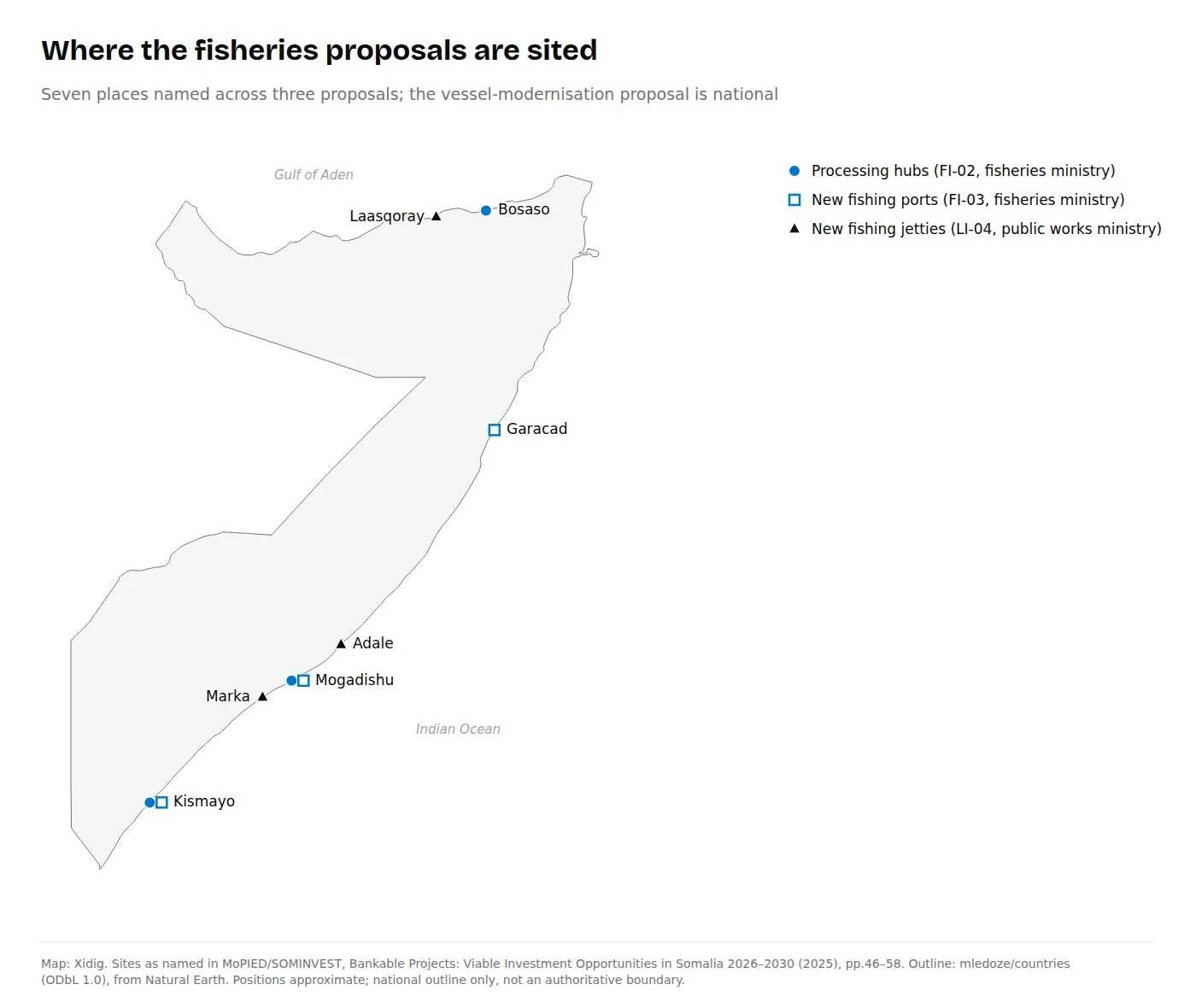
Sites named in the fisheries-related proposals. Mogadishu and Kismayo appear in two proposals each.
Seven places are named across three proposals (nine site mentions); the vessel proposal is national. Mogadishu and Kismayo each appear twice. Several overlap with BADMAAL's sites: Kismayo, Marka, Garacad and Mogadishu. Xidig found no current fisheries-infrastructure information for Adale. For Laasqoray, the only source found is a 2005 FAO profile noting a rehabilitated canning factory. Laasqoray lies in an area where administration is contested; this report takes no position on it.
Dependencies and implementation constraints
- Energy and water for cold chain. The processing-hub sheet itself lists "reliable energy" and "clean water" as services the hubs would need to provide.
- Land: BADMAAL's appraisal notes "limited land availability" at Mogadishu's two traditional landing sites, Hamarweyne and Lido.
- Coordination: two ministries propose landing infrastructure: Fisheries and Blue Economy (fishing ports, FI-03) and Public Works (fishing jetties, LI-04); see More about the source. BADMAAL and FAO also work at some of the same sites.
- Market access: export requires certification and a functioning cold chain from landing to shipping.
- Finance and partners: none named. The fishing-ports sheet's "confidential discussions" cannot be verified.
Risks and unknowns
- Possible duplication: the fishing-ports (FI-03) and fishing-jetties (LI-04) proposals are both US$20.7M, with different sites and ministries.
- Unsourced targets: 4,762 jobs, 28,441 MT of extra catch, 6,500 MT, US$31M and 40% export (see More about the source).
- Sustainability: adding catch capacity (LI-04 cites "15,000 tonnes of fishing capacity") without stock assessments could risk over-fishing. Estimates of the sustainable catch vary widely.
Questions members should verify before acting
- Are FI-03 and LI-04 separate projects, or two versions of one budget?
- How do the government's sites relate to BADMAAL's 12 sites? Is the ministry coordinating them?
- Is there a stock assessment behind the extra-catch targets?
- Who would own and operate the processing hubs, and on what terms?
- Is there any current procurement? Check the Ministry of Fisheries and Blue Economy and the World Bank project page.
What is confirmed, and what isn't
Confirmed
- The four proposals, their printed costs, sites and pre-feasibility status.
- The BADMAAL project, its funding, sites and April 2025 progress, from World Bank documents.
- FAO–Japan work at the Lido market.
- Post-harvest loss and illegal-catch estimates, as World Bank figures.
Our interpretation
- Cold chain and handling skills are the most practical member roles.
- Duplication between FI-03 and LI-04 is possible, not established.
Not yet verified
- All job and output figures on the sheets.
- The "confidential discussions".
- Sustainable yield (sources disagree).
- The coastline length (three figures in circulation).
- Current conditions at Adale and Laasqoray.
Relevant next steps
- Follow the BADMAAL project page and the Ministry of Fisheries and Blue Economy for site-level procurement.
- Coastal members: share what exists at your landing site (ice, storage, power) through Xidig, to help later reports.
- Technicians: consider cold-chain and solar refrigeration training.
More about the source
The government's investment booklet, Bankable Projects 2026–2030 (MoPIED / SOMINVEST), is one of the sources for this report. The details it gives are summarised here as printed.
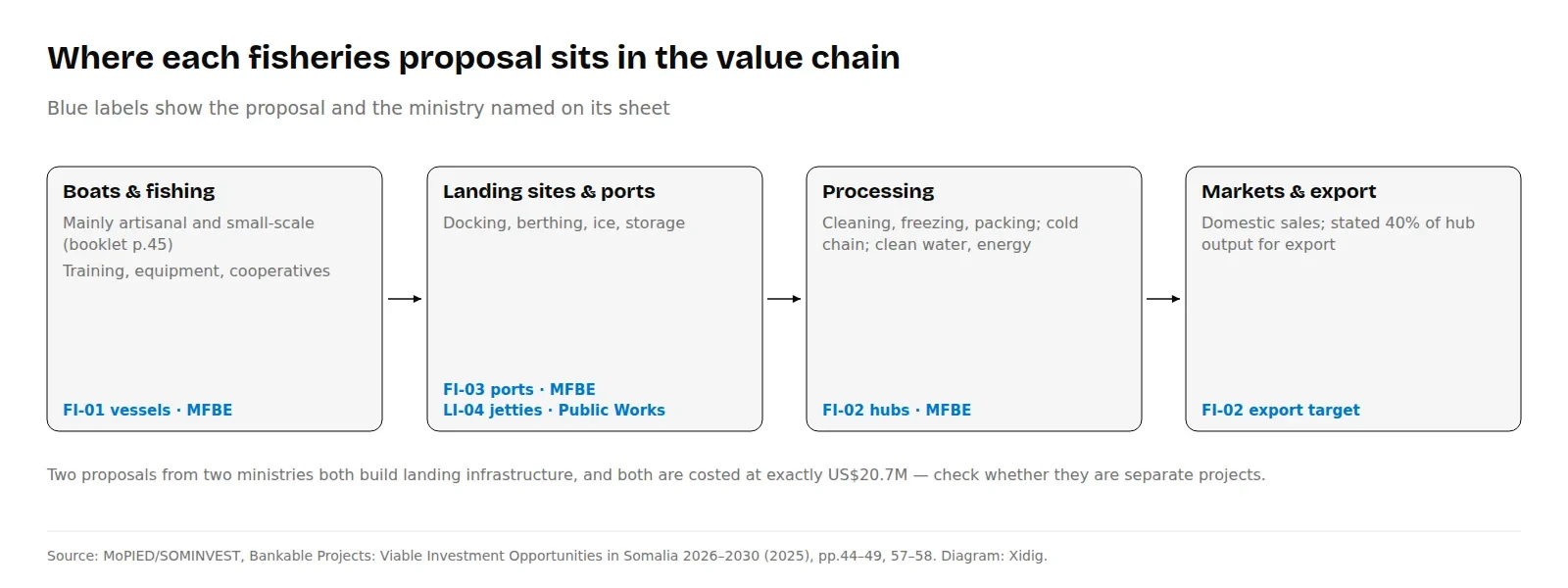
The fisheries proposals cover the whole chain, but landing infrastructure is proposed twice by two ministries at the same cost.
Modernisation of Vessels and Fishing Practices (FI-01, pp.44–45).
- What: "To modernize Somalia's fisheries by providing training on sustainable fishing, supplying modern equipment, establishing cooperatives, and attracting investment for technology adoption."
- Stated results: it "is expected to create 4,762 jobs and result in an additional annual catch of 28,441 MT".
- Estimates: US$24.75M; 5 years.
- Context given: "The fisheries sector is mainly artisanal and small-scale" (p.45).
Fisheries Processing Hubs (FI-02, pp.46–47).
- What: "3 Processing Hubs and Economic Zones in Mogadishu, Kismayo, and Bossaso". They would offer "tax incentives, clean water, equipment for rent, waste management, and reliable energy".
- Stated results: the project "is expected to increase annual production by 6,500 MT, valued at $31 million", create "over 620 jobs" and result in "40% of production being exported".
- Estimates: US$12.6M; 1 year.
Construction of New Fishing Ports (FI-03, pp.48–49).
- What: new fishing ports "in 3 sites: Mogadishu Port, Kismayo Port, and Gara'ad Port".
- Status line: "The project is currently in early-stage, highly confidential discussions with private partners."
- Estimates: US$20.7M; 1 year.
Construction of New Fishing Jetties (LI-04, pp.57–58). Ministry of Public Works, Reconstruction and Housing.
- What: "new fishing ports in Marka, Adale, and Laasqoray".
- Stated results: infrastructure for "3,100 boats and 15,000 tonnes of fishing capacity", "over 300 jobs" and support for "420+ fishing families".
- Estimates: US$20.7M; 5 years.
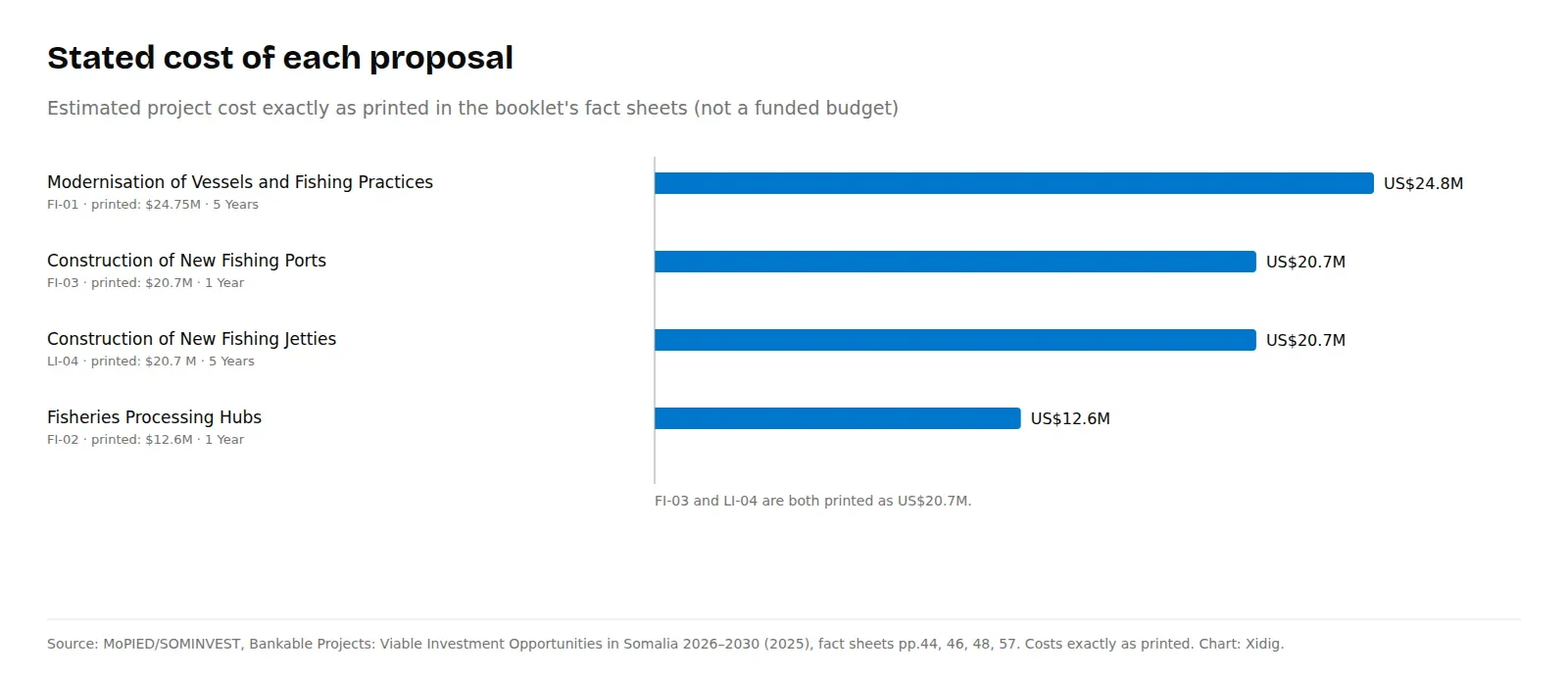
Estimated costs as printed. FI-03 and LI-04 are both printed as US$20.7M.
- Primary source: MoPIED / SOMINVEST, Bankable Projects 2026–2030, posted 19 Nov 2025. Fisheries section at PDF pp.44–49; the fishing-jetties proposal sits in the logistics section at pp.57–58.
- Type: investment-promotion list.
- Status: pre-feasibility on all four sheets.
Related reports
- Somalia's Bankable Projects 2026–2030, explained
- Somalia's seaports and a proposed Mogadishu dry dock
- How fishing cooperatives work in Somalia
- Cold chain for fish, milk and meat in Somalia
- Somalia's fish-catch figures: why they differ and how to read them
About this report
By Xidig members and collaborators.
Project codes. Codes such as EN-04 or AG-05 are Xidig's own shorthand for the booklet's fact sheets, by sector; the booklet itself does not number its projects.
How we researched it. We read the full 97-page booklet and checked every figure, page reference and quotation used here against it. We then compared the booklet's claims with the official, international and news sources listed below, and we say where they differ. We did not interview anyone for this report. Where the booklet's figures are unclear, we reproduce them as printed and explain the issue in the notes.
Corrections. If you spot an error, please tell us using the correction link on this page.
Sources
Primary
- MoPIED / SOMINVEST, Bankable Projects 2026–2030, PDF pp.44–49, 57–58: https://sominvest.gov.so/bankable-projects-in-somalia-2026-2030/
Supporting
- World Bank, BADMAAL Project Appraisal Document PAD00140 (20 May 2024): https://documents1.worldbank.org/curated/en/099052324161040631/pdf/BOSIB108b9787807018d6d1e665f996841d.pdf
- World Bank, BADMAAL Implementation Status & Results Report (15 Apr 2025): https://documents1.worldbank.org/curated/en/099041525113034681/pdf/P178032-1b6ba979-3fa4-456a-8f0a-e5136d58776f.pdf
- World Bank, BADMAAL Project Information Document (10 Mar 2024): https://documents1.worldbank.org/curated/en/099040924023540214/pdf/P178032167c6fa091b37114b892af7017d.pdf
- Ministry of Fisheries and Blue Economy / World Bank, BADMAAL ESMF (Aug 2024): https://documents1.worldbank.org/curated/en/099091824151533029/pdf/P178032-ac1e5207-4acd-4127-85a1-784d181ab0ed.pdf
- FAO Somalia, "FAO joins forces with Japan and the government of Somalia…" (2025): https://www.fao.org/somalia/news/details/fao-joins-forces-with-japan-and-the-government-of-somalia-in-latest-step-to-boost-under-performing-fishing-industry/en
- GIZ, "Improved food security through access to fish products in Kismayo": https://www.giz.de/en/worldwide/52929.html
- World Bank, "Somalia issues fishing licenses…" (7 Mar 2019): https://www.worldbank.org/en/news/factsheet/2019/03/07/somalia-issues-fishing-licenses-fees-will-help-develop-fisheries-sector
- Dawan Africa, "Somalia, Turkey's TIKA discuss support for fisheries and blue economy" (27 Aug 2026): https://www.dawan.africa/news/somalia-turkeys-tika-discuss-support-for-fisheries-and-blue-economy
- SONNA, Somtürk joint fisheries company (29 Mar 2026): https://sonna.so/en/article/somalia-launches-somturk-joint-fisheries-company-to-boost-blue-economy
- Dawan Africa, "President Hassan Sheikh: Somalia's coastline extends beyond 3,800 kilometres" (4 Aug 2026): https://www.dawan.africa/news/president-hassan-sheikh-somalias-coastline-extends-beyond-3800-kilometres
- FAO, Fishery Country Profile: Somalia (Jan 2005): https://www.fao.org/fishery/docs/DOCUMENT/fcp/en/FI_CP_SO.pdf
- World Bank WDI ER.FSH.CAPT.MT (updated 13 Jul 2026)