Mogadishu's waste: collection, recycling and waste-to-energy
Tusmada
- Summary
- Where Xidig members may contribute
- Possible services, research, supplier or collaboration roles
- Who may find this useful
- Mogadishu's waste today
- Geographic context
- Dependencies and implementation constraints
- Risks and unknowns
- Questions members should verify before acting
- What is confirmed, and what isn't
- Relevant next steps
- More about the source
- Related reports
- About this report
- Sources
Who collects Mogadishu's waste, where it goes, the new city law, where members fit, and a US$133M waste-to-energy proposal on the government's list.
Not investment advice. Independent analysis of a government publication. It is not an offer or a tender notice, and the Government of Somalia has not endorsed it.
Summary
Mogadishu's waste is handled by a mix of the Banadir Regional Administration, private operators and informal workers, and the city's known disposal site is an open dumpsite. That leaves real openings for members in collection, sorting and recycling, composting, and the waste data any bigger facility would need first.
What Xidig found:
- The system is patchy. In a 2026 survey of 273 residents, 95.2% said they were charged for collection, about 47% had weekly collection and 26% buried or burned their waste. There is no recent official figure for how much waste the city produces.
- New rules, slow enforcement. The city administration adopted its first law on the capital's cleanliness in June 2026, according to local reporting, and a national plastic-bag ban announced in 2024 has been slow to enforce.
- Existing work is small. The World Bank supports technical work on waste in Mogadishu, and small plastic recyclers operate there. Xidig found no waste-to-energy plant, feasibility study or agreement anywhere in Somalia; the national climate plan mentions waste-to-energy only as a programme line.
The government has also proposed US$133M for waste facilities in Mogadishu that would sort, recycle and turn waste into energy, at pre-feasibility stage and without covering collection or landfill; details are under More about the source.
Where Xidig members may contribute
Service, collaboration and research openings, not confirmed contracts or tenders:
- Collection and transport: private operators already collect for a fee, and the new city law sets rules they will need to meet.
- Sorting, recycling and composting: plastics, metals and organics, at small scale and linked to existing recyclers.
- Waste data: quantity and composition studies, and dumpsite and hotspot mapping. Any plant, public or private, would need these first.
- Public awareness: the sheet itself names this as a component.
- Know-how from abroad: members who have worked on landfills, waste-to-energy or municipal waste contracts elsewhere.
Possible services, research, supplier or collaboration roles
- A waste characterisation study for one or more districts: what is thrown away, how much, and how wet.
- Composting pilots for market and food waste. Wet organic waste is hard to burn but can be composted.
- Collection-route and fee research with private operators and the BRA.
- Recycled-plastic products through existing recyclers. The PET proposal in Edible oil refining and PET preforms in Somalia also counts on recycling.
Who may find this useful
- Environmental and civil engineers.
- Urban planners and GIS specialists.
- Owners of small collection or recycling businesses.
- Public-health and sanitation professionals.
- Community organisers and district-level volunteers.
- Students in environmental science.
Mogadishu's waste today
Who handles Mogadishu's waste. A 2022 World Bank safeguards document for Mogadishu describes a mixed system: "The local government collects, transports, and disposes waste materials from the city", while private operators collect from "households, businesses, and some industries", and "Informal sector workers are engaged in both collection service and waste separation". It says the Banadir Regional Administration (BRA) operates the Qashinweyne dumpsite in Gubadley district.
How much waste. There is no recent official figure. A 2019 VOA report put Mogadishu's waste at "an estimated 2,500 metric tons of garbage per day" for "a city of some 2 million people"; the city has grown since. A World Bank estimate quoted in the government's environment policy gives "over 1,500 tons" a day for all of Somalia's urban areas. The two figures don't fit together, which shows how thin the data is.
How residents experience it. In a 2026 survey of 273 residents across Mogadishu's 17 districts, 95.2% said they were charged for collection, about 47% had weekly collection, 26% buried or burned their waste and about 5% recycled (Frontiers in Sustainability, June 2026). These are survey results, not official statistics. In August 2026 Kaab TV reported that in several districts "piles of garbage remain uncollected for extended periods".
Law and policy.
- City: the BRA adopted its first law on the capital's cleanliness in June 2026, with penalties ranging from warnings and fines to licence suspension (Hiiraan Online, 17 Jun 2026).
- National: the Environmental Protection and Management Act 2024 covers waste management; one stated aim is "the environmentally sound management and disposal of all wastes".
- Environment policy: the government's National Environmental Policy commits to "Establish landfill disposal sites" and to "Ban the use of light-weight single use plastic products". It does not mention waste-to-energy.
- Climate plan: Somalia's 2025 climate commitment (NDC 3.0) lists "construction of controlled landfills in urban areas; waste-to-energy programs; and recycling, especially of plastics". It budgets USD 4.62 million for the whole waste sector, "the smallest share" of the plan. The government's US$133M proposal for one city is nearly 30 times that.
- Plastic bags: the Ministry of Environment and Climate Change (MoECC) announced a nationwide ban on plastic bags on 1 February 2024, effective 30 June 2024. Police announced enforcement in October 2024, and in December 2024 a ministry official told AFP that existing stock could still be sold.
Projects already under way. Beyond the climate plan's programme line, Xidig found no waste-to-energy plant, feasibility study or agreement anywhere in Somalia. What exists is smaller:
- World Bank technical assistance. Additional financing for the Somalia Urban Resilience Project includes technical assistance "to enhance Mogadishu's capacity in the collection and disposal of solid waste" (2022). A solid-waste mapping exercise with the federal government, to "locate illegal dumping hotspots", has run since 2022.
- A landfill that wasn't built. A sanitary landfill and liquid-waste system for Hargeisa was designed in 2017 at about US$14M, but was dropped for lack of donor interest and financing (World Bank completion report, December 2021).
- Recycling. Small plastic recyclers operate in Mogadishu. One, working with a Save the Children project, reported in June 2025 that it had brought 500 women waste collectors into its work.
The 35% claim. Xidig found no source, baseline or method for the sheet's "35% reduction in urban pollutants".
What this means. The proposal starts at the end of the waste chain. A waste-to-energy plant needs a steady supply of collected, sorted waste of known composition, a buyer for its power, and a controlled place for what's left over. The sheet addresses none of these, and they are the gaps that recent studies of Mogadishu describe. A 2026 academic review of Somalia's waste sector concludes that change "depends more on effective governance… than on advanced technologies alone".
Geographic context
The proposal covers Mogadishu only and names no sites. The known dumpsite is at Qashinweyne in Gubadley district. In 2018 the government said it would allocate two landfill sites, one in the north and one in the south of the city (VOA, 2019). Xidig found no evidence that either became an engineered landfill.
Dependencies and implementation constraints
- Who is in charge: the BRA runs the dumpsite and city services, but the proposal names MoECC as promoter. How the two would share the project is not explained.
- Collection: a plant can only process waste that is collected, and collection today is patchy.
- Waste data: Xidig found no published composition or quantity study for Mogadishu.
- Power buyer: "revenue from energy sales" needs a buyer and a tariff. Most electricity is sold by private providers (see Why electricity costs so much in Somalia).
- Land for facilities and a controlled landfill.
- Fees and enforcement: residents already pay for collection, and the new city law gives the BRA enforcement powers.
Risks and unknowns
- Technology risk: waste-to-energy without composition data or a landfill fallback.
- Mandate overlap between MoECC, the BRA and private operators.
- Unsourced figures: the 35% pollution reduction, and no cost breakdown for US$133M.
- Overlap with World Bank-supported waste work in Mogadishu.
Questions members should verify before acting
- Which body would own and run the facilities: MoECC, the BRA or a private partner?
- What waste data lies behind the proposal: tonnes per day and composition?
- Does the US$133M include collection vehicles and a controlled landfill?
- Who would buy the electricity, and at what price?
- What does "35% reduction in urban pollutants" measure, and against what baseline?
- How does the proposal relate to the World Bank-supported waste work and the BRA's June 2026 cleanliness law?
What is confirmed, and what isn't
Confirmed
- The proposal, its US$133M printed cost, its promoter and its pre-feasibility stage.
- The mixed public, private and informal collection system and the Qashinweyne dumpsite (World Bank, 2022).
- The Environmental Protection and Management Act 2024; the NDC 3.0 waste measures and budget; the February 2024 plastic-bag ban.
- The BRA cleanliness law (June 2026), as reported.
Our interpretation
- The proposal skips the collection and disposal stages that a waste-to-energy plant depends on.
- Small-scale collection, recycling, composting and data work are the most realistic member roles.
Not yet verified
- Current waste quantities and composition in Mogadishu.
- The basis of the 35% figure.
- What became of the 2018 landfill-site allocations.
- Enforcement of the plastic-bag ban since 2025.
Relevant next steps
- Follow MoECC and BRA announcements, and the World Bank's Somalia urban projects, for official notices.
- If you run or plan a collection or recycling business, check the BRA's licensing rules under the new law.
- Share local knowledge about collection and dumpsites through Xidig, with care: don't share personal details of waste workers or residents.
More about the source
The government's investment booklet, Bankable Projects 2026–2030 (MoPIED / SOMINVEST), is one of the sources for this report. The details it gives are summarised here as printed.
Integrated Waste Management for Mogadishu (EV-01, pp.90–91).
- What: "Development of multiple waste management facilities in Mogadishu to transform waste into sustainable energy. The project includes segregation, recycling, pollution control, and waste-to-energy systems, with major public awareness and job creation components."
- Key drivers (p.91): "35% reduction in urban pollutants", "Energy generation from waste and revenue from energy sales" and "Employment generation in recycling and plant operations".
- Estimates: US$133M; 5 years.
- Ticks: Greenfield and Expansion; PPP and Joint Venture.
- Not stated: sites, capacity in tonnes per day, the waste-to-energy technology, who would buy the electricity, or how the cost breaks down.
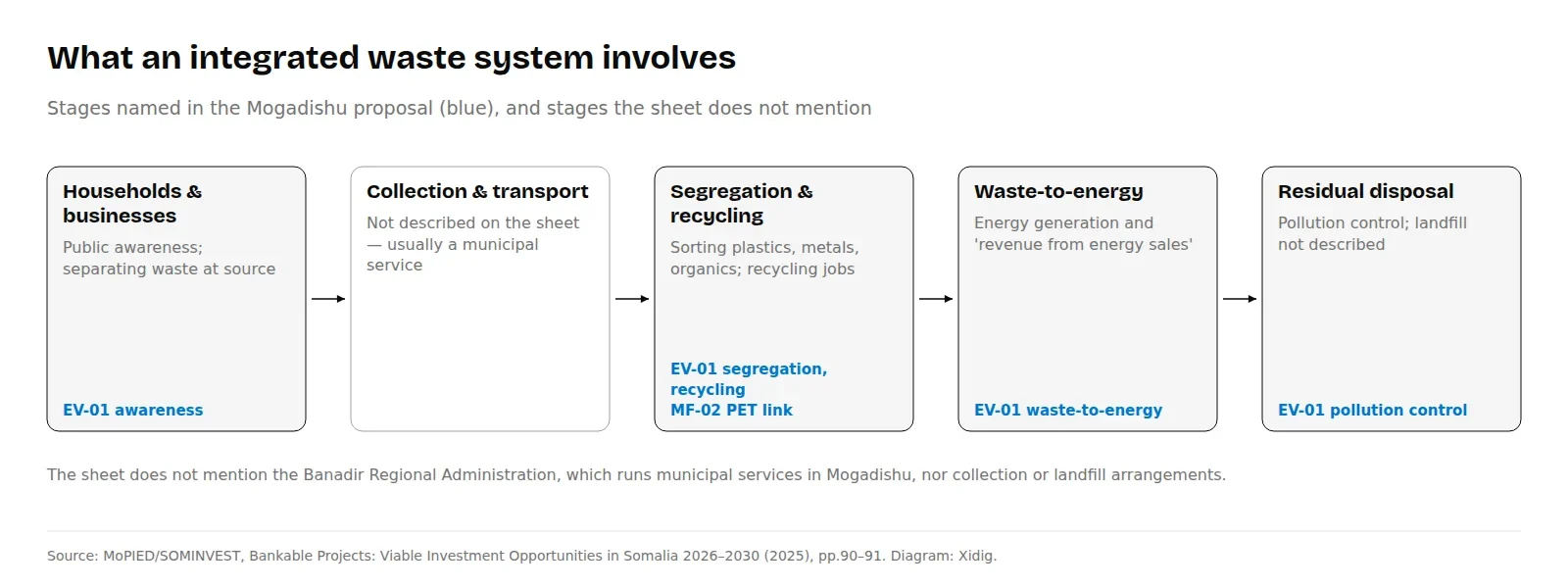
The proposal covers sorting, recycling and energy, but not collection, landfill or the city administration's role.
- Primary source: MoPIED / SOMINVEST, Bankable Projects 2026–2030, posted 19 Nov 2025. Environment & Climate Resilience section, PDF pp.90–91.
- Promoters: SOMINVEST and the Ministry of Environment and Climate Change. The project contact is the ministry's office in Wadajir District.
- Sector as printed: "Environment & Climate Resilience"; subsector "Waste Management & Renewable Energy".
- Stage: pre-feasibility. The implementation period is 5 years, and the project lifetime is printed as 2025–2029. The sheet has no existing-infrastructure section.
Related reports
- Somalia's Bankable Projects 2026–2030, explained
- Edible oil refining and PET preforms in Somalia
- Why electricity costs so much in Somalia
- Waste-to-energy, explained: what would work for Mogadishu
- Plastic recycling and PET in Mogadishu
About this report
By Xidig members and collaborators.
Project codes. Codes such as EN-04 or AG-05 are Xidig's own shorthand for the booklet's fact sheets, by sector; the booklet itself does not number its projects.
How we researched it. We read the full 97-page booklet and checked every figure, page reference and quotation used here against it. We then compared the booklet's claims with the official, international, academic and news sources listed below, and we say where they differ. We did not interview anyone for this report.
Corrections. If you spot an error, please tell us using the correction link on this page.
Sources
Primary
- MoPIED / SOMINVEST, Bankable Projects 2026–2030, PDF pp.90–91: https://sominvest.gov.so/bankable-projects-in-somalia-2026-2030/
Supporting
- World Bank, Somalia Urban Resilience Project II, ESMP and Stakeholder Engagement Plan for Mogadishu Quick-Win Investments (Sep 2022): https://documents1.worldbank.org/curated/en/099335109192251890/pdf/P1709220dab9be0b0aeb4080c9f7f42a68.pdf
- World Bank, SURP-II Additional Financing (P178887), Environmental and Social Review Summary (4 Apr 2022): https://documents1.worldbank.org/curated/en/099755004042234857/txt/P1788870c4bfca0f709e7004e4834f8db82.txt
- World Bank, Somalia Urban Investment Planning Project, Implementation Completion and Results Report (31 Dec 2021): https://documents1.worldbank.org/curated/en/274991656646956785/pdf/Somalia-Urban-Investment-Planning-Project.pdf
- Arab Urban InfoHub, "Solid Waste Mapping, Mogadishu" (2022–ongoing): https://araburban.org/en/infohub/projects/?id=10611
- Federal Government of Somalia, NDC 3.0, submitted to the UNFCCC (Jun 2025): https://unfccc.int/sites/default/files/2025-06/Somalia%20NDC%203.0_Submitted_to_UNFCCC_Final.pdf
- Ministry of Environment and Climate Change, National Environmental Policy: https://ice.simad.edu.so/wp-content/uploads/2023/11/National-Environmental-Policy-EN.pdf
- UNEP LEAP, Environmental Protection and Management Act 2024: https://leap.unep.org/en/countries/so/national-legislation/environmental-protection-and-management-act-2024
- Ministry of Environment and Climate Change, "Somalia announces ban on plastic bags to combat pollution" (Feb 2024): https://moecc.gov.so/somalia-announces-ban-on-plastic-bags-to-combat-pollution/
- AFP via Modern Ghana, "Somalia struggles to rid itself of plastic despite ban" (18 Dec 2024): https://www.modernghana.com/news/1366424/somalia-struggles-to-rid-itself-of-plastic-despite.html
- Hiiraan Online, "Banadir administration adopts first law targeting capital's cleanliness" (17 Jun 2026): https://www.hiiraan.com/news4/2026/Jun/205439/banadir_administration_adopts_first_law_targeting_capitals_cleanliness.aspx
- Frontiers in Sustainability, "An assessment of municipal solid waste management practices and challenges in Mogadishu, Somalia" (22 Jun 2026): https://www.frontiersin.org/journals/sustainability/articles/10.3389/frsus.2026.1812205/full
- VOA via Garowe Online, "In Mogadishu, White Sand, Blue Waters, Heaping Piles of Trash" (11 Jan 2019): https://www.garoweonline.com/en/news/somalia/somalia-in-mogadishu-white-sand-blue-waters-heaping-piles-of-trash
- Kaab TV, "Mogadishu Residents Urge Banadir to Fix Roads and Waste Woes" (26 Aug 2026): https://en.kaabtv.com/mogadishu-residents-urge-banadir-to-fix-roads-and-waste-woes/
- Save the Children, "Reviving Mogadishu: a renaissance in plastic recycling" (5 Jun 2025): https://www.savethechildren.net/somalia/news/reviving-mogadishu-renaissance-plastic-recycling
- African Journal of Environmental Science and Technology, Ahmed (2026), vol. 20(9): https://academicjournals.org/journal/AJEST/article-abstract/A9AF3FA75000