Edible oil refining and PET preforms in Somalia
Tusmada
- Summary
- Where Xidig members may contribute
- Possible services, research, supplier or collaboration roles
- Who may find this useful
- What the trade data and market evidence show
- Geographic context
- Dependencies and implementation constraints
- Risks and unknowns
- Questions members should verify before acting
- What is confirmed, and what isn't
- Relevant next steps
- More about the source
- Related reports
- About this report
- Sources
Somalia relies on imported cooking oil and bottle preforms. What trade data says about demand, what already exists, and the government's proposed refinery and preform plant.
Not investment advice. Independent analysis of a government publication. It is not an offer or a tender notice, and the Government of Somalia has not endorsed it. Return figures stated in the booklet are not repeated here.
Summary
Somalia relies on imported cooking oil and imported plastic packaging, which leaves room for local processing, supply and distribution work. Trade partners recorded about US$271M of refined palm oil shipped to Somalia in 2022 and no crude palm oil, and Xidig found no palm-oil refinery in Mogadishu. At least one Mogadishu water company financed its own bottle-blowing machine in 2025, but Xidig found no preform or bottle plant in Somalia.
What Xidig found:
- Oil demand is real. Trade partners reported refined palm oil shipments of about US$182M–271M a year in 2021–2023, with the UAE, Malaysia and Indonesia the main suppliers.
- Some demand claims don't check out. A consumption figure of 20–75 litres per person a year is well above what trade and FAO-based data suggest, and a figure of 800,000 preforms a day could not be verified.
- Raw materials are the main question. A refinery would need imported crude oil or local oilseeds, and Somalia's sesame harvest swings widely. A preform plant would need imported PET resin, of which almost none is recorded today.
The government has proposed a cooking oil extraction and refining plant (US$10M) and a PET preform factory (US$4.5M), both in or near Mogadishu with private investors; details are under More about the source.
Where Xidig members may contribute
Service, supplier and research openings, not confirmed contracts or tenders:
- Supply chains: sourcing crude oil or PET resin, and the port, storage and customs work either plant would need.
- Distribution: local cooking-oil packing and distribution to retailers.
- Local oilseeds: sesame and groundnut sourcing, and support for farmers, if a plant would crush local seed.
- Recycling: collecting used PET bottles for recyclers.
- Research: market studies for cooking oil and bottled water, which the sheets don't cite.
Possible services, research, supplier or collaboration roles
- Market study: cooking-oil use by household type, and bottled-water volumes in Mogadishu.
- Food-safety and labelling capacity for locally refined or packed oil.
- Preform supply agreements with existing bottlers, if a plant goes ahead.
- PET collection linked to existing recyclers.
Who may find this useful
- Food technologists and quality-control specialists.
- Chemical and process engineers.
- Importers, traders and logistics firms.
- Water-bottling businesses.
- Plastics and recycling entrepreneurs.
- Agronomists working on oilseeds.
What the trade data and market evidence show
Cooking oil imports. Somalia doesn't publish its own trade figures, so the best check is what other countries report sending there. For refined palm oil (HS 151190), partners reported:
| Year | Value | Volume | Main suppliers |
|---|---|---|---|
| 2021 | about US$182M | about 151,000 t | UAE, Malaysia, Indonesia, Oman |
| 2022 | about US$271M | about 177,000 t | UAE (US$102M), Malaysia (US$96M), Indonesia (US$41M) |
| 2023 | about US$202M | about 183,000 t | Malaysia (US$91M), UAE (US$55M), Indonesia (US$33M) |
Xidig's sums of World Bank WITS partner-reported exports to Somalia. They include re-exports through the UAE, Oman and Djibouti, and miss informal trade.
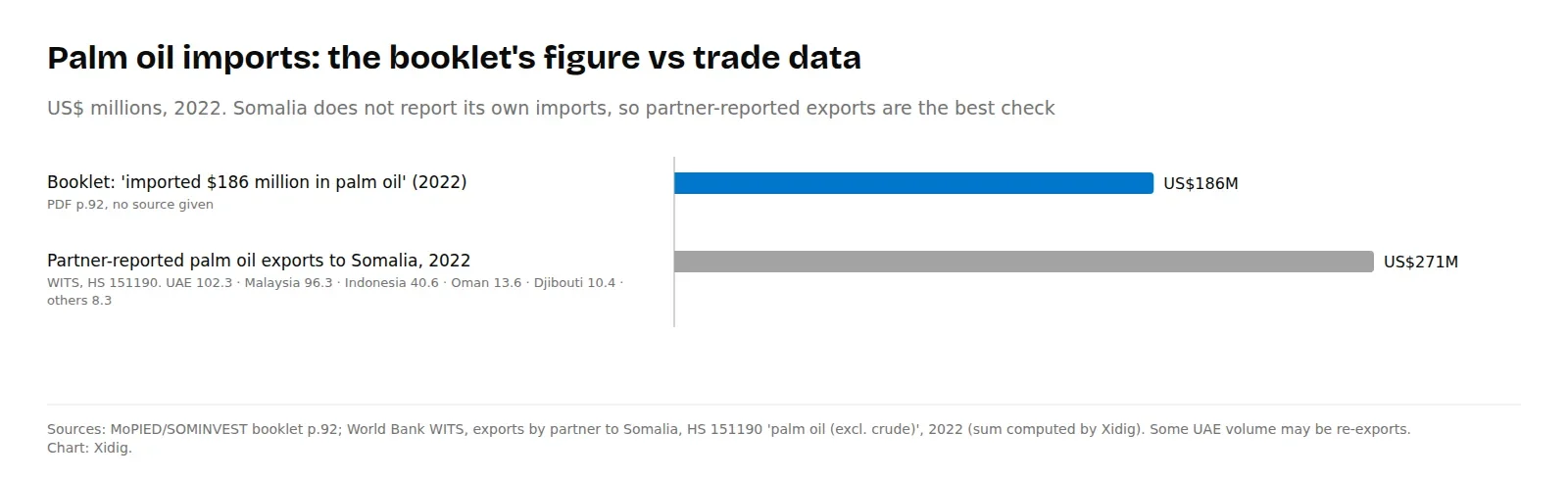
Trade partners reported about US$271M of refined palm oil shipped to Somalia in 2022. The government's US$186M is closer to the 2021 total.
Partners reported no crude palm oil (HS 151110) shipped to Somalia in 2022, which fits the government's point that nothing is refined locally. Sunflower oil added about US$16.6M in 2022, mostly from Turkey.
How much oil people use. FAO-based data put Somalia's vegetable oil supply at about 5.8 kg per person in 2021 and 4.7 kg in 2022. Xidig's own estimate from import records is higher: palm and sunflower oil imports in 2022 came to about 186,000 tonnes, or roughly 10 kg per person, about 11 litres. For comparison, the same FAO-based data give about 8 kg in Kenya and about 12 kg as the world average (2023). Either way, the government's figure of 20–75 litres a year is well above what the evidence suggests.
Is there really no refinery? Xidig found no palm-oil refinery in Mogadishu. Elsewhere:
- Berbera: an edible-oil company sells refined palm olein and sunflower oil from its plant in Berbera, without saying whether it refines them itself. A UAE-based food company announced a "300,000-square-foot packing facility" in Berbera's economic zone in 2022. That is packing, not refining.
- Sesame oil: small traditional mills press sesame in Mogadishu. Somalia's proposal to FAO's Hand-in-Hand investment forum in 2025 includes a sesame oil processing factory, which suggests none exists at scale.
Local oilseeds. The "extraction" half of the proposal would need local crops. FAO data show Somalia's sesame harvest swinging from about 36,000 tonnes a year (2017–2019) to under 5,000 tonnes in 2021, then about 28,000 tonnes in 2023 and 17,000 tonnes in 2024. A plant relying on local seed would face that volatility.
Bottled water and preforms. Xidig could not verify "over twenty large water filling companies" or "800,000 preforms daily", and found no water companies' union. The claim that bottlers already have blowing machines is supported: in 2025 one Mogadishu water company financed "an automatic blow molding machine with a preform auto feeder" and "5.65 million preforms and caps" (Shuraako, April 2025). Xidig found no preform or bottle plant in Somalia.
Plastic imports. Recorded imports of plastic bottles, preforms and similar containers (HS 392330, a wider category) were about US$5.9M and about 3,100 tonnes in 2023, mostly from the UAE. At 12–20 g each, 800,000 preforms a day would weigh about 3,500–5,800 tonnes a year. That is more than all recorded imports in the category, so either the demand figure is high or much of the trade isn't recorded (Xidig's rough calculation). Recorded PET resin imports were only about US$49,000 in 2022, so a preform plant would need a new resin supply.
Industrial zones and incentives. The sheets cite "existing industrial zones". The US government's 2025 investment climate statement says "Somalia does not currently operate any officially designated free trade zones or special economic zones under national law". It also says a national investment incentives framework "remains in draft form and has not yet been adopted". The legal basis for the sheets' five-year tax exemption is not stated.
Plastic ban. The February 2024 ban covers plastic bags, not PET bottles. PET recycling links this proposal to Mogadishu's waste: collection, recycling and waste-to-energy.
Geographic context
Both plants would be in or near Mogadishu, close to the port. The refinery sheet cites "Proximity to potential port site", and neither sheet names a site. Other edible-oil activity found by Xidig is in Berbera.
Dependencies and implementation constraints
- Raw materials: imported crude palm oil or local oilseeds for the refinery; imported PET resin for the preforms.
- Power: both plants need reliable, affordable electricity (see Why electricity costs so much in Somalia).
- Food-safety standards for refined oil.
- Competition with established importers of refined oil.
- Legal basis for the stated tax exemption, and the absence of designated economic zones.
Risks and unknowns
- Demand figures: the consumption range and the preform figure are unsourced and look high against trade data.
- Return claims on both sheets have no stated basis.
- Status: the PET sheet ticks "Feasibility Completed", but the study is not cited.
- Copy error: the refinery sheet's contact email belongs to the Ministry of Education.
Questions members should verify before acting
- Who is the private investor behind each proposal, and what has SOMINVEST agreed with them?
- Where is the PET feasibility study, and can it be shared?
- Would the refinery process imported crude palm oil, local oilseeds or both?
- What is the source for "800,000 preforms daily" and "over twenty large water filling companies"?
- Under which law would the five-year tax exemption apply?
- Where is the "existing industrial zone" the sheets refer to?
What is confirmed, and what isn't
Confirmed
- The two proposals, their printed costs, promoters and stages.
- Partner-reported refined palm oil exports to Somalia: about US$182M (2021), US$271M (2022) and US$202M (2023). No crude palm oil was recorded in 2022.
- Existing blow-moulding machines at a Mogadishu water company (2025).
- The announced edible-oil packing plant in Berbera (2022).
- No officially designated economic zones under national law (US government, 2025).
Our interpretation
- Cooking-oil demand is large, but the government's own consumption figure is unreliable.
- Raw-material supply is the main risk for both plants.
Not yet verified
- Any source for the 20–75 litre consumption range.
- The number of large water companies and daily preform demand.
- Whether any plant in Somalia refines oil rather than packing it.
- The PET feasibility study.
Relevant next steps
- Follow SOMINVEST and the Ministry of Commerce and Industry for news of these projects and of the investment incentives framework.
- If you import cooking oil or run a bottling business, compare the booklet's demand figures with your own.
- Share market knowledge through Xidig, without sharing commercially sensitive data.
More about the source
The government's investment booklet, Bankable Projects 2026–2030 (MoPIED / SOMINVEST), is one of the sources for this report. The details it gives are summarised here as printed.
Cooking Oil Extraction and Refining Plant (MF-01, pp.92–93).
- What: "a local edible oils refinery and extraction plant due to rising domestic demand and heavy reliance on imports". The sheet says: "In 2022, the country imported $186 million in palm oil, with household consumption averaging 20–75 liters per person annually, while no local refinery currently exists."
- Why there: "Supported by existing industrial zones, port access, and commercial networks". Existing infrastructure listed: "Land availability", "Proximity to the Capital City, Mogadishu", "Proximity to potential port site" and "Existing repairable road network" (p.93).
- Estimates: US$10M; 24 months to build; 10-year lifetime.
- Ticks: Joint Venture and Private; no investment type ticked.
- Incentive: "5 Years tax exemption for secondary investors for this project", on top of the standard incentives.
PET Manufacturing (PET preforms) (MF-02, pp.94–95).
- What: "a PET Preform manufacturing facility". The sheet says: "With over twenty large water filling companies requiring more than 800,000 preforms daily, the market demand is immediate and substantial." It adds that "Existing bottle-blowing machinery and the city's port ensure smooth integration of locally produced preforms and access to raw PET resin".
- Key drivers: "High preform demand" and "A union of over twenty large water filling companies in Mogadishu" (p.95).
- Estimates: US$4.5M; 24 months to build; 15-year lifetime.
- Ticks: Brownfield and Private; "Feasibility Completed".
- Incentive: the same five-year tax exemption for secondary investors.
Both sheets also state a return on investment. They give no calculation, and Xidig does not repeat return claims.
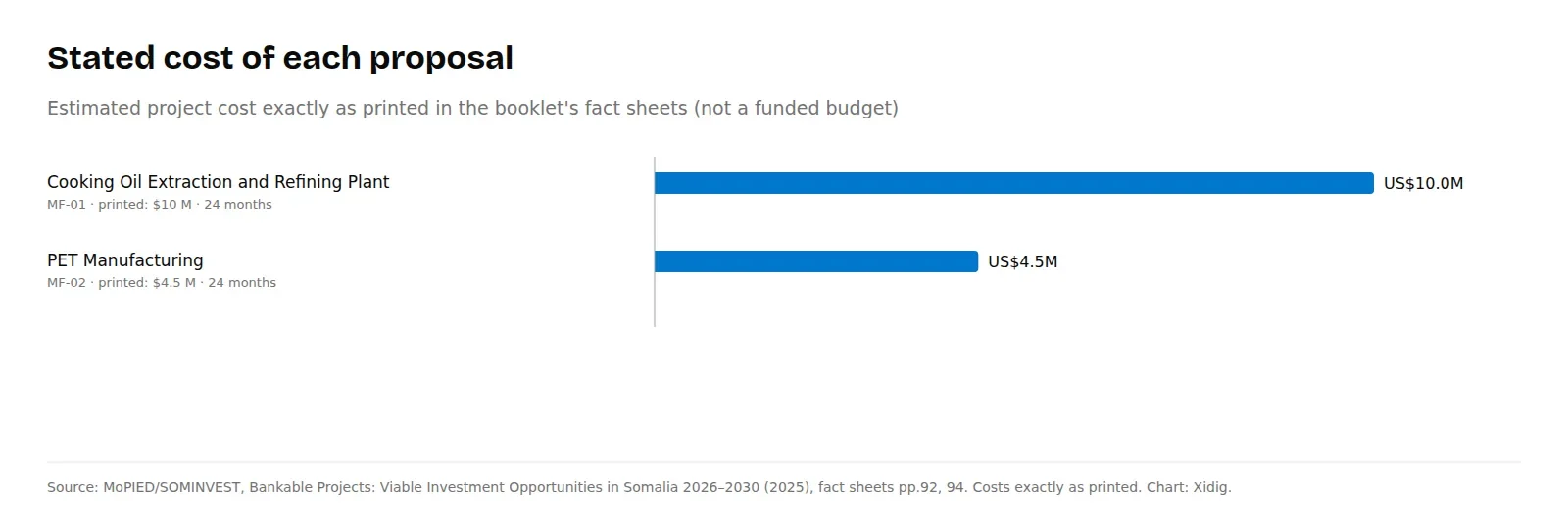
Estimated costs as printed. They are not approved or funded budgets.
- Primary source: MoPIED / SOMINVEST, Bankable Projects 2026–2030, posted 19 Nov 2025. Manufacturing section, PDF pp.92–95.
- Promoters: SOMINVEST with "a Private Investor" (MF-01) and "Private Investor" (MF-02). The refinery sheet's second contact is an address on Afgoye Road KM5 with the Ministry of Education's email (info@moe.gov.so), which looks like a copy error.
- Subsectors as printed: "Oil" and "PLASTIC PET".
- Stage: pre-feasibility on both sheets. The PET sheet's tick box says "Feasibility Completed".
Related reports
- Somalia's Bankable Projects 2026–2030, explained
- Mogadishu's waste: collection, recycling and waste-to-energy
- Seed, fodder, meat, dairy and poultry in Somalia
- Plastic recycling and PET in Mogadishu
About this report
By Xidig members and collaborators.
Project codes. Codes such as EN-04 or AG-05 are Xidig's own shorthand for the booklet's fact sheets, by sector; the booklet itself does not number its projects.
How we researched it. We read the full 97-page booklet and checked every figure, page reference and quotation used here against it. We then compared the booklet's claims with trade data and the official, international and news sources listed below, and we say where they differ. Trade totals are Xidig's sums of partner-reported figures. We did not interview anyone for this report.
Corrections. If you spot an error, please tell us using the correction link on this page.
Sources
Primary
- MoPIED / SOMINVEST, Bankable Projects 2026–2030, PDF pp.92–95: https://sominvest.gov.so/bankable-projects-in-somalia-2026-2030/
Supporting
- World Bank WITS, palm oil (excl. crude) exports to Somalia (HS 151190), 2021, 2022 and 2023: https://wits.worldbank.org/trade/comtrade/en/country/All/year/2022/tradeflow/Exports/partner/SOM/product/151190 (change the year in the link for 2021 and 2023)
- World Bank WITS, crude palm oil (HS 151110), sunflower oil (HS 151219) and soybean oil (HS 150790) exports to Somalia, 2022: same link pattern, with the product code changed
- World Bank WITS, carboys, bottles, flasks and similar articles (HS 392330) exports to Somalia, 2023: https://wits.worldbank.org/trade/comtrade/en/country/All/year/2023/tradeflow/Exports/partner/SOM/product/392330
- World Bank WITS, polyethylene terephthalate (HS 390760) exports to Somalia, 2022: https://wits.worldbank.org/trade/comtrade/en/country/All/year/2022/tradeflow/Exports/partner/SOM/product/390760
- Our World in Data (FAO), vegetable oil supply per person (2021–2023): https://ourworldindata.org/grapher/vegetable-oil-vs-gdp
- Our World in Data (FAO), sesame seed production: https://ourworldindata.org/grapher/sesame-seed-production
- DP World, "IFFCO develops edible oil packing plant at DP World's economic zone in Somaliland" (8 Nov 2022): https://www.dpworld.com/en/news/iffco-develops-edible-oil-packing-plant-at-dp-worlds-economic-zone-somaliland
- FAO, Hand-in-Hand Investment Forum 2025, Somalia (updated 25 Sep 2025): https://www.fao.org/hand-in-hand/hih-investment-forum-2025/somalia/en
- Shuraako, "Clean Water, Bright Future" (14 Apr 2025): https://shuraako.org/clean-water-bright-future/
- US Department of State, 2025 Investment Climate Statement: Somalia (Sep 2025): https://www.state.gov/wp-content/uploads/2025/09/638719_2025-Somalia-Investment-Climate-Statement.pdf
- Ministry of Environment and Climate Change, "Somalia announces ban on plastic bags to combat pollution" (Feb 2024): https://moecc.gov.so/somalia-announces-ban-on-plastic-bags-to-combat-pollution/