Seed, fodder, meat, dairy and poultry in Somalia
Tusmada
- Summary
- Where Xidig members may contribute
- Possible services, research, supplier or collaboration roles
- Who may find this useful
- Livestock, feed, seed and dairy today
- Geographic context
- Dependencies and implementation constraints
- Risks and unknowns
- Questions members should verify before acting
- What is confirmed, and what isn't
- Relevant next steps
- More about the source
- Related reports
- About this report
- Sources
Livestock exports, a national feed shortage, scarce certified seed and limited processing. Where members' skills fit, and five small farm-to-market proposals on the government's list.
Not investment advice. Independent analysis of a government publication; not a tender, job or funding notice.
Summary
Livestock is the backbone of Somalia's exports: livestock exports were worth about US$923M in 2025, according to the Somali National Bureau of Statistics, down from about US$951M in 2024, with the drop attributed to drought. The needs along the chain, from feed and seed to processing, are well evidenced. For members, the practical roles are in animal health and feed, food safety, cold chain, and small-business services along these chains.
What Xidig found:
- Feed is short. FAO reports a national shortage of 34 percent of dry matter for animal feed, and says half of a US$70M portfolio goes directly to fodder value-chain development.
- Certified seed is scarce. A Seed and Plant Varieties Law was signed in December 2024, but certified seed meets only a small share of demand.
- Processing is limited. FAO lists Somalia as the world's second-largest camel milk producer, yet the World Bank notes that it imports dairy products while exporting none. The World Bank describes commercial meat processing as limited to very small quantities for export.
- Programmes are under way. A World Bank food systems project covers red meat, dairy and fodder, an IFAD rural livelihoods programme runs to 2031, and an Islamic-finance product for livestock businesses was launched in Mogadishu in May 2026.
The government has also listed five small private-sector proposals, for seed (US$0.7M), fodder (US$1.9M), meat processing (US$26.5M), dairy (US$7.4M) and poultry in Mogadishu (US$5.4M), all at pre-feasibility stage; details are under More about the source.
Where Xidig members may contribute
These are service and skills opportunities: plausible needs, not confirmed contracts or jobs.
- Skills: veterinary and animal-health services, fodder agronomy and hay and silage making, seed multiplication, meat inspection and hygiene, dairy processing and quality testing, poultry husbandry and biosecurity.
- Service: food-safety and export-certification advice, cold-chain equipment servicing, business planning for small processors, and agricultural finance, including Islamic-finance products.
- Collaboration: producer groups and cooperatives around fodder or milk collection.
Possible services, research, supplier or collaboration roles
- Feed and fodder supply during dry seasons. Validate demand with buyers first.
- Hygiene and quality training for slaughter, dairy and poultry operations.
- Research on milk collection, losses and prices in peri-urban areas, where the ministry notes that "the sale of raw milk is already a very important economic activity".
- Links between seed companies and farmer groups under the new seed law.
Who may find this useful
- Pastoralists, farmers and traders.
- Veterinarians, animal scientists and agronomists.
- Food technologists and quality specialists, including diaspora professionals.
- Small processors and retailers.
- Students in agriculture and veterinary science.
Livestock, feed, seed and dairy today
Livestock is the backbone of exports.
- SNBS figures: livestock exports fell from US$950.93 million in 2024 to US$922.91 million in 2025 (SNBS GDP 2025 tables), with the drop attributed to "the effects of the drought". The quarterly bulletin for late 2024 showed livestock exports up 54% on a year earlier.
- Share of exports: the World Bank has described livestock as "the largest export (75–78 percent of total exports by value)".
- Central Bank figures: Ecofin (October 2025) cites data showing export revenue rising "from $311 million in 2018 to $970 million in 2024". That is the pre-revision figure.
Feed and drought.
- Shortage: FAO reports "an overall national shortage of 34 percent of dry matter" for animal feed (October 2025). It says half of a US$70M portfolio goes directly to fodder value-chain development.
- Drought losses: during the 2021–22 drought, "around 3 million livestock have died" (FAO, June 2022).
Seed.
- Law: a Seed and Plant Varieties Law was signed on 24 December 2024.
- Coverage: a 2025 country report on the Ministry of Agriculture's site, citing a 2023 study, says certified seed "meets a small percentage of the national seed requirement: 6% for maize, 4% for sorghum, and 22% for cowpea". It counts 18 seed companies by January 2025.
Dairy.
- Output: milk output reached "1.1 million tons in 2013", with camel milk dominant (World Bank, 2018). FAO lists Somalia as the world's second-largest camel milk producer.
- Constraints: the World Bank notes "lack of processes to preserve milk" and that "Somalia imports dairy products while exporting none".
Meat processing.
- Existing plants: the Ministry of Livestock's 2019 strategy notes that the Mogadishu plant SoMeat "has two modern slaughterhouses and exports frozen cattle carcasses to Oman".
- Scale: the World Bank describes commercial meat processing as "limited to very small quantities of chilled goat and beef meat for export".
- Trade shocks: past Saudi Arabian import bans, the latest imposed in September 2016 and lifted in July 2018, show how exposed live-animal trade is to health certification.
Poultry. The World Bank noted in 2018 that imports of day-old chicks and eggs "are still limited but growing steadily". Xidig found no authoritative current data on egg or poultry supply in Mogadishu.
Programmes already under way (separately from the government's proposals).
- World Bank Food Systems Resilience Project: US$150M plus US$30M additional financing approved in June 2025. It covers "red meat, dairy, and fodder" value chains.
- IFAD rural livelihoods programme: 2023–2031.
- "Kobciye": an Islamic-finance product for livestock businesses launched by IBS Bank in Mogadishu in May 2026, at an event attended by government officials and development partners (Dawan Africa).
Geographic context
Only the poultry proposal names a place (Mogadishu). The seed, fodder, meat and dairy sheets give no location, so no map is included. Existing facilities mentioned in other sources include SoMeat in Mogadishu, plants near Hargeisa and Galkayo, and the Burao slaughterhouse (FAO, 2013). Livestock export ports have historically included Berbera and Bosaso (Ministry of Livestock strategy, 2019).
Dependencies and implementation constraints
- Rain and feed: drought cuts herd numbers and exports, as the 2025 SNBS figures show.
- Animal-health certification: needed for export markets.
- Cold chain and power: essential for dairy and meat. See Solar power and battery storage in Somalia and Why electricity costs so much in Somalia for electricity costs.
- Seed regulation: the 2024 law needs implementing rules and certification capacity.
- Finance: none is named. All five sheets tick "Private".
Risks and unknowns
- Unsourced figures: 144 jobs, 218 jobs and US$1.13M of GDP contribution (see More about the source).
- Missing detail: locations, capacities and business models are absent from four sheets.
- Copy error: the meat-processing sheet's header (p.17; see More about the source).
- Private sponsor: the poultry sheet names a company. Xidig has not verified it and does not endorse it.
Questions members should verify before acting
- Where would the fodder, seed, meat and dairy facilities be located, and at what capacity?
- How do these proposals relate to the World Bank's Food Systems Resilience Project and FAO's fodder programme?
- What certification would meat or dairy exports need, and who issues it?
- Is any of the five proposals looking for partners now? Check with the named ministry, not third parties.
- For the poultry project: has the sponsor completed a feasibility study?
What is confirmed, and what isn't
Confirmed
- The five proposals, their printed costs and status.
- SNBS livestock export figures for 2024–2025.
- The FAO feed-shortage and drought-loss figures.
- The 2024 seed law and certified-seed coverage.
- The Food Systems Resilience Project.
Our interpretation
- Feed, animal health, food safety and cold chain are the most useful member roles.
- The five proposals are small relative to the sector.
Not yet verified
- Job and GDP figures.
- Sites and capacities.
- The poultry sponsor's plans.
- Current poultry and egg import data.
- Current status of export abattoirs.
Relevant next steps
- Follow the Ministries of Livestock and Agriculture and the World Bank and FAO programme pages.
- Veterinary and food-safety professionals: consider how to support certification capacity.
- Share local knowledge of fodder, milk or poultry markets through Xidig.
More about the source
The government's investment booklet, Bankable Projects 2026–2030 (MoPIED / SOMINVEST), is one of the sources for this report. The details it gives are summarised here as printed.
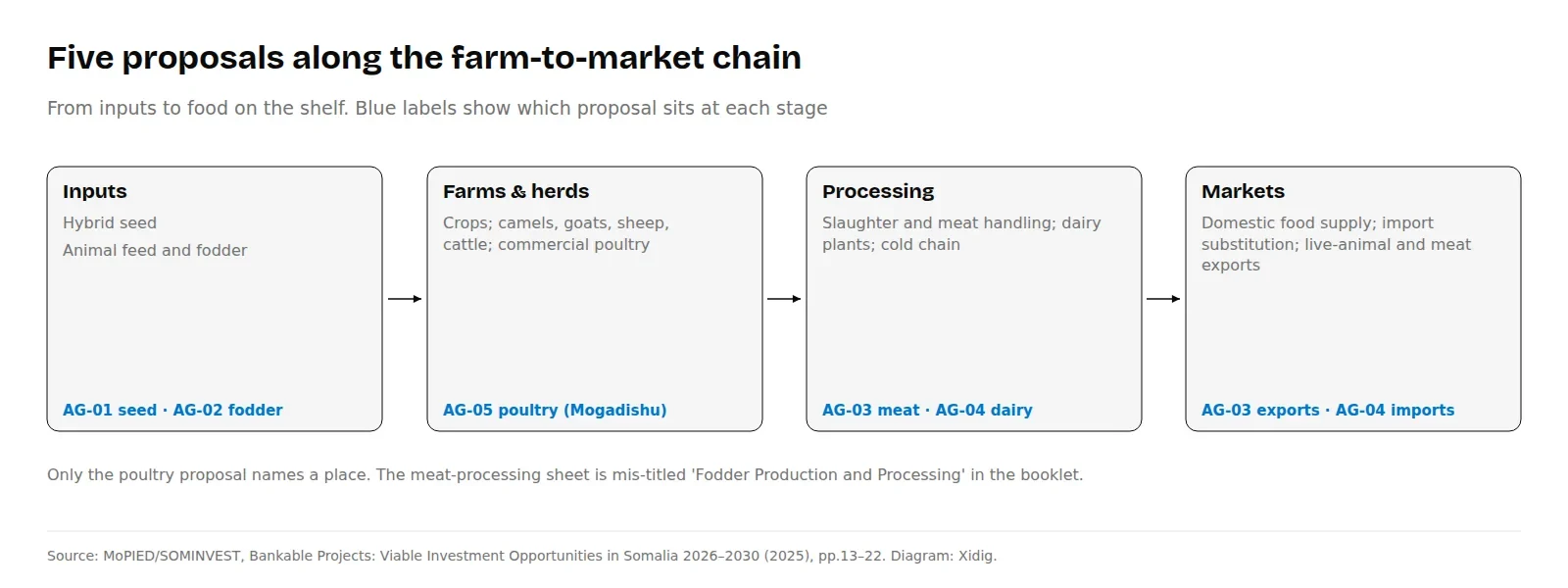
Where the five agriculture and livestock proposals sit.
- Seed Production and Processing (AG-01, pp.13–14). "introduce and enhance accessibility to high-quality hybrid seeds that offer higher yields and climate resilience". It says this would create "144 jobs". US$0.7M; 5 years.
- Fodder Production and Processing (AG-02, pp.15–16). "cultivation and processing of high-quality animal feed to support the livestock sector". It says this would "contribute $1.13 million to the GDP, and create 218 jobs". US$1.9M; 5 years.
- Live Animals and Meat Processing (AG-03, pp.17–18). "improve domestic food supply and reduce reliance on imported meat products, while also driving export revenues". Existing infrastructure: "Small privet owned Infrastructure & certain government district slather house" [sic]. US$26.5M; 5 years.
- The page header repeats "Fodder Production and Processing", a layout error. This report uses the subsector name.
- Dairy Production & Value-Added Dairy Products (AG-04, pp.19–20). "modern dairy farms, processing plants, and cold chain infrastructure". Drivers include "Enhancing pastoralist incomes" and "Reducing dairy import dependency". Existing infrastructure: "Old factories". US$7.4M; 3 years.
- Poultry — Commercial Broilers and Layers Farming (AG-05, pp.21–22). A commercial egg project in Mogadishu, proposed by a named private sponsor company with a Nairobi-based consultancy. US$5.4M; 2 years.
- This report doesn't profile the company. The sheet's text refers to the sponsor by two different abbreviations.
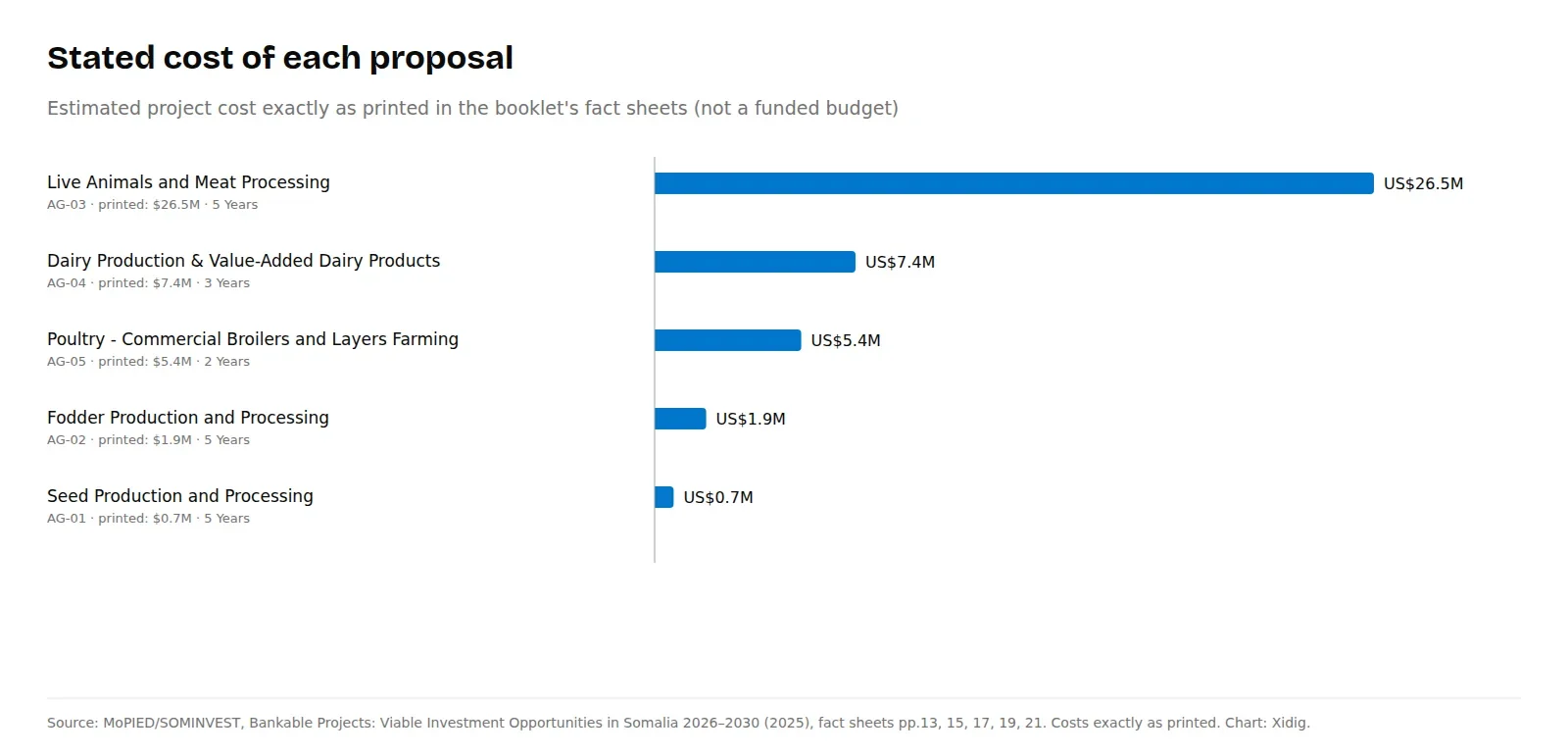
Estimated costs as printed. They are not approved or funded budgets.
- Primary source: MoPIED / SOMINVEST, Bankable Projects 2026–2030, posted 19 Nov 2025. Agriculture & livestock section, PDF pp.13–22.
- Promoters: SOMINVEST with the Ministry of Agriculture and Irrigation (seed, fodder) or the Ministry of Livestock, Forestry & Range (meat, dairy, poultry).
- Status: pre-feasibility on all five sheets, which are also all ticked Greenfield and Private.
Related reports
- Somalia's Bankable Projects 2026–2030, explained
- Somalia's roads and trade corridors
- Cold chain for fish, milk and meat in Somalia
- Seed systems in Somalia: where farmers' seed comes from and why it matters
- Fodder, drought and herd survival in Somalia
- Camel milk and dairy in Somalia: a big producer that imports its milk powder
- Livestock exports: why the figures don't match
- Eggs and chicken in Mogadishu: imports, local farms and the gap
About this report
By Xidig members and collaborators.
Project codes. Codes such as EN-04 or AG-05 are Xidig's own shorthand for the booklet's fact sheets, by sector; the booklet itself does not number its projects.
How we researched it. We read the full 97-page booklet and checked every figure, page reference and quotation used here against it. We then compared the booklet's claims with the official, international and news sources listed below, and we say where they differ. We did not interview anyone for this report. Where the booklet's figures are unclear, we reproduce them as printed and explain the issue in the notes.
Corrections. If you spot an error, please tell us using the correction link on this page.
Sources
Primary
- MoPIED / SOMINVEST, Bankable Projects 2026–2030, PDF pp.13–22: https://sominvest.gov.so/bankable-projects-in-somalia-2026-2030/
Supporting
- Somali National Bureau of Statistics, Somalia GDP 2025 (30 Jun 2026): https://nbs.gov.so/somalia-gross-domestic-product-gdp-2025/
- SNBS, Quarterly Statistical Bulletin Q4 2024: https://nbs.gov.so/wp-content/uploads/2025/07/Quarterly-Statistical-Bulletin-Q4-2024.pdf
- SNBS, Somalia GDP 2024 release (Jun 2025): https://nbs.gov.so/wp-content/uploads/2025/06/Somalia-GDP-2024-release-text-v3-2025.pdf
- Ecofin Agency, "Somalia targets record $1 billion in livestock exports for 2025" (28 Oct 2025): https://www.ecofinagency.com/news/2810-49903-somalia-targets-record-1-billion-in-livestock-exports-for-2025
- World Bank, Somalia Country Economic Memorandum: Agriculture overview (Jul 2018): https://documents1.worldbank.org/curated/en/803231522165074948/txt/124653-Somalia-CEM-Agriculture-Report-Overview-English-Revised-July-2018.txt
- FAO, "Strengthening livelihoods through fodder value chain development in Somalia" (29 Oct 2025): https://www.fao.org/africa/news-stories/news-detail/strengthening-livelihoods-through-fodder-value-chain-development-in-somalia/en
- FAO, "As rains fail again, catastrophic hunger looms over Somalia" (6 Jun 2022): https://www.fao.org/newsroom/detail/as-rains-fail-again-catastrophic-hunger-looms-over-somalia/
- FAO, Dairy portal: Camels: https://www.fao.org/dairy-production-products/dairy/camels/en
- TASAI, Somalia Country Report 2025 (Jun 2025, hosted by the Ministry of Agriculture): https://moa.gov.so/wp-content/uploads/2025/10/Som_2025_en_country-report_Jun2025_web.pdf
- Ministry of Livestock, Forestry and Range, Livestock Sector Development Strategy (2019): https://molfr.gov.so/wp-content/uploads/2024/06/LSDS-Final-Book-livestock-sector-development-strategy-published-2020-1-1.pdf
- FAO / UN Somalia, "Burao slaughterhouse sets a milestone" (29 Nov 2013): https://somalia.un.org/en/34585-burao-slaughterhouse-sets-milestone-somali-meat-industry
- The EastAfrican, "Saudi Arabia lifts Somalia livestock ban" (Jul 2018): https://www.theeastafrican.co.ke/business/Saudi-Arabia-lifts-Somalia-livestock-ban/2560-4644498-btrqap/index.html
- World Bank, Food Systems Resilience Project Aide Memoire (Jul 2025): https://documents1.worldbank.org/curated/en/099120125232636873/pdf/P177816-64ffc2de-3518-4695-99f1-65e8540fa6fc.pdf
- IFAD, Rural Livelihoods Resilience Programme: https://www.ifad.org/en/w/projects/2000004325
- Dawan Africa, "Somalia launches Islamic finance programme for livestock sector" (23 May 2026): https://www.dawan.africa/news/somalia-launches-islamic-finance-programme-for-livestock-sector