Why electricity costs so much in Somalia
Tusmada
- Summary
- Where Xidig members may contribute
- Possible services, research, supplier or collaboration roles
- Who may find this useful
- Prices, providers and where policy is heading
- Geographic context
- Dependencies and implementation constraints
- Risks and unknowns
- Questions members should verify before acting
- What is confirmed, and what isn't
- Relevant next steps
- More about the source
- Related reports
- About this report
- Sources
Power in Somalia is expensive, private and mostly diesel. How the market works, where policy is heading, and the national company and heavy-fuel-oil plants the government has proposed.
Not investment advice. Independent analysis of a government publication; not a tender or funding notice.
Summary
Electricity in Somalia is expensive. Using field data from 2017, the World Bank put the weighted average cost at about US$0.61 per kWh, excluding Somaliland. In 2021 the World Bank found that private providers supplied more than 90% of the country's electricity, nearly all of it from diesel generators. Each provider runs its own separate network. The ministry's 2025 power plan prioritises solar and wind, and the Energy Minister has set a target of prices below 20 cents per kilowatt-hour within five years.
What Xidig found:
- The figures are old. Public tariff data by town dates from 2017. Members who pay electricity bills can help build a better picture, carefully and with consent.
- The rules are still settling. The Electricity Act, signed on 8 March 2023, created a National Electricity Authority. The only text published online is in Somali and is headed as a draft bill.
- Skills are needed whatever the mix. Power-system planning, grid operations and utility management will be needed whichever generation mix is chosen.
The government has also proposed a national electricity company, SONEC (US$11.7M), and four 100 MW heavy-fuel-oil plants (US$450M), both at an early stage; details are under More about the source, and the questions they raise under Risks and unknowns.
Where Xidig members may contribute
These are learning opportunities first. The proposals are institutional and early-stage.
- Learning: how the Electricity Act 2023 structures the sector: the National Electricity Authority, licensing and a national company.
- Research: up-to-date tariff data by town. The public figures are old, so members who pay electricity bills can help build a better picture, carefully and with consent.
- Skills (general): power-system planning, grid operations and utility management. These are needed whichever generation mix is chosen.
Possible services, research, supplier or collaboration roles
- Independent tariff surveys and cost-of-supply analysis.
- Legal and translation work on the Electricity Act. The only text published online is in Somali and is headed as a draft bill; no official English version was found (see Somalia's Electricity Act 2023, explained).
- Grid-integration and planning studies, if and when commissioned.
Who may find this useful
- Engineers and energy economists.
- Staff of electricity service providers.
- Business owners whose costs depend on power prices.
- Students of public policy and law.
Prices, providers and where policy is heading
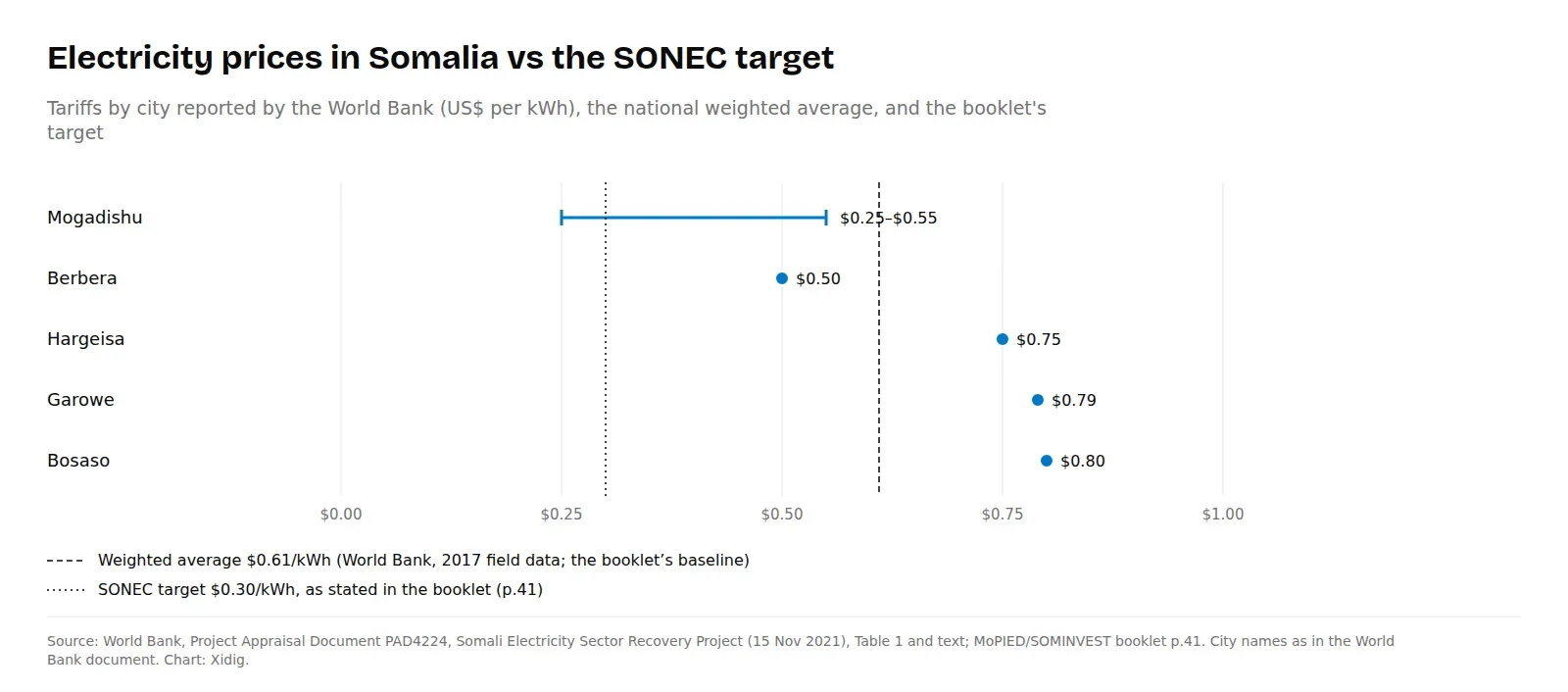
The government's US$0.61/kWh baseline matches a World Bank average built on 2017 data. City tariffs are several years old.
How the market works today. The World Bank's 2021 appraisal found that private electricity service providers "supply more than 90 percent of the electricity in the country". It also found that "nearly 100 percent of the generation is derived from" high-speed diesel generators. The Ministry of Energy and Water Resources' 2025 plan describes each provider as "vertically integrated as an autonomous parallel electricity provider". That fragmentation is what SONEC is meant to address.
The price. The World Bank wrote that "based on field data collected in 2017, the cost per kWh in Somalia, excluding Somaliland, ranges from US$0.25–US$1.30 per kWh, with a weighted average of about US$0.61 per kWh". The ministry's 2025 plan repeats the US$0.61 average. The US government's 2024 commercial guide gives a range of "50-125 cents/kWh". In November 2025 the Energy Minister set a public target of prices "below 20 cents per kilowatt-hour within the next five years" (SONNA). That is lower than the US$0.30 target in the SONEC proposal.
Where policy is heading. The ministry's 2025 generation and transmission plan says Somalia "should prioritize the large-scale deployment of renewable energy technologies—particularly solar PV and wind". The plan's cost comparisons do include heavy-fuel-oil generators as a candidate technology, but its conclusion prioritises solar and wind.
According to an African Development Bank press release (16 December 2025), its African Development Fund approved US$23M for Bosaso to fund work that "will introduce new solar generation, expand the distribution network and install modern meters". Bosaso is one of the four proposed HFO sites.
Geographic context
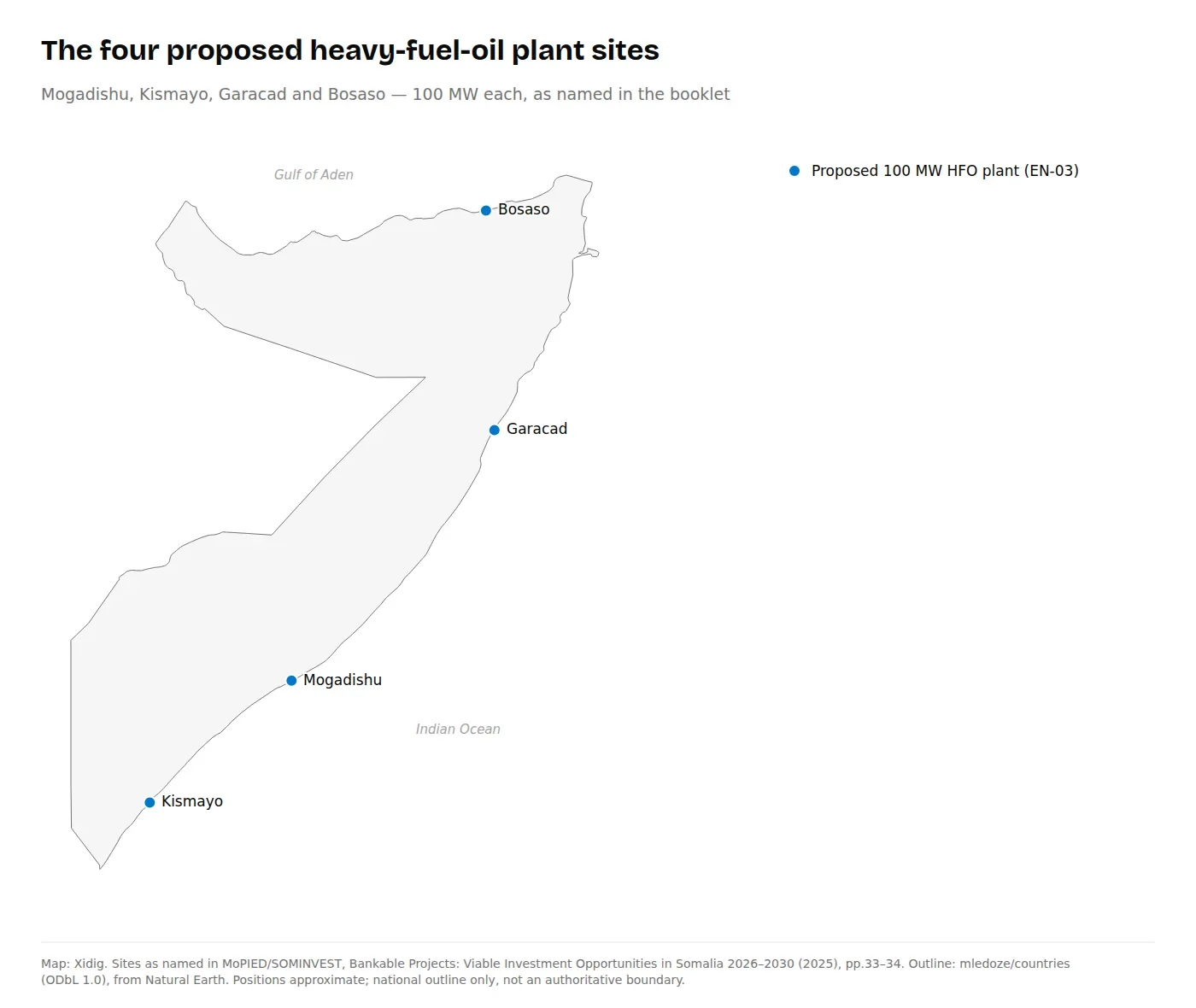
Sites named for the HFO proposal. The sheet's tick box says feasibility has started.
SONEC is national. The HFO plants are named for four coastal towns, three of which have ports: Mogadishu, Kismayo and Bosaso. Garacad also has a port, opened in 2022. The proposal does not describe how 100 MW plants would connect to each town's existing private networks. The 2021 World Bank table gives installed capacity of 47 MW for Mogadishu and 14 MW for Bosaso.
Dependencies and implementation constraints
- Law and institutions: SONEC depends on the Electricity Act. As of June 2026, government plans for state stakes in power and water firms were still waiting on "the draft law" (Dawan Africa, 1 Jun 2026). That article does not name SONEC.
- Existing providers: unifying networks means agreements with private companies that own them. The World Bank's ASCENT project reports a pending merger of three Mogadishu providers.
- Fuel supply for HFO: import, storage and price exposure.
- Finance: no funding or partner is named on either sheet.
Risks and unknowns
- Which article? The booklet cites "Article 44 of the 2023 Electricity Act". In the Somali text of the Act published on the ministry's website (headed as a 2022 draft bill), Article 44 ("Qodobka 44aad") deals with revoking licences, and Article 47 ("Qodobka 47aad: Shirkadda Korontada Qaran") concerns the national electricity company. The reference may reflect an earlier draft or a different translation.
- Engine brand. Rolls-Royce sold Bergen Engines to Langley Holdings in January 2022, so the "Rolls Royce Bergen Engines" wording on the government's HFO sheet (see More about the source) is out of date. Naming a supplier in a promotion document also raises procurement questions.
- Emissions. The IPCC's default CO₂ factor for residual fuel oil (77,400 kg/TJ) is higher than for diesel (74,100) or natural gas (56,100). Four 100 MW HFO plants would run against the government's own renewable-first plan.
- Cost basis: it is unclear whether US$450M covers one plant or four.
- Tariff target: no calculation behind US$0.30/kWh is given.
Questions members should verify before acting
- Has SONEC been legally established? Under which article of the Electricity Act?
- Who is carrying out the HFO feasibility study the tick box refers to (see More about the source)? Has the ministry confirmed it?
- Is the US$450M for one plant or four?
- How do the HFO proposals fit the ministry's 2025 renewable-first plan?
- What tariffs do providers in your town charge today, and who regulates them?
What is confirmed, and what isn't
Confirmed
- The two proposals, their printed costs (US$11.7M; US$450M) and their status ticks.
- The World Bank's US$0.61/kWh average is based on 2017 data.
- More than 90% of electricity comes from private providers, with generation nearly all diesel (2021).
- The Electricity Act was signed on 8 March 2023 and created a National Electricity Authority. In the published Somali text (headed as a draft bill), Article 47 concerns the national electricity company and Article 44 deals with licence revocation; the signed Act's numbering may differ.
- Rolls-Royce sold Bergen Engines in 2022.
- The minister's "below 20 cents" target (Nov 2025).
Our interpretation
- SONEC is the only proposal on the government's list aimed at market structure rather than new capacity.
- HFO plants would sit uneasily with the ministry's 2025 plan.
Not yet verified
- Why the government's proposal cites Article 44.
- Whether any HFO feasibility work has started.
- Whether US$450M is per plant.
- Current tariffs after 2017 by town.
- Any SONEC establishment since 2023.
- Whether Article 20 of the 2020 Petroleum Law provides for SONOC, and whether there is proven commercial gas for the gas plant.
Relevant next steps
- Read the Electricity Act (Somali) on the ministry's site and the 2025 generation plan.
- Track National Electricity Authority licensing announcements.
- If you work for an electricity provider, share how consolidation is affecting your area, through Xidig and within your employer's rules.
More about the source
The government's investment booklet, Bankable Projects 2026–2030 (MoPIED / SOMINVEST), is one of the sources for this report. The details it gives are summarised here as printed.
Somalia National Electricity Company (SONEC) (EN-07, pp.41–42).
- Mandate: "SONEC, mandated under Article 44 of the 2023 Electricity Act, will function as the national electricity company. It will establish subsidiaries for power generation, transmission & distribution, and corporate management."
- Aim: to "reduce tariffs from USD 0.61/kWh to USD 0.30/kWh and unify fragmented infrastructure".
- Estimates: US$11.7M; 1.5 years; PPP ticked.
- Key drivers (p.42): "Current system fragmented with high tariffs", "Unified T&D will lower costs and expand coverage" and "SONOC–SONEC partnership builds integrated energy framework". SONOC is the proposed national oil company.
Mogadishu, Kismayu, Garacad and Bosasso HFO Power Plant (100 MW each plant) (EN-03, pp.33–34).
- What: "HFO power plant based on Rolls Royce Bergen Engines with required balance of plant". The scope includes "engineering, procurement, construction, commissioning and startup".
- Estimates: construction 24 months; "8000 Hours (24 hours 333 days per year)" of operation; 30-year lifetime; estimated cost US$450M. The sheet doesn't say whether that is per plant or for all four.
- Ticks: Brownfield, Joint Venture, "Feasibility Started".
- Existing infrastructure cited: "Existing ports HFO imports" and "Existing grid, distribution and retail infrastructure" (p.34).
Two further energy sheets: oil and gas. These are not electricity proposals, but they sit upstream of power generation.
- Somalia National Oil Company (SONOC) (EN-01, pp.29–30). "Mandated under Article 20 of the 2020 Petroleum Law, SONOC will be established as Somalia's National Oil Company". It "will engage in exploration, refining, gas processing, trading, and local content development". US$2.1M; 5 years; ticked Greenfield, PPP and Pre-Feasibility. The sheet's subsector reads "Renewable Energy (Biogas)", which does not match the description and looks like a copy error.
- Gas Processing Plant (EN-02, pp.31–32). "Establishing infrastructure for natural gas processing, storage, and distribution", to replace "a portion of its imported energy with cleaner, locally sourced energy". It is "projected to create around 165 jobs". US$169.5M; 4 years; ticked Greenfield, PPP and Pre-Feasibility. The sheet cites "Regulatory oversight from the Somali Petroleum Authority (SPA)" (p.32). It does not name a site or a source of gas.
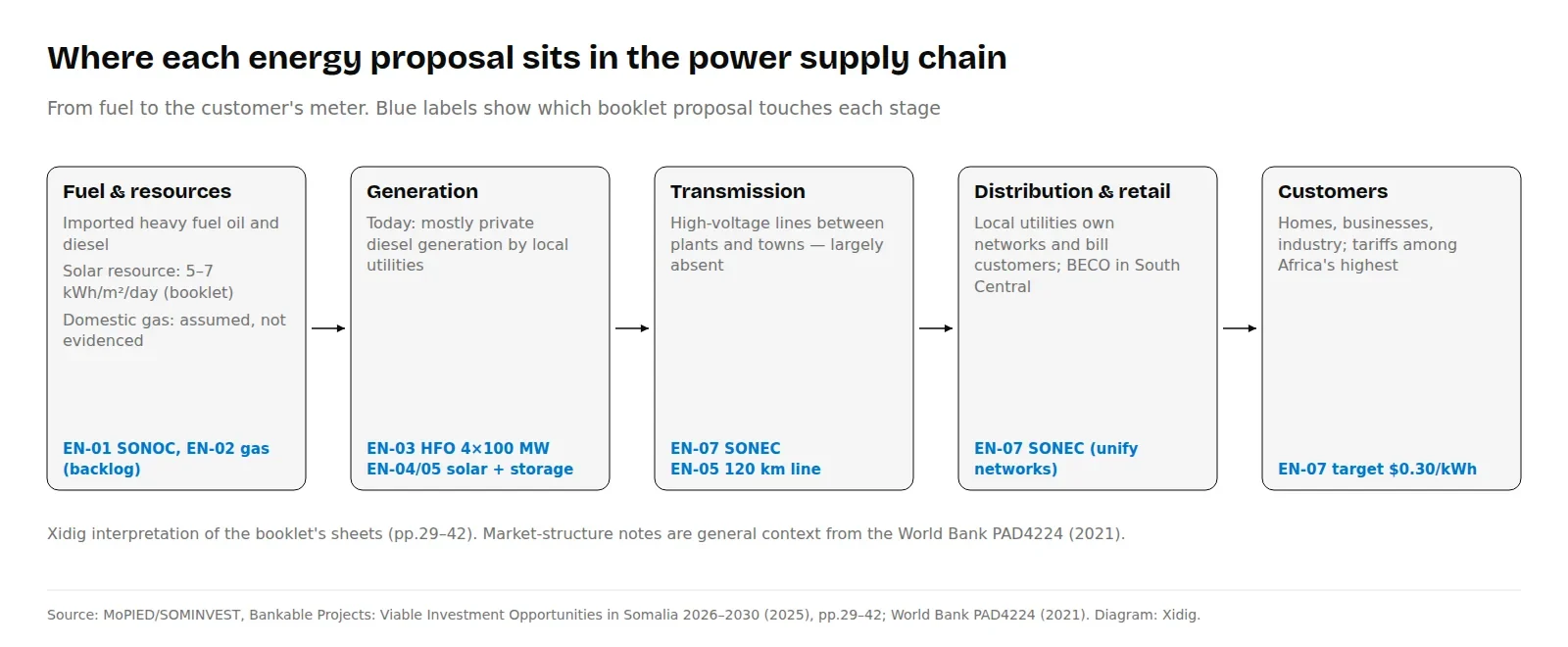
How the energy proposals map onto the supply chain. SONEC is the only proposal aimed at structure rather than new capacity.
- Primary source: MoPIED / SOMINVEST, Bankable Projects 2026–2030, posted 19 Nov 2025. Fact sheets for SONEC at PDF pp.41–42 and for the HFO plants at pp.33–34.
- Type: investment-promotion list.
- Status: SONEC is at pre-feasibility stage. The HFO sheet ticks "Feasibility Started".
Related reports
- Somalia's Bankable Projects 2026–2030, explained
- Solar power and battery storage in Somalia
- Somalia's Electricity Act 2023, explained
- Heavy fuel oil or solar? Costs and emissions in context
- Oil and gas in Somalia: where exploration stands
- The Petroleum Law 2020 and the Somali Petroleum Authority, explained
About this report
By Xidig members and collaborators.
Project codes. Codes such as EN-04 or AG-05 are Xidig's own shorthand for the booklet's fact sheets, by sector; the booklet itself does not number its projects.
How we researched it. We read the full 97-page booklet and checked every figure, page reference and quotation used here against it. We then compared the booklet's claims with the official, international and news sources listed below, and we say where they differ. We did not interview anyone for this report. Where the booklet's figures are unclear, we reproduce them as printed and explain the issue in the notes.
Corrections. If you spot an error, please tell us using the correction link on this page.
Sources
Primary
- MoPIED / SOMINVEST, Bankable Projects 2026–2030, PDF pp.29–34, 41–42: https://sominvest.gov.so/bankable-projects-in-somalia-2026-2030/
Supporting
- World Bank, PAD4224, Somali Electricity Sector Recovery Project (15 Nov 2021), text and Table 1: https://documents1.worldbank.org/curated/en/989971641921723162/pdf/Somalia-Somali-Electricity-Sector-Recovery-Project.pdf
- Ministry of Energy and Water Resources, Optimized Cost Electricity Generation and Transmission Development Plan (Jun 2025): https://moewr.gov.so/wp-content/uploads/2025/07/Somalia-Generation-and-Transmission-Plan-2025-MoEWR.pdf
- Ministry of Energy and Water Resources, Somalia Electricity Act 2023 (page and Somali PDF): https://moewr.gov.so/ova_doc/somalia-electricity-act/ · https://moewr.gov.so/wp-content/uploads/2023/10/Somalia-Electricity-Act-2023.pdf
- US International Trade Administration, Somalia Country Commercial Guide: Energy (22 Jan 2024): https://www.trade.gov/country-commercial-guides/somalia-energy-and-electricity
- SONNA, "Energy Minister outlines ambitious plan to slash electricity costs nationwide" (28 Nov 2025): https://sonna.so/en/energy-minister-outlines-ambitious-plan-to-slash-electricity-costs-nationwide
- Dawan Africa, "Somalia plans state stakes in power, water firms to expand infrastructure" (1 Jun 2026): https://www.dawan.africa/news/somalia-plans-state-stakes-in-power-water-firms-to-expand-infrastructure
- African Development Bank, "African Development Fund approves $23 million to boost clean energy access in Bosaso" (16 Dec 2025): https://www.afdb.org/en/news-and-events/press-releases/african-development-fund-approves-23-million-boost-clean-energy-access-bosaso-somalia-89735
- Langley Holdings, completion of Bergen Engines acquisition (4 Jan 2022): http://www.langleyholdings.com/news/2022/01/04/langley-completes-acquisition-of-bergen-engines-from-rolls-royce/
- IPCC, 2006 Guidelines, Vol. 2 Ch. 1, Table 1.4: https://www.ipcc-nggip.iges.or.jp/public/2006gl/pdf/2_Volume2/V2_1_Ch1_Introduction.pdf