Solar power and battery storage in Somalia
Tusmada
- Summary
- Where Xidig members may contribute
- Possible services, research, supplier or collaboration roles
- Who may find this useful
- Why solar matters here, and what is already being built
- Geographic context
- Dependencies and implementation constraints
- Risks and unknowns
- Questions members should verify before acting
- What is confirmed, and what isn't
- Relevant next steps
- More about the source
- Related reports
- About this report
- Sources
Solar with battery storage is spreading in Somali towns. What is already being built, where the skills gaps are, and the three solar proposals on the government's list.
Not investment advice. Independent analysis of a government publication. The proposals described here are not tenders or funded projects.
Summary
Solar power with battery storage is spreading in Somalia, and the work behind it needs people: installers, technicians, engineers and trainers. World Bank projects are already installing solar and batteries in several towns and have procurement under way for two large solar-and-storage plants in Mogadishu. Electricity is expensive and mostly diesel-generated, rural access had fallen to about a quarter of people by 2024, and the ministry's 2025 generation plan makes solar and wind its main priority for new capacity.
What Xidig found:
- Work is under way. World Bank-funded contracts totalling 37.5 MW were under implementation in five towns in April 2026, and the same project is installing solar-plus-battery systems at 196 health and 272 education sites, with those in Somalia reported commissioned in late 2025.
- Mogadishu is next. A March 2026 World Bank paper reports technical evaluation completed for two lots, each of 55 MWp of solar with 160 MWh of batteries. No capacity had been installed as of July 2026.
- Skills are the most solid opening. Installing, operating and maintaining solar-plus-storage systems is a growing need, whichever projects go ahead.
The government has also listed three solar proposals, all at an early stage: off-grid plants for 15 towns (US$75M), a 100 MW solar farm with storage (US$132M) and a panel factory (US$5M). No source Xidig found shows they are part of the World Bank work; details are under More about the source.
Where Xidig members may contribute
These are skills and service opportunities, meaning plausible needs, not confirmed vacancies or tenders.
- Skills: installation, commissioning, operation and maintenance of solar PV and battery storage systems, plus safety and metering.
- Service: site surveys, load and demand assessments for towns, environmental and social screening, and community engagement.
- Learning: understanding the Electricity Act 2023 licensing rules for mini-grids and service providers.
- Research and collaboration: mapping which towns already have solar mini-grids, to help identify the unnamed "second-tier towns".
Possible services, research, supplier or collaboration roles
- Training delivery for solar technicians. Programmes exist: Save the Children and the Puntland Ministry of Labour, Youth and Sports, with GIZ funding, trained 140 young people in solar installation in 2023. IRENA notes a national TVET centre and a Solar Technology Application Resource Centre (STAR-C).
- Supply and logistics of components. Demand should be validated before anyone commits stock.
- Independent monitoring of installed systems' performance, where operators or funders commission it.
Who may find this useful
- Electrical engineers and technicians, including diaspora engineers with grid or storage experience.
- Local electricity service providers and their staff.
- TVET students and trainers in electrical trades.
- Researchers working on energy access, and local businesses with high power costs.
Why solar matters here, and what is already being built
Electricity in Somalia is expensive, and almost all of it is generated by private companies running diesel generators (our report on electricity costs sets out the figures). The Ministry of Energy and Water Resources' 2025 generation plan makes solar, with wind, its main priority for new capacity.
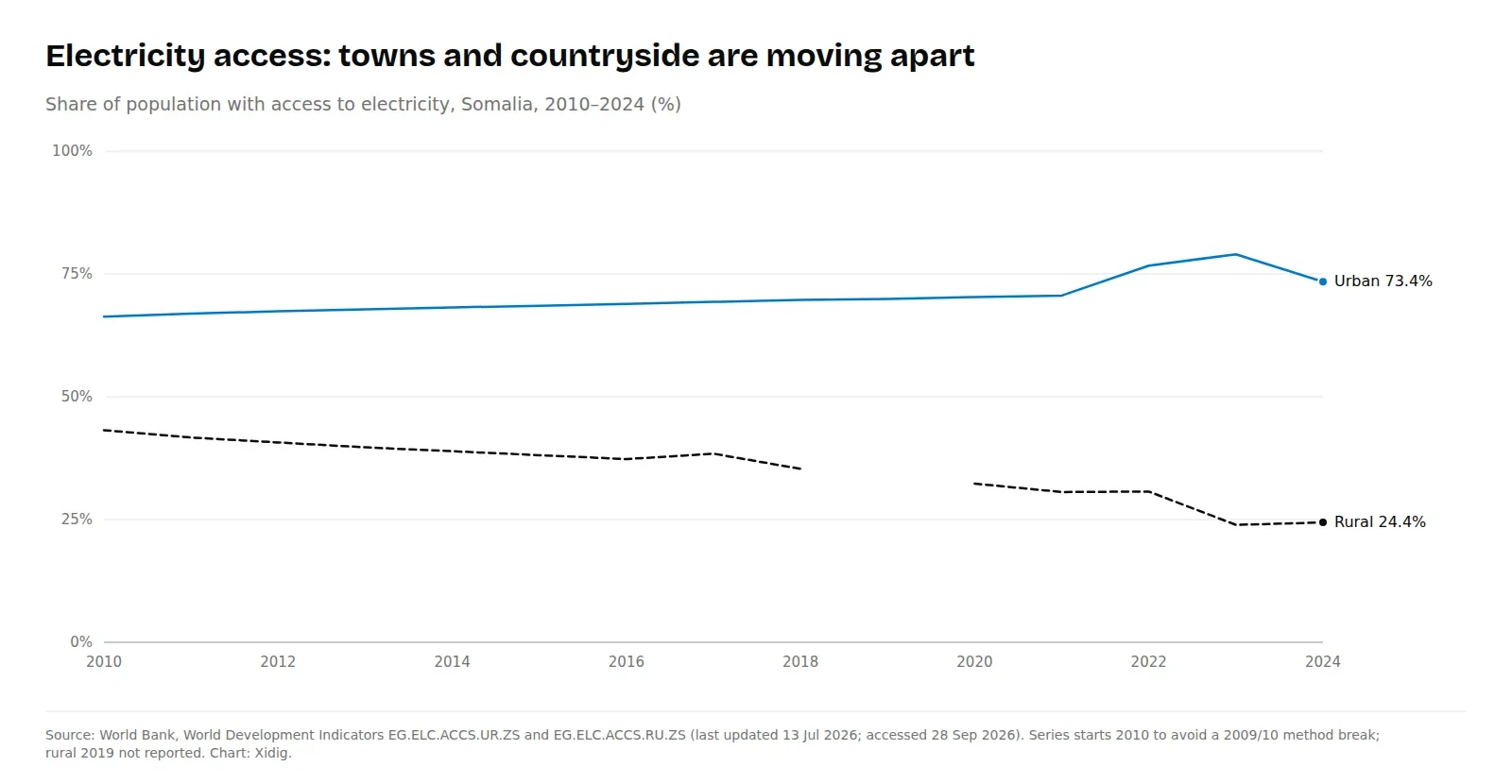
Urban access has risen while rural access has fallen. Modelled World Bank estimates; rural 2019 not reported.
Access figures show why towns outside the main cities matter. World Bank estimates show urban access at about 73% in 2024 and rural access at about 24%, down from 43% in 2010.
The solar resource is strong. IRENA's 2025 energy-transition assessment says Somalia "receives 6-8 kWh per square metre (m2) of solar irradiation on average daily". The government's proposal gives 5–7 kWh/m²/day with "over 310 sunny days", repeating SOMINVEST's energy-sector page rather than an independent measurement.
What is already happening (separately from the government's proposals):
- Somali Electricity Sector Recovery Project (SESRP, World Bank). The project's status report of May 2026 lists six contracts totalling 37.5 MW "under implementation" as of 30 April 2026, in Galkayo, Garowe, Baidoa, Berbera and Borama. It gives no completion dates for them. The project also installs solar-plus-battery systems at 196 health and 272 education sites. It says those in Somalia were commissioned in September 2025 (health) and November 2025 (education), and that commissioning in Somaliland was "expected by May 30, 2026". Its indicator table already counts all 196 and 272 sites as connected by 30 April 2026, so the report is not consistent on this point. A restructuring in March 2026 extended the project to June 2028 and cancelled US$4.38M.
- ASCENT Somalia (World Bank, about US$96M after a US$4M cancellation). Its aim is to "increase access to sustainable and clean energy through private sector participation". A March 2026 restructuring paper reports technical evaluation completed for two Mogadishu lots, Daynile and Jazeera, "each consisting of 55 MWp Solar PV and 160 MWh BESS". As of July 2026 no capacity had been installed. The paper also names a pending merger of operations of three Mogadishu providers: BECO, Blue Sky Energy and Mogadishu Power Supply.
- BECO has run an 8 MWp solar plant in Mogadishu since 2020 (Reuters and SONNA, June 2020). No independent source confirms battery storage at BECO today.
The government's 100 MW + 300 MWh proposal is similar in scale to the ASCENT Mogadishu lots, but the figures differ. No source links the two. Readers should treat them as separate until SOMINVEST or the ministry says otherwise.
Geographic context
The off-grid proposal names no towns: it gives three per Federal Member State, 15 in all. The booklet's own table on p.9 lists eight member-state entries, so which five states are meant is unclear. The 100 MW farm is placed only in "South Central Somalia", BECO's service area. The factory lists a Mogadishu contact address. No map is included, because the sheets give no sites precise enough to plot.
Dependencies and implementation constraints
- Regulation: the Electricity Act, signed on 8 March 2023, created the National Electricity Authority (NEA), which licenses providers and sets tariffs. The NEA reportedly licensed 20 electricity service providers in November 2025 (Africa Minigrids Program). Any plant would need to fit that licensing regime.
- Grid integration: a 100 MW farm needs a buyer and a network able to take its output. The 120 km line in the proposal is part of that.
- Finance: no funding or procurement is stated on any of the three sheets. The booklet does name co-promoters: BECO for the 100 MW farm and HASPP for the panel factory.
- Market structure: Mogadishu's providers are still being consolidated, according to the ASCENT restructuring paper.
Risks and unknowns
- Capacity per off-grid plant: 5 MW or 15 MW? (see More about the source)
- Whether the 168 million kWh and 3.15 Mt CO₂ figures are annual or lifetime (see More about the source).
- The factory's 2,900 direct jobs from US$5M is an unusually high ratio. It has no source. HASPP's own website describes it as a Mogadishu manufacturer of "solar energy accessories", but Xidig found no independent information on its capacity or operations.
Questions members should verify before acting
- Has the Ministry of Energy and Water Resources named the 15 towns, and is there a feasibility study?
- Is the 100 MW + 300 MWh proposal connected to the World Bank's ASCENT procurement in Mogadishu, or separate?
- What licence would a mini-grid operator need from the National Electricity Authority?
- Is there a current tender? Check the ministry, the World Bank project pages and official procurement notices, not social media.
- For the factory: what capacity and product range are planned, and what is the evidence behind the job estimate?
What is confirmed, and what isn't
Confirmed
- The three proposals, their stated costs (US$75M, US$132M, US$5M) and their pre-feasibility status (pp.35–40).
- The World Bank's SESRP and ASCENT projects exist, with the figures cited from their own documents.
- BECO's 8 MWp solar plant has operated since 2020.
- The Electricity Act 2023 and the NEA exist.
Our interpretation
- Skills in solar-plus-storage are a plausible growing need, given the World Bank investments already under way.
- The booklet proposals may overlap with existing programmes. This is not established.
Not yet verified
- Plant capacities and energy/CO₂ periods.
- The factory's job and household figures.
- HASPP's operations.
- Which towns are meant.
- Whether any of the three proposals has advanced.
Relevant next steps
- Follow the World Bank SESRP and ASCENT project pages for real procurement.
- Technicians: look into TVET and STAR-C training routes.
- Share local knowledge of existing town mini-grids through Xidig.
More about the source
The government's investment booklet, Bankable Projects 2026–2030 (MoPIED / SOMINVEST), is one of the sources for this report. The details it gives are summarised here as printed.
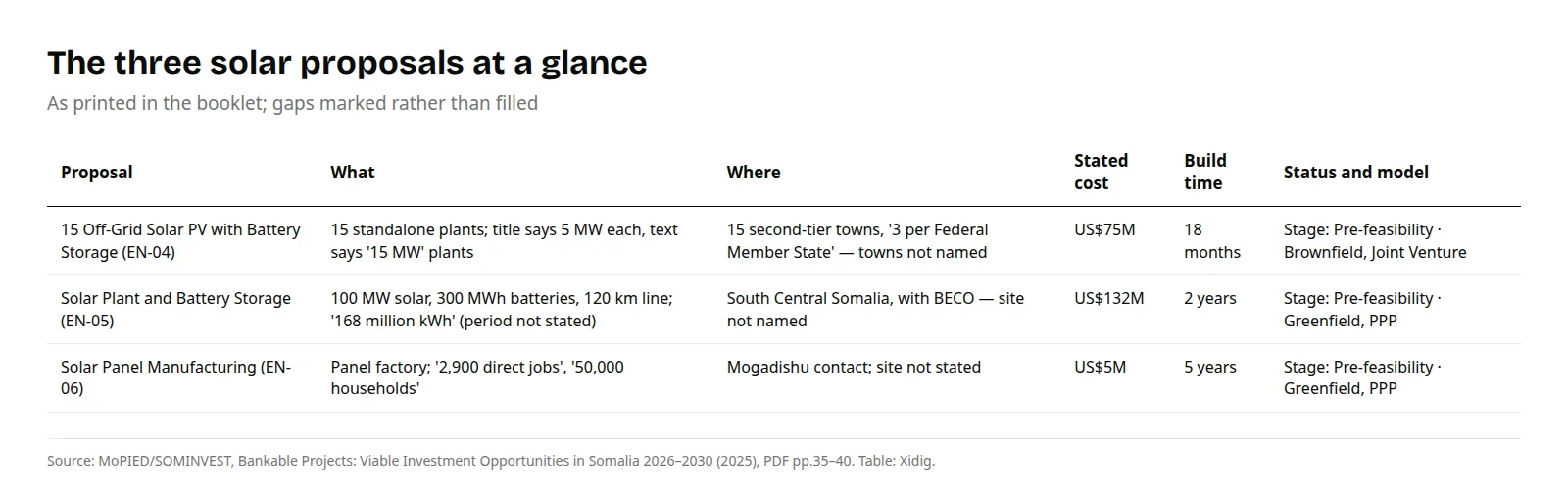
The three solar proposals as printed, including the inconsistencies a reader should check.
1. 15 Off-Grid 5 MW Solar PV with Battery Storage (EN-04, pp.35–36).
- What: the sheet describes the "development, pre-construction, construction and operating phases of the standalone off-grid 15 MW Solar PV Power Plants for 15-second tier towns", with "Three (3) plants per Federal Member State".
- Estimates: US$75M; plant construction 18 months; lifetime 20 years.
- Ticks: Brownfield and Joint Venture.
- Inconsistency: the title says 5 MW per plant and the description says 15 MW. The towns are not named.
2. Solar Plant and Battery Storage (EN-05, pp.37–38; the sheet header reads "Solar Lant").
- What: "a 100 MW Solar farm with 300 MWh of battery storage system and a 120 km transmission-distribution line". The sheet says it "will produce approximately 168 million kWh and reduce 3,150,000 tons of CO2", without saying over what period.
- Promoters: SOMINVEST, the Ministry of Energy and Water Resources and BECO. The sheet notes that "BECO owns and operates most of the electricity transmission & distribution systems in South Central Somalia" (p.38).
- Estimates: US$132M; 2 years; lifetime 20 years.
3. Solar Panel Manufacturing (EN-06, pp.39–40).
-
What: a factory that "could create approximately 2900 direct jobs, provide affordable energy to over 50,000 households, and reduce carbon emissions by an estimated 100,000 tons annually".
-
Co-promoter: a private company, Horn of Africa Solar Panel Plant Ltd (HASPP).
-
Aim: "To supply high-quality solar energy accessories to Somalia and the entire East African region" (p.40).
-
Estimate: US$5M.
-
Primary source: MoPIED / SOMINVEST, Bankable Projects: Viable Investment Opportunities in Somalia (2026–2030), first edition, posted 19 Nov 2025. Fact sheets at PDF pp.35–40.
-
Type: an investment-promotion list; not a procurement notice.
-
Status: pre-feasibility on all three sheets.
Related reports
- Somalia's Bankable Projects 2026–2030, explained
- Why electricity costs so much in Somalia
- Battery storage for Somali towns, explained
- Solar installer and technician skills in Somalia
- Mini-grids in Somalia: how they work, how they're licensed and financed
About this report
By Xidig members and collaborators.
Project codes. Codes such as EN-04 or AG-05 are Xidig's own shorthand for the booklet's fact sheets, by sector; the booklet itself does not number its projects.
How we researched it. We read the full 97-page booklet and checked every figure, page reference and quotation used here against it. We then compared the booklet's claims with the official, international and news sources listed below, and we say where they differ. We did not interview anyone for this report. Where the booklet's figures are unclear, we reproduce them as printed and explain the issue in the notes.
Corrections. If you spot an error, please tell us using the correction link on this page.
Sources
Primary
- MoPIED / SOMINVEST, Bankable Projects 2026–2030, PDF pp.35–40: https://sominvest.gov.so/bankable-projects-in-somalia-2026-2030/
Supporting
- World Bank, Project Appraisal Document PAD4224, Somali Electricity Sector Recovery Project (15 Nov 2021): https://documents1.worldbank.org/curated/en/989971641921723162/pdf/Somalia-Somali-Electricity-Sector-Recovery-Project.pdf
- World Bank, SESRP Implementation Status & Results Report, sequence 9 (May 2026): https://documents1.worldbank.org/curated/en/099052026102521532/txt/P173088-3c537d88-c73c-4bac-b9df-dbccdff162bd.txt
- World Bank, SESRP Restructuring Paper (5 Mar 2026): https://documents1.worldbank.org/curated/en/099032626073010531/txt/P173088-db056fb6-ff05-4619-bc8c-69938418e4de.txt
- World Bank, SESRP Implementation Status & Results Report (4 Nov 2025): https://documents1.worldbank.org/curated/en/099110425105521326/txt/P173088-768d0297-9765-4477-ab01-1aef8b51b2df.txt
- World Bank, ASCENT Somalia ISR Seq. 4 (25 Jul 2026): https://documents1.worldbank.org/curated/en/099072426230522119/txt/P181341-4c372fdc-c937-4b1c-bab0-ed974c1e8cc9.txt
- World Bank, ASCENT Somalia Restructuring Paper (18 Mar 2026): https://documents1.worldbank.org/curated/en/099031826051522777/txt/P181341-397e066d-cae6-4ca2-a658-9b5d051a7ce8.txt
- World Bank, SEAP ICR Review (13 Nov 2024): https://documents1.worldbank.org/curated/en/099111324154025715/txt/P165497-5bba6960-c978-4104-87c3-f697e5eaefe9.txt
- IRENA, Energy Transition Assessment: Somalia (Jun 2025): https://www.irena.org/-/media/Files/IRENA/Agency/Publication/2025/Jun/IRENA_COU_Energy_transition_assessment_Somalia_2025.pdf
- Ministry of Energy and Water Resources, Optimized Cost Electricity Generation and Transmission Development Plan (Jun 2025): https://moewr.gov.so/wp-content/uploads/2025/07/Somalia-Generation-and-Transmission-Plan-2025-MoEWR.pdf
- Ministry of Energy and Water Resources, Somalia Electricity Act 2023: https://moewr.gov.so/ova_doc/somalia-electricity-act/
- Africa Minigrids Program, NEA licensing of 20 providers (17 Nov 2025): https://africaminigrids.org/amp-helps-somalia-build-its-first-unified-system-for-licensing-electricity-providers/
- SONNA, "BECO builds 8 MWp solar power plant in Mogadishu" (7 Jun 2020): https://sonna.so/en/beco-builds-8-mwp-solar-power-plant-in-mogadishu/
- Save the Children, solar training in Puntland (2 Oct 2023): https://www.savethechildren.net/blog/solar-energy-trainings-giving-somali-youth-chance-succeed
- World Bank WDI, EG.ELC.ACCS.UR.ZS / EG.ELC.ACCS.RU.ZS (updated 13 Jul 2026)
- SOMINVEST, Energy sector page (solar resource claim): https://sominvest.gov.so/key-sectors/energy/