Heavy fuel oil or solar? Costs and emissions in context
Tusmada
- Summary
- Where Xidig members may contribute
- Possible services, research, supplier or collaboration roles
- Who may find this useful
- Comparing the options
- Dependencies and implementation constraints
- Risks and unknowns
- Questions members should verify before acting
- What is confirmed, and what isn't
- Relevant next steps
- More about the source
- Related reports
- About this report
- Sources
Oil-fired plants or solar with batteries for Somalia's new power. How their costs, fuel risk and emissions compare, and what the energy ministry's own plan says.
Not investment advice. Independent analysis of a government publication and other public sources. It is not an offer or a tender notice, and the Government of Somalia has not endorsed it.
Summary
Somalia has about 345 MW of installed generating capacity, according to its 2025 climate plan, and on 2017 data consumers paid a weighted average of about US$0.61 per kWh for almost entirely diesel-generated power (World Bank). How new capacity is added will shape what people pay. Solar is now among the cheapest sources of new power worldwide but needs batteries for night-time supply; oil-fired plants run day and night but depend on imported fuel. Members with energy-modelling and environmental skills can help compare the options for specific towns.
What Xidig found:
- Solar power is cheap. New utility solar averaged US$0.043 per kWh worldwide in 2024 (IRENA), and firm solar-plus-storage cost about US$0.054–0.082 per kWh in regions with strong sun in 2025.
- Fuel is the risk. By Xidig's arithmetic, at late-September 2026 prices, heavy fuel oil alone costs at least US$0.13 per kWh before shipping to Somalia. In mid-March 2026 fuel-oil prices at the main bunkering hubs were close to double their pre-war average.
- The ministry's plan favours renewables. The energy ministry's 2025 generation plan prioritises solar and wind. Its least-cost model adds only one small (10 MW) heavy-fuel-oil unit, and the plan says oil-fired plants should be kept for emergency or backup use.
- Emissions differ widely. On median life-cycle estimates, oil-fired power emits about 840 grams of greenhouse gas per kWh, against 46 grams for solar (IPCC).
The government has proposed four 100 MW heavy-fuel-oil plants (US$450M), which together would exceed today's installed capacity, alongside a 100 MW solar farm with storage and 15 off-grid solar plants; details are under More about the source.
Where Xidig members may contribute
Learning openings, not confirmed contracts or tenders:
- Energy modelling: comparing the cost of each option for a specific town, using local fuel and tariff data.
- Environmental assessment: air quality and emissions reviews for any thermal plant.
- Explaining trade-offs: clear Somali-language material for public consultations.
Possible services, research, supplier or collaboration roles
- A town-level cost comparison of solar with storage against the current diesel supply.
- A plain-language brief on the ministry's 2025 generation plan.
- Research: tracking fuel import costs for power generation.
Who may find this useful
- Energy economists and engineers.
- Environmental specialists.
- Policymakers and journalists.
- Diaspora investors weighing energy projects.
Comparing the options
Scale.
- Installed capacity today: Somalia's climate plan (NDC 3.0, 2025) gives total installed capacity of 345 MW, of which 42 MW, or 12%, is renewable.
- The proposal's size: the four HFO plants, at 400 MW, would be larger than that total.
What the energy ministry plans.
- Priority: the Ministry of Energy and Water Resources' Generation and Transmission Plan (June 2025) says Somalia "should prioritize the large-scale deployment of renewable energy technologies—particularly solar PV and wind".
- Candidates: the plan's least-cost modelling (Chapter 4) included 10 MW and 20 MW HFO engine plants among its candidate technologies, alongside diesel, gas, coal, nuclear, solar and wind.
- Additions: in the reference scenario the model selects one 10 MW HFO unit, in South West, installed from 2030 to 2041 (Annex 3.1, Table A3-2). Its large thermal additions are gas turbines, mostly fuelled by liquefied natural gas, which the plan finds "the most cost-effective among thermal options".
- Oil-fired plants: the plan says they "should be reserved strictly for emergency or backup purposes, rather than for regular dispatch", because of their high emissions and cost.
- Long-term aim: in the plan's reference scenario, renewables (including hydro) reach "nearly 60%" of generation by 2050.
- Fit with the proposals: the government's list does not explain how its four proposed HFO plants (EN-03) fit with this plan.
Cost of power (levelised cost, over a plant's life).
- Solar worldwide: new utility solar averaged US$0.043 per kWh worldwide in 2024 (IRENA, 2025).
- Solar in Africa: a summary of IRENA's 2025 data puts Africa at US$0.052 per kWh, with installed costs of US$837 per kW.
- Solar with storage: in regions with strong sun, firm (round-the-clock) solar-plus-storage cost about US$0.054–0.082 per kWh in 2025 (IRENA, 2026, via Energy-Storage.News).
- HFO: Xidig found no authoritative cost figure for a large permanent HFO engine plant. The closest World Bank figure is for emergency rental units running on diesel or HFO, whose tariffs were typically US$0.30–0.40 per kWh in the study's reference years (mostly 2012–2014; published 2016); that is not the cost of a permanent plant. The fuel-only cost below is a floor.
- Somalia (2017 data): consumers paid US$0.25–1.30 per kWh, a weighted average of about US$0.61 (excluding Somaliland), for almost entirely diesel-generated power (World Bank).
Fuel price risk.
- Fuel use: Bergen's B33:45L data sheet (one of its current engines) gives about 46–47% efficiency on diesel oil. By Xidig's calculation that is about 180 grams of fuel per kWh; HFO, with a lower energy content, would need about 190 grams.
- Current prices: HFO (IFO 380) cost about US$708 per tonne at Fujairah on 28 September 2026. That makes the fuel alone at least US$0.13 per kWh, before shipping to Somalia (Xidig's arithmetic).
- The 2026 spike: in mid-March 2026 the average price of high-sulphur fuel oil across the top 20 bunkering hubs was US$794 per tonne, "close to double the pre-war average" (Lloyd's List, via Kuehne+Nagel).
- Who pays: changes in oil prices usually pass through to power costs, unless tariffs are fixed or subsidised.
Capital cost.
- The proposal: EN-03's printed cost works out to about US$1,125 per kW (Xidig's arithmetic).
- Comparisons: Kenya's 87 MW Thika HFO plant was estimated at US$153 million, about US$1,760 per kW (2016). A US government benchmark for engine plants was US$2,018 per kW (2021 dollars).
- Solar: in Africa it cost US$837 per kW installed in 2025.
- Caution: these figures are from different years and scopes, so they are rough comparisons. Per-kW figures are also not like-for-like: solar produces power only in daylight, so a kW of solar generates much less energy per year than a kW of engine capacity running around the clock.
Emissions.
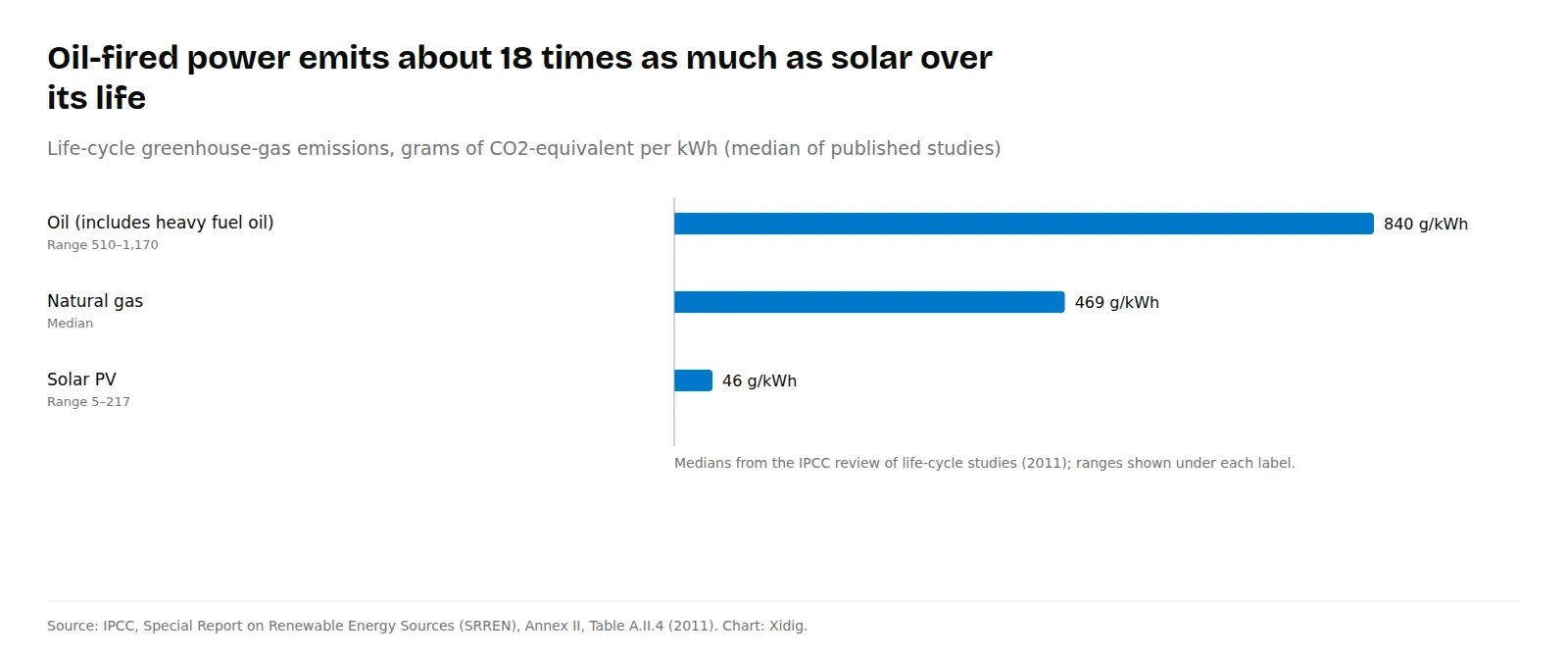
Life-cycle emissions per kWh, median of published studies (IPCC).
- Annual total: running 400 MW for 8,000 hours a year would produce about 3.2 billion kWh. That means roughly 2–2.7 million tonnes of CO2-equivalent a year: the lower figure from the engine's efficiency, the higher from the IPCC median for oil-fired power, which includes less efficient plants (Xidig's arithmetic).
- Somalia's climate plan: separately, the NDC aims to cut energy-sector emissions by 3.24 million tonnes (50%) below business-as-usual, as part of its 2035 target, which is largely conditional on international support.
- Local air quality: HFO plants also emit sulphur dioxide and nitrogen oxides. International (IFC) guidelines set limits for them.
Regional experience.
- Djibouti: HFO and diesel supplied about 20% of its power but accounted for "about half of the total cost of generation". By 2020, imports from Ethiopia covered about 80% of supply (World Bank, 2020).
- Kenya: its government is "weaning off the more expensive heavy fuel oil (HFO) plants" (US Commerce Department, 2024). Thermal power fell to 8.1% of the electricity Kenya Power bought in the first half of 2026, from 10% a year earlier (Business Daily).
What each option offers.
- HFO: power at any hour, on sites near ports, with known technology. The costs are fuel imports, exposure to oil prices and higher emissions.
- Solar with batteries: low running costs and no fuel imports. The costs are land, battery replacement, and output that depends on weather and storage size.
Somalia's own plan pairs a large build-out of solar and storage with substantial gas-fired capacity.
Dependencies and implementation constraints
- For HFO: fuel import and storage at ports, foreign exchange, and emission controls.
- For solar: land, batteries and grid connection.
- For both: licences under the Electricity Act and agreements with existing town providers.
Risks and unknowns
- Oil prices: future prices after the 2026 spike.
- Fit with the national plan: whether EN-03 fits the ministry's generation plan.
- Demand: real demand for 400 MW of new capacity.
- Estimates: the cost comparisons use different years and scopes.
Questions members should verify before acting
- Is EN-03 still part of the government's generation plans?
- Who would buy the power, and at what price?
- How would fuel be supplied and paid for?
- What would solar with storage cost at the same site?
What is confirmed, and what isn't
Confirmed
- The government's proposals and their costs.
- The ministry's 2025 plan: its renewables priority, its candidate technologies and its reference-scenario results (Chapter 4 and Annex 3.1).
- IRENA solar costs, IPCC emission medians, and NDC capacity figures.
Our interpretation
- Fuel price risk is the main difference in running costs.
- The arithmetic on fuel cost, emissions and cost per kW, which is labelled as ours in the text.
Not yet verified
- An authoritative cost per kWh for large HFO plants.
- The current status of EN-03.
Relevant next steps
- Read the ministry's 2025 Generation and Transmission Plan.
- Follow the National Electricity Authority for new generation licences.
More about the source
The government's investment booklet, Bankable Projects 2026–2030 (MoPIED / SOMINVEST), is one of the sources for this report. The details it gives are summarised here as printed.
-
HFO Power Plant, 100 MW each (EN-03, pp.33–34). "HFO power plant based on Rolls Royce Bergen Engines". Planned running is "8000 Hours (24 hours 333 days per year)", over a 30-year lifetime. US$450M for four plants. The tick box says "Feasibility Started". The engine maker was sold by Rolls-Royce to Langley Holdings in January 2022.
-
Solar Plant and Battery Storage (EN-05, pp.37–38). 100 MW of solar with 300 MWh of storage. US$132M.
-
15 Off-Grid 5 MW Solar PV with Battery Storage (EN-04, pp.35–36). US$75M.
-
Primary source: MoPIED / SOMINVEST, Bankable Projects 2026–2030, posted 19 Nov 2025. Fact sheets at PDF pp.33–38.
-
Stage: pre-feasibility on all three sheets; the HFO sheet's tick box says "Feasibility Started".
Related reports
- Why electricity costs so much in Somalia
- Solar power and battery storage in Somalia
- Battery storage for Somali towns, explained
- Somalia's Electricity Act 2023, explained
About this report
By Xidig members and collaborators.
Project codes. Codes such as EN-04 or AG-05 are Xidig's own shorthand for the booklet's fact sheets, by sector; the booklet itself does not number its projects.
How we researched it. We read the full 97-page booklet and checked every figure, page reference and quotation used here against it. We then compared the booklet's claims with the official, international, academic and news sources listed below, and we say where they differ. We did not interview anyone for this report.
Corrections. If you spot an error, please tell us using the correction link on this page.
Sources
Primary
- MoPIED / SOMINVEST, Bankable Projects 2026–2030, PDF pp.33–38: https://sominvest.gov.so/bankable-projects-in-somalia-2026-2030/
Supporting
- Ministry of Energy and Water Resources, Somalia Generation and Transmission Plan (June 2025): https://moewr.gov.so/wp-content/uploads/2025/07/Somalia-Generation-and-Transmission-Plan-2025-MoEWR.pdf
- Federal Government of Somalia, NDC 3.0 (2025): https://unfccc.int/sites/default/files/2025-06/Somalia%20NDC%203.0_Submitted_to_UNFCCC_Final.pdf
- IRENA, Renewable Power Generation Costs in 2024, summary (Jul 2025): https://www.irena.org/-/media/Files/IRENA/Agency/Publication/2025/Jul/IRENA_TEC_RPGC_in_2024_Summary_2025.pdf
- Energy Transition Africa, analysis of IRENA 2025 costs for Africa (3 Jul 2026): https://www.energytransitionafrica.com/insights/article/irena-renewable-power-generation-costs-2025-africa-analysis
- Energy-Storage.News, on IRENA's 24/7 renewables report (2026) (13 May 2026): https://www.energy-storage.news/irena-renewables-with-storage-cost-competitive-with-fossil-fuels-for-round-the-clock-power/
- World Bank, Trimble et al., Policy Research Working Paper 7788 (Aug 2016): https://documents1.worldbank.org/curated/en/182071470748085038/pdf/wps7788.pdf
- World Bank, SESRP Project Appraisal Document (15 Nov 2021): https://documents1.worldbank.org/curated/en/989971641921723162/pdf/Somalia-Somali-Electricity-Sector-Recovery-Project.pdf
- Bergen Engines, B33:45L data sheet: https://www.bergenengines.com/wp-content/uploads/2021/12/Bergen-Engines-B33-45L.pdf
- Langley Holdings, "Langley completes acquisition of Bergen Engines from Rolls-Royce" (4 Jan 2022): https://www.langleyholdings.com/news/2022/01/04/langley-completes-acquisition-of-bergen-engines-from-rolls-royce/
- Bunker Index, Fujairah prices (accessed 29 Sep 2026): https://www.bunkerindex.com/prices/port.php?p=214&n=fujairah-united-arab-emirates
- Kuehne+Nagel, reporting Lloyd's List on bunker prices (13 Mar 2026): https://mykn.kuehne-nagel.com/news/article/fears-mount-on-ship-fuel-availability-as
- PPIAF / World Bank Group / AfDB, Kenya: Thika Power case study (2016): https://www.ppiaf.org/sites/default/files/documents/2016-01/KenyaThikaPower_WBG_AfDB.pdf
- US Energy Information Administration, AEO2022 Table 8.2: https://www.eia.gov/outlooks/aeo/assumptions/pdf/table_8.2.pdf
- IPCC, SRREN Annex II, Table A.II.4 (2011): https://www.ipcc.ch/site/assets/uploads/2018/03/Annex-II-Methodology-1.pdf
- IFC, Environmental, Health and Safety Guidelines for Thermal Power Plants (2008): https://www.ifc.org/content/dam/ifc/doc/2000/2008-thermal-power-ehs-guidelines-en.pdf
- World Bank, Second Djibouti–Ethiopia Power System Interconnection Project, PID (2020): https://documents1.worldbank.org/curated/en/102531590698893548/pdf/Concept-Project-Information-Document-PID-Second-Djibouti-Ethiopia-Power-System-Interconnection-Project-P173763.pdf
- US Department of Commerce, Kenya electrical power systems (5 Jul 2024): https://www.trade.gov/knowledge-product/kenya-electrical-power-systems
- Business Daily, on Kenya's thermal power use (6 Sep 2026): https://www.businessdailyafrica.com/bd/corporate/industry/kenya-cuts-thermal-power-usage-electricity-prices-5584336
Source notes
- Xidig's arithmetic is labelled in the text. Costs from different years and project scopes are rough comparisons only.