Battery storage for Somali towns, explained
Tusmada
- Summary
- Where Xidig members may contribute
- Possible services, research, supplier or collaboration roles
- Who may find this useful
- Batteries explained
- Storage in Somalia today
- Dependencies and implementation constraints
- Risks and unknowns
- Questions members should verify before acting
- What is confirmed, and what isn't
- Relevant next steps
- More about the source
- Related reports
- About this report
- Sources
What megawatts and megawatt-hours mean, what batteries cost now, how heat affects them, and how much storage Somali towns are already building.
Not investment advice. Independent analysis of a government publication and other public sources. It is not an offer or a tender notice, and the Government of Somalia has not endorsed it.
Summary
Batteries let solar power be used after dark, so solar can replace much of the diesel used at night. Storage is already being installed at town providers in Baidoa, Galkayo and Garowe, and is planned in Mogadishu, Bosaso and Kismayo. That creates a need for skills in battery design, cooling, maintenance, safety and end-of-life planning.
What Xidig found:
- Prices have fallen. A complete battery system cost about US$117 per kWh on 2025 global averages, with prices higher outside China.
- Projects are under way. By November 2025 four contracts under the World Bank's electricity project covered 23.02 MWp of solar and 42.3 MWh of batteries in Baidoa, Galkayo and Garowe, and installation had begun. Two Mogadishu plants of 160 MWh each are planned; Xidig found no award.
- Heat is the local challenge. In some warm African mini-grids with limited cooling, batteries lasted less than 4 years. Xidig found no published measurements for Somali conditions.
- No recycling nearby. A GIZ-supported study found no operational lithium-ion recycling plant in Kenya or the wider East African region.
The government has also proposed a 100 MW solar farm with 300 MWh of storage, larger than any battery project now planned in Somalia, and 15 off-grid solar plants whose battery size is not given; details are under More about the source.
Where Xidig members may contribute
Learning and skills openings, not confirmed contracts or tenders:
- Battery design: sizing batteries for existing town networks.
- Cooling and site design: keeping batteries cool in hot sites.
- Operation and maintenance: monitoring, safety and fire-response training.
- End-of-life planning: collection and safe storage of spent batteries.
Possible services, research, supplier or collaboration roles
- A battery safety and maintenance course for technicians at town providers.
- A spent-battery collection pilot in one town.
- Research: checking how installed batteries are performing in Somali heat.
Who may find this useful
- Electrical and power-system engineers.
- Solar and battery technicians.
- Fire-safety and environmental specialists.
- Energy finance professionals.
Batteries explained
Megawatts and megawatt-hours.
- Power and energy: a battery's power (MW) is how fast it can deliver electricity. Its energy (MWh) is how much it holds.
- The proposed farm: 300 MWh could deliver the farm's full 100 MW for about three hours, if the batteries are rated at that power. The government's proposal gives no battery power rating.
- Cost scaling: the US National Renewable Energy Laboratory (NREL) notes that system costs per kW rise with duration, because more battery capacity is needed.
Battery types. Lithium iron phosphate (LFP) has become the main chemistry for stationary storage. The IEA says it made up about 80% of new battery storage in 2023. The World Bank's energy programme (ESMAP) compares the two main options for mini-grids:
| Lead-acid | Lithium-ion | |
|---|---|---|
| Cycles before replacement | 500–1,000 | 2,000–6,000 |
| Usable depth of discharge | 50–60% | 90% |
| Cost (2023 ESMAP table) | US$80–150/kWh | US$250–350/kWh |
Heat.
- Shorter life: an NREL study of African mini-grids found that in some settings, mainly warm climates with limited cooling, both battery types lasted "less than 4 years". With air-conditioning, lifetimes rose by roughly 2 to 4 years.
- Lifetime cost: lithium-ion had the lower lifetime cost in every case studied.
- Somalia's climate: this matters in hot, dusty sites and coastal towns.
Costs now.
- Battery packs: stationary storage packs fell to US$70/kWh in 2025, 45% lower than in 2024 (BloombergNEF, December 2025).
- Complete systems: installed systems averaged about US$117/kWh globally, with large regional differences: US$73 in China, US$177 in Europe and US$219 in the United States (BloombergNEF, as reported by Energy-Storage.News).
- All-in projects: Ember put all-in costs for four-hour projects outside China and the US at about US$125/kWh (October 2025).
- Mini-grids: in best-in-class solar-hybrid mini-grids, batteries were the largest single capital cost, at about 15% (ESMAP, 2022).
Safety.
- Failure rates: failures at large battery sites fell from about 9.2 per GW in 2018 to about 0.2 in 2023. Most incidents came from operation and integration rather than faulty cells (EPRI, PNNL and TWAICE).
- Standards: the main standards are UL 9540 and IEC 62619.
End of life. A GIZ-supported study by Knights Energy (c. 2025) found "no operational lithium-ion battery recycling plants in Kenya or the wider East African region". Kenyan firms are repurposing batteries for second-life use. The Kismayo project's environmental study commits to "safely recycling or disposing of expired batteries".
Storage in Somalia today
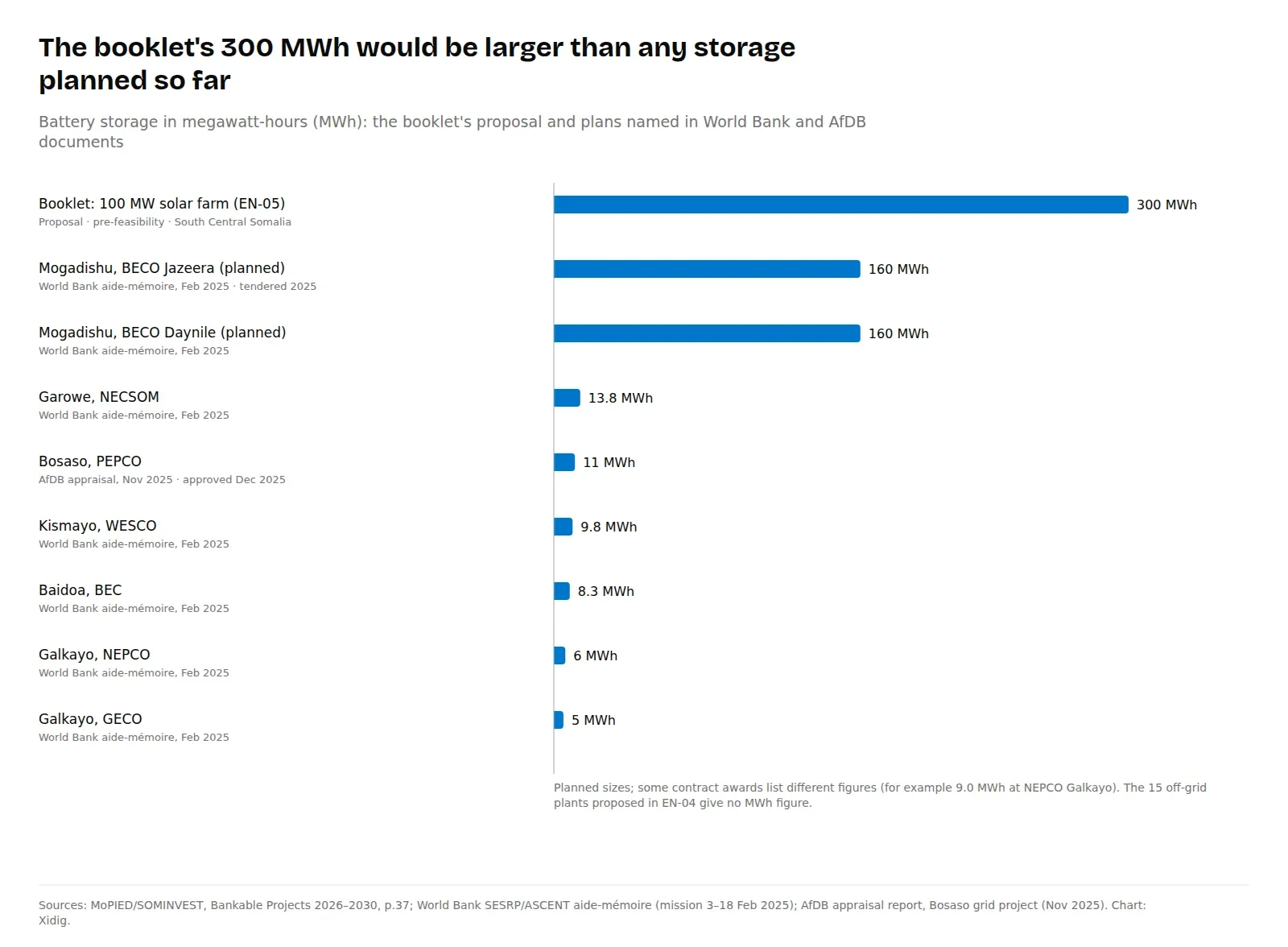
Planned battery storage in Somalia, and the government's proposal. Sizes are from planning documents; some contracts list different figures.
- Town providers (World Bank): a February 2025 World Bank mission listed proposed solar-and-battery projects at town providers, for example NECSOM in Garowe (10 MWp and 13.8 MWh, estimated at US$13.44M) and WESCO in Kismayo (6 MWp and 9.8 MWh, estimated at US$8.10M).
- Contracts awarded: by November 2025 four contracts had been awarded, covering 23.02 MWp of solar and 42.3 MWh of batteries in Baidoa, Galkayo and Garowe, and installation had begun.
- Mogadishu: the same mission listed two plants for BECO in Mogadishu, at Jazeera and Daynile, each 55 MWp with 160 MWh, estimated at US$45M. A tender for the Jazeera plant was issued in 2025. Xidig found no award.
- Bosaso: the African Development Bank's project, approved on 16 December 2025, includes a "BESS of 3 MW/11,000 kWh" with 7.15 MWp of solar.
- Differing figures: some sizes differ between documents. For example, the NEPCO Galkayo contract lists 9.0 MWh, not 6 MWh, and the awarded contracts total 42.3 MWh against 33.1 MWh in the plans for the same towns. Kismayo's environmental study describes 4.8 MW of solar and a 3.2 MW battery with no MWh figure.
How the government's proposals compare.
- Storage ratio: the proposed solar farm's (EN-05) ratio of storage to solar (3.0 MWh per MW) is similar to the BECO plans (2.9 MWh per MWp).
- Scale: its 300 MWh would be almost twice either BECO plant.
- Cost: by Xidig's arithmetic, the farm's US$132M cost (EN-05) for 100 MW works out to US$1.32M per MW, including 300 MWh of storage and a 120 km line. BECO's plans work out to about US$0.82M per MWp.
- Off-grid plants: the 15 off-grid plants (EN-04) give no battery size, so they cannot be compared.
Dependencies and implementation constraints
- Cooling and shade for battery rooms.
- Trained technicians and spare parts.
- A plan for replacing and disposing of batteries over the project's life.
- Import costs: the World Bank's regulatory scorecard records no duty exemption for mini-grid equipment.
Risks and unknowns
- Battery life in local heat: Xidig found no published measurements for Somali conditions.
- Size: the off-grid plants' battery size.
- Status of the BECO plants and the proposed farm's relation to them.
- Price swings in battery and shipping costs.
Questions members should verify before acting
- How large is the battery, in MWh, for each proposed plant?
- What cooling is planned?
- Who will maintain and replace the batteries, and when?
- Where will spent batteries go?
What is confirmed, and what isn't
Confirmed
- The storage figures in the government's proposals.
- Planned and awarded storage in World Bank and AfDB documents.
- Global cost and technology figures from NREL, the IEA, ESMAP and BloombergNEF.
Our interpretation
- EN-05's duration is similar to the BECO plans, and its scale is larger.
Not yet verified
- Awards for the BECO plants and Kismayo.
- The performance of installed batteries in Somalia.
Relevant next steps
- Follow the World Bank's electricity projects for battery procurement and training.
- Engineers: note your storage experience in Xidig so groups can find you.
More about the source
The government's investment booklet, Bankable Projects 2026–2030 (MoPIED / SOMINVEST), is one of the sources for this report. The details it gives are summarised here as printed.
-
Solar Plant and Battery Storage (EN-05, pp.37–38). "a 100 MW Solar farm with 300 MWh of battery storage system and a 120 km transmission-distribution line", with the Banadir Electricity Company (BECO). US$132M.
-
15 Off-Grid 5 MW Solar PV with Battery Storage (EN-04, pp.35–36). The title says 5 MW per plant, but the description says "15 MW Solar PV Power Plants". No battery size is given. US$75M.
-
Primary source: MoPIED / SOMINVEST, Bankable Projects 2026–2030, posted 19 Nov 2025. Fact sheets at PDF pp.35–38.
-
Stage: pre-feasibility on both sheets.
Related reports
- Solar power and battery storage in Somalia
- Solar installer and technician skills in Somalia
- Mini-grids in Somalia: how they work, how they're licensed and financed
- Heavy fuel oil or solar? Costs and emissions in context
About this report
By Xidig members and collaborators.
Project codes. Codes such as EN-04 or AG-05 are Xidig's own shorthand for the booklet's fact sheets, by sector; the booklet itself does not number its projects.
How we researched it. We read the full 97-page booklet and checked every figure, page reference and quotation used here against it. We then compared the booklet's claims with the official, international, academic and news sources listed below, and we say where they differ. We did not interview anyone for this report.
Corrections. If you spot an error, please tell us using the correction link on this page.
Sources
Primary
- MoPIED / SOMINVEST, Bankable Projects 2026–2030, PDF pp.35–38: https://sominvest.gov.so/bankable-projects-in-somalia-2026-2030/
Supporting
- NREL, Annual Technology Baseline 2024, utility-scale battery storage: https://atb.nrel.gov/electricity/2024/utility-scale_battery_storage
- IEA, Batteries and Secure Energy Transitions, executive summary (2024): https://www.iea.org/reports/batteries-and-secure-energy-transitions/executive-summary
- ESMAP / World Bank, Energy Storage for Mini Grids (2023): https://documents1.worldbank.org/curated/en/099121323112040367/txt/P1710100aea43a0ae0a038034d730b04087.txt
- ESMAP, Mini Grids for Half a Billion People (2022): https://www.esmap.org/sites/default/files/esmap-files/Mini%20Grids%20for%20Half%20a%20Billion%20People%20-%20OKR%20Download%20Version_compressed_MKA.pdf
- NREL (Lockhart et al.), Comparative Study of Techno-economics of Lithium-Ion and Lead-Acid Batteries in Micro-grids in Sub-Saharan Africa (June 2019): https://www.nrel.gov/docs/fy19osti/73238.pdf
- BloombergNEF, battery pack price survey (9 Dec 2025): https://about.bnef.com/insights/clean-transport/lithium-ion-battery-pack-prices-fall-to-108-per-kilowatt-hour-despite-rising-metal-prices-bloombergnef/
- Energy-Storage.News, "Battery storage system prices continue to fall sharply, BNEF and Ember reports find" (Dec 2025): https://www.energy-storage.news/battery-storage-system-prices-continue-to-fall-sharply-bnef-and-ember-reports-find/
- Energy-Storage.News, "Battery storage failure incident rate dropped 97% between 2018 and 2023" (16 May 2024): https://www.energy-storage.news/battery-storage-failure-incident-rate-dropped-97-between-2018-and-2023/
- UL Solutions, guide to battery energy storage compliance: https://www.ul.com/resources/your-guide-battery-energy-storage-regulatory-compliance
- GIZ-supported study by Knights Energy, Analysis of the Current Battery Ecosystem in Kenya (c. 2025): https://changing-transport.org/wp-content/uploads/2025_Battery-Ecosystem-in-Kenya.pdf
- World Bank, SESRP/ASCENT aide-mémoire, mission of 3–18 Feb 2025: https://documents1.worldbank.org/curated/en/099060225083542736/pdf/P181341-86c58d96-6d11-4f5f-9e0d-73c747f62dd0.pdf
- World Bank, SESRP Implementation Status and Results Report (4 Nov 2025): https://documents1.worldbank.org/curated/en/099110425105521326/pdf/P173088-768d0297-9765-4477-ab01-1aef8b51b2df.pdf
- TaiyangNews, "Somalia launches 55 MW solar, 160 MWh storage tender" (7 Feb 2025): https://taiyangnews.info/tenders/somalia-launches-55-mw-solar-160-mwh-storage-tender
- African Development Bank, "African Development Fund approves $23 million to boost clean energy access in Bosaso" (16 Dec 2025): https://www.afdb.org/en/news-and-events/press-releases/african-development-fund-approves-23-million-boost-clean-energy-access-bosaso-somalia-89735
- African Development Bank, Bosaso power grid project appraisal (Nov 2025): https://www.afdb.org/sites/default/files/documents/projects-and-operations/somalia_rehabilitation_and_expansion_of_bosaso_power_grid_and_strengthning_of_energy_sector_institutions_espsei.pdf
- Ministry of Energy and Water Resources, WESCO Kismayo ESIA (Nov 2024): https://moewr.gov.so/wp-content/uploads/2025/09/WESCO-ESIA-FINAL-REPORT.pdf
- Contract award listing, NEPCO Galkayo solar and storage: https://allbusiness.africa/contract-awards/so-design-supply-installation-testing-and-commissioning-of-43mwp-solar-power-plant-with-90-mwh-of-battery-storage-system-including-9km-of-33kv-evacuation-line-for-the-nepco-galkayo-pl-somalia-1150
Source notes
- Battery sizes differ between planning documents, tenders and awards; the chart uses the booklet, the February 2025 World Bank aide-mémoire and the AfDB appraisal.
- ESMAP, RISE Somalia country page (duty exemptions): https://rise.esmap.org/country/somalia