Seed systems in Somalia: where farmers' seed comes from and why it matters
Tusmada
- Summary
- Where Xidig members may contribute
- Possible services, research, supplier or collaboration roles
- Who may find this useful
- How seed reaches Somali farms
- Dependencies and implementation constraints
- Risks and unknowns
- Questions members should verify before acting
- What is confirmed, and what isn't
- Relevant next steps
- More about the source
- Related reports
- About this report
- Sources
Most seed is still saved on farm, a seed regulator only began work in 2025, and aid buyers dominate the market. Where the skills gaps are, and the government's seed proposal.
Not investment advice. Independent analysis of a government publication and other public sources. It is not an offer or a tender notice, and the Government of Somalia has not endorsed it.
Summary
Most Somali farmers still plant seed they saved or bought locally, and the formal seed system is only now taking shape. A seed law was signed in December 2024 and the regulator began formal operations in early 2025, so there is room for people who can test, breed, multiply and advise on seed. Agronomists, seed technologists, laboratory staff and extension workers are all scarce.
What Xidig found:
- Saved seed dominates. Certified seed covered only 6% of maize, 4% of sorghum and 22% of cowpea needs (2023 estimate).
- A small regulator. The regulator had nine inspectors (February 2025) and a laboratory with three staff that tested 71 seed samples in 2024.
- Few new varieties. Three stress-, heat- or drought-tolerant varieties were released in 2023–24, and there was no active maize breeder in 2024.
- Aid buyers dominate. NGOs account for between 58% and 63% of seed companies' sales of maize, sorghum and cowpea seed.
- Programmes are under way. World Bank, Green Climate Fund and African Development Bank programmes include support for the seed regulator and seed distribution.
The government has also proposed a hybrid seed business (US$0.7M) that names no crops, sites or buyers; details are under More about the source.
Where Xidig members may contribute
Skills, service and collaboration openings, not confirmed contracts or tenders:
- Seed technology and testing: laboratory methods, germination and purity testing, quality systems.
- Plant breeding and variety trials: Somalia had no active breeder in 2024.
- Extension: government had 30 extension officers, all men (TASAI, 2025).
- Farmer seed businesses: helping cooperatives become licensed seed producers.
Possible services, research, supplier or collaboration roles
- Remote mentoring for the national seed laboratory.
- A cooperative seed-multiplication pilot using a released variety.
- Research: tracking which varieties farmers in your area plant, and where they get the seed.
Who may find this useful
- Agronomists and plant breeders.
- Laboratory technicians.
- Agricultural extension workers.
- Farmer cooperatives in the Shabelle and Bay regions.
How seed reaches Somali farms
The farms.
- Maize: Shabelle is "Somalia's most important maize producing region, accounting for 51 percent of the total production in the southern region", mostly grown with furrow irrigation.
- Sorghum: it is "mainly grown in rain-fed conditions", led by Bay region, followed by Lower and Middle Shabelle.
- Rainfall: even among riverine farmers, about three-quarters of production is rain-fed (UNDP and FAO, 2024).
- Harvests swing widely:
- The 2025 Gu harvest in the south was 14% above average.
- The 2025/26 Deyr harvest was "the lowest deyr harvest ever recorded", 83% below average (FEWS NET, February 2026).
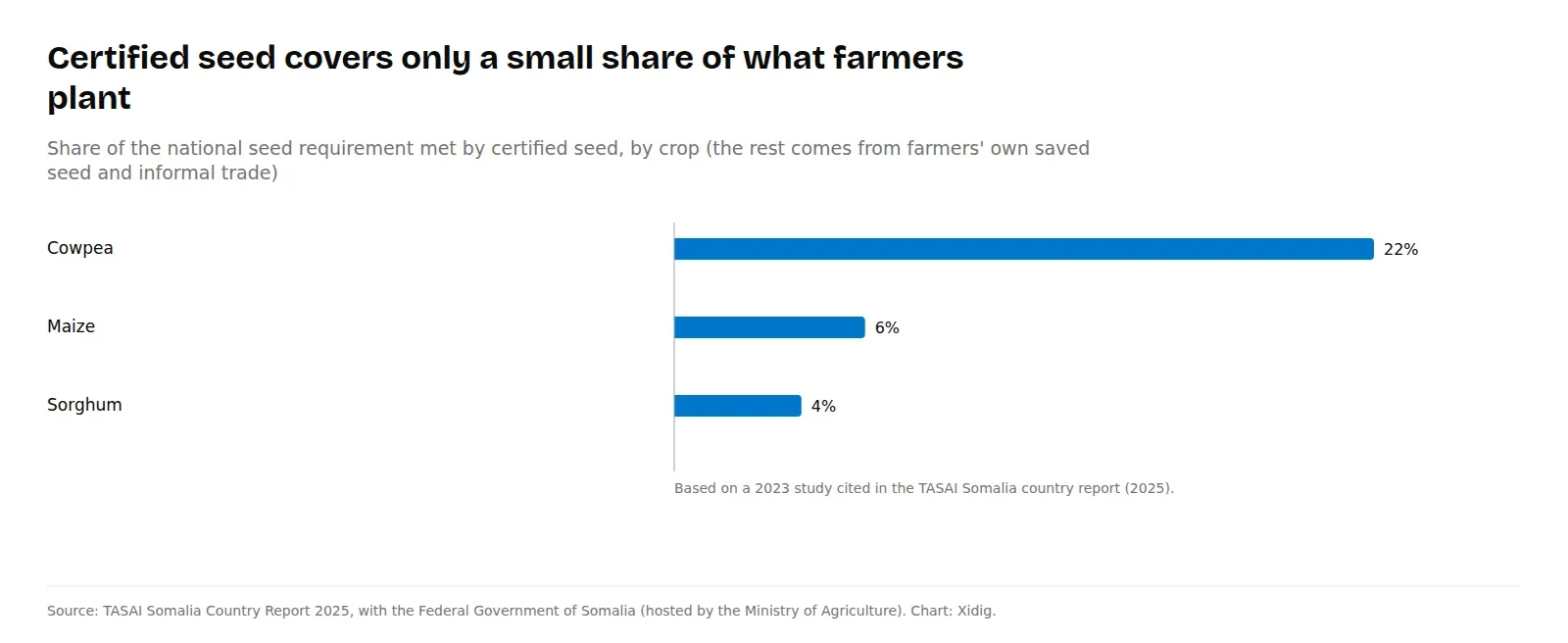
Certified seed covers only a small share of what farmers plant.
Where seed comes from. The main source for this section is the 2025 TASAI country report, prepared with the federal government.
- Informal seed: "94% of the national seed requirement for maize seed, 96%… sorghum… 78%… cowpea" comes from the informal system.
- Sales: in 2024, companies sold 1,184 tonnes of certified seed and 706 tonnes of uncertified seed.
- Companies: 14 of 15 registered seed companies produced and sold seed in 2024.
- Buyers: "NGOs are the main buyers of seed for maize, sorghum, and cowpea, accounting for between 58% and 63% of aggregate sales by seed companies."
The rules.
- The law: the Seed and Plant Varieties Law was signed on 24 December 2024.
- The regulator: the regulator (SARIS) was set up in 2019 but "only launched formal operations in early 2025". It had nine inspectors (February 2025) and a laboratory with three staff that tested 71 seed samples in 2024.
- Imports: they need test results and a phytosanitary certificate. There were "no recorded imports or exports of certified seed in 2024".
- Fake seed: seed companies reported 62 cases to the TASAI survey, while the government recorded three.
New varieties.
- Released 2023–24: three new varieties: Siman hybrid maize (2023, stress-tolerant), Machakos 66 cowpea (2024, heat-tolerant) and Gadam sorghum (2024, drought-tolerant and early-maturing).
- Most seed is old: most varieties sold by companies "have not gone through the official release process", and "nearly all varieties currently available to farmers… are old".
- Breeding: there was one active maize breeder in 2023 and none in 2024. Rehabilitation of the research centres at Bonkay and Afgooye is under way.
Prices.
- Maize (2024): hybrid maize seed cost about US$3 per kg and open-pollinated maize seed US$1.47 per kg. Maize grain sold for US$0.71 per kg (TASAI).
- Affordability: improved seed is "still expensive for most of the farmers to buy" (UNDP and FAO, 2024).
Programmes already under way.
- World Bank Food Systems Resilience Project (US$150M, plus US$30M additional financing): it includes strengthening the seed regulator and a seed systems policy.
- Green Climate Fund and FAO project, Ugbaad (US$94.9M, approved October 2024): it includes climate-resilient seed distribution. A 2025 ministry terms of reference required seed with "germination 85-95%, purity 99%".
- African Development Bank regional programme: it supports early-generation seed in Somalia and neighbouring countries.
What this means.
- The market: the proposed seed business would sell into a market led by aid buyers, with a new regulator and few released varieties.
- Its value: it would be most useful if it multiplied released, tested varieties and built sales to farmers directly.
Dependencies and implementation constraints
- Released varieties and a working certification system.
- Irrigation and reliable rains for seed multiplication.
- Buyers: demand beyond aid purchases.
- Staff: trained inspectors and lab staff.
Risks and unknowns
- Climate swings: harvests vary sharply between seasons.
- Aid-led demand may fall if funding falls.
- Fake or uncertified seed undercutting prices.
- Hybrids: they must be bought again each season, which may not suit all farmers.
Questions members should verify before acting
- Which varieties are released for your area?
- Who buys certified seed locally: farmers or aid agencies?
- Does the regulator have inspectors in your region?
- What do farmers pay for seed, and what do they get for grain?
What is confirmed, and what isn't
Confirmed
- The certified-seed shares (2023 estimate cited by TASAI), seed sales, prices and regulator capacity (TASAI, 2025).
- The 2023–24 variety releases.
- The seed law (December 2024).
- The World Bank and GCF programmes.
Our interpretation
- The seed business is most useful if it multiplies released varieties and sells to farmers directly.
Not yet verified
- The job and cost figures in the government's proposal.
- How widely farmers use new varieties.
Relevant next steps
- Follow the Ministry of Agriculture and Irrigation and the seed regulator for certification rules and tenders.
- Agronomists and lab specialists: note your skills in Xidig so groups can find you.
More about the source
The government's investment booklet, Bankable Projects 2026–2030 (MoPIED / SOMINVEST), is one of the sources for this report. The details it gives are summarised here as printed.
- Seed Production and Processing (AG-01, pp.13–14). "The project aims to introduce and enhance accessibility to high-quality hybrid seeds that offer higher yields and climate resilience in Somalia." It would create "144 jobs". US$0.7M; 5 years; private.
- Key drivers (p.14): "Limited access to high-quality seeds" and "The need to improve crop productivity and resilience".
The sheet does not say which crops, where the seed would be grown, or who would buy it.
- Primary source: MoPIED / SOMINVEST, Bankable Projects 2026–2030, posted 19 Nov 2025. Fact sheet at PDF pp.13–14.
- Promoters: SOMINVEST and the Ministry of Agriculture and Irrigation.
- Stage: pre-feasibility.
Related reports
- Seed, fodder, meat, dairy and poultry in Somalia
- Fodder, drought and herd survival in Somalia
- Skills map: which professional skills the 37 proposals would need
- Somalia's Bankable Projects 2026–2030, explained
About this report
By Xidig members and collaborators.
Project codes. Codes such as EN-04 or AG-05 are Xidig's own shorthand for the booklet's fact sheets, by sector; the booklet itself does not number its projects.
How we researched it. We read the full 97-page booklet and checked every figure, page reference and quotation used here against it. We then compared the booklet's claims with the official, international, academic and news sources listed below, and we say where they differ. We did not interview anyone for this report.
Corrections. If you spot an error, please tell us using the correction link on this page.
Sources
Primary
- MoPIED / SOMINVEST, Bankable Projects 2026–2030, PDF pp.13–14: https://sominvest.gov.so/bankable-projects-in-somalia-2026-2030/
Supporting
- TASAI, Somalia Country Report 2025 (June 2025), with the Federal Government of Somalia: https://moa.gov.so/wp-content/uploads/2025/10/Som_2025_en_country-report_Jun2025_web.pdf
- UNDP / FAO (SCALA), Sorghum, Maize and Sesame Value Chains in Somalia (Mar 2024): https://www.undp.org/sites/g/files/zskgke326/files/2024-04/scala20somalia20report-final-15mar_0.pdf
- FSNAU, 2025 Post-Gu IPC findings (23 Sep 2025): https://fsnau.org/downloads/Somalia_2025_Post_Gu_IPC_Analyses_Findings_and_Recommendations_Final_23_Sep_2025.pdf
- FEWS NET, Somalia Food Security Outlook (Feb 2026): https://fews.net/east-africa/somalia/food-security-outlook/february-2026
- SATG, "Siman hybrid: revolutionizing maize farming for prosperity in Somalia": https://satg.org/siman-hybrid-revolutionizing-maize-farming-for-prosperity-in-somalia/
- World Bank, Food Systems Resilience Project aide-mémoire (Jul 2025): https://documents1.worldbank.org/curated/en/099120125232636873/pdf/P177816-64ffc2de-3518-4695-99f1-65e8540fa6fc.pdf
- Green Climate Fund, FP246: https://www.greenclimate.fund/portfolio/projects/fp246
- Ministry of Agriculture and Irrigation, certified seed procurement terms of reference (2025): https://moa.gov.so/terms-of-reference-for-consulting-services-for-procurement-and-delivery-of-certified-seed-delivery-services-to-the-ministry-of-agriculture-and-irrigation-moai-and-federal-member-states-fms/
- African Development Bank, on early warning and seed production in East Africa (Mar 2026): https://www.afdb.org/en/news-and-events/afdb-backed-initiative-enhances-early-warning-systems-and-seed-production-east-africa-91803
Source notes
- The number of registered seed companies differs between sources (14–18), depending on date and definition.