Skills map: which professional skills the 37 proposals would need
Tusmada
- Summary
- Where Xidig members may contribute
- Possible services, research, supplier or collaboration roles
- Who may find this useful
- What the sheets say about skills
- The skills map
- Dependencies and implementation constraints
- Risks and unknowns
- Questions members should verify before acting
- What is confirmed, and what isn't
- Relevant next steps
- More about the source
- Related reports
- About this report
- Sources
Construction, power and plant-maintenance skills recur most often across Somalia's 37 proposed projects. Where the local gaps are, and where diaspora and local professionals fit.
Not investment advice. Independent analysis of a government publication. It is not a job listing, and the Government of Somalia has not endorsed it.
Summary
Big infrastructure and industry projects need people to design, build, run and maintain them, and some of the skills involved are scarce in Somalia today. Xidig read all 37 fact sheets in the government's Bankable Projects 2026–2030 booklet and grouped the professional skills each project would need.
What Xidig found:
- Most common: civil engineering and construction (17 sheets), then electrical, solar and power systems (9) and plant operation and maintenance (9).
- Needed everywhere: project management, procurement, and finance and legal skills. 27 sheets tick public–private partnership (PPP), so PPP and contract expertise would be needed across sectors.
- Thin locally: Xidig found little or no in-country training for refrigeration, ship repair or biomedical equipment maintenance. Those are gaps the projects would expose, and where diaspora professionals could teach.
This is Xidig's reading, not the booklet's own list: the sheets rarely name skills directly, and all 37 projects are at pre-feasibility stage.
Where Xidig members may contribute
Skills and collaboration openings, not job offers:
- Teach what's missing: refrigeration, ship repair, biomedical maintenance and solar upkeep have little or no local training.
- Review and design: diaspora engineers can review feasibility work, often remotely.
- Mentor local firms preparing bids for donor-funded tenders.
- Short placements for specialists, such as clinicians, marine engineers or plant operators, alongside local staff.
Possible services, research, supplier or collaboration roles
- A member skills register, so project groups can find the people they need.
- Short courses tied to real projects: solar maintenance, cold-chain equipment and welding (see Cold chain for fish, milk and meat in Somalia).
- Research: checking the booklet's job figures against what each project would actually need.
Who may find this useful
- Engineers of every discipline.
- Technicians and trades: electricians, welders, refrigeration and plant operators.
- Clinicians and biomedical engineers.
- Teachers and TVET trainers.
- Finance, procurement and legal professionals.
- Students choosing a field of study.
What the sheets say about skills
Only a few sheets mention skills or training directly:
- Education (ED-01, pp.83–84) calls for "harmonization of Technical and Vocational Education and Training (TVET) programs with industry requirements".
- Dry dock (LI-06, pp.61–62) aims to "Provide local repair services, reducing reliance on Dubai and Mombasa".
- Referral hospitals (HE-03, p.79) list "Medical Training Institutions" as existing infrastructure.
- Fisheries (FI-01, pp.44–45) proposes modernising fishing practices as well as vessels.
Most sheets give job numbers instead, such as "Create 400 new jobs" for the regional airports (AV-01) or "around 165 jobs" for the gas plant (EN-02). None of them say what kind of jobs, or where the skilled staff would come from.
The skills map
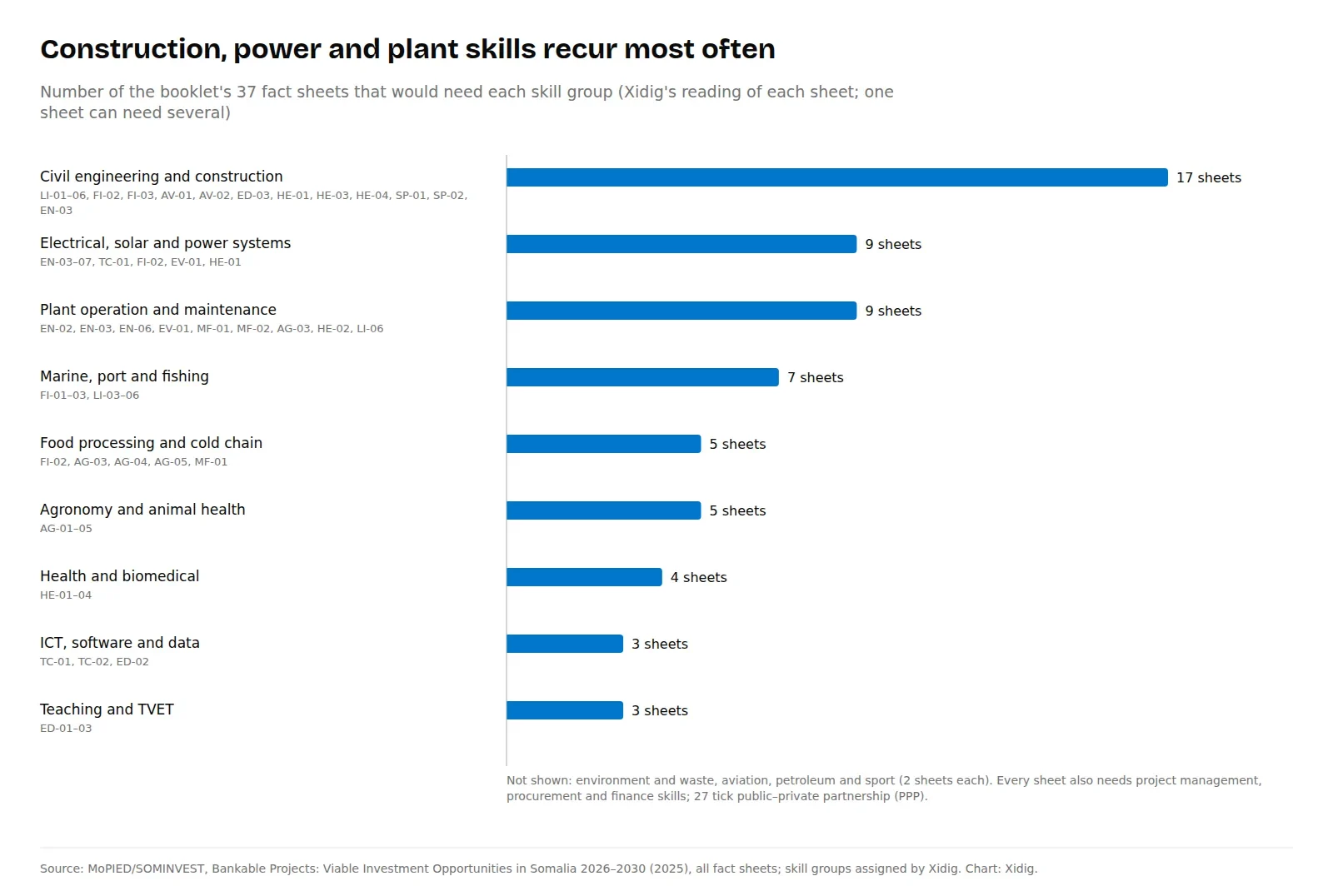
How many of the 37 sheets would need each skill group, in Xidig's reading. One sheet can need several groups.
| Skill group | Sheets | Examples from the booklet | Local gap found |
|---|---|---|---|
| Civil engineering and construction | 17 | Roads and corridors (LI-01, LI-02), ports (LI-03, LI-05), jetties (LI-04), airports (AV-01, AV-02), schools (ED-03), hospitals (HE-01, HE-03), stadiums (SP-01, SP-02) | At least one donor-funded road, Beledweyne–Kalabayr, went to tender in September 2026. |
| Electrical, solar and power systems | 9 | HFO plants (EN-03), 15 off-grid solar plants (EN-04), solar farm (EN-05), panel factory (EN-06), SONEC (EN-07), hospital "Energy systems" (HE-01) | World Bank projects are bringing solar and batteries to hundreds of health and school sites, which will need upkeep. |
| Plant operation and maintenance | 9 | Gas plant (EN-02), waste-to-energy (EV-01), cooking oil (MF-01), PET preforms (MF-02), pharmaceuticals (HE-02), dry dock (LI-06) | Few of these plant types exist yet in Somalia. |
| Marine, port and fishing | 7 | Vessels (FI-01), hubs (FI-02), fishing ports (FI-03), seaports (LI-03, LI-05), dry dock (LI-06) | Xidig found no ship-repair yard in Somalia. |
| Food processing and cold chain | 5 | Fish hubs (FI-02), meat (AG-03), dairy (AG-04), poultry (AG-05), cooking oil (MF-01) | Xidig found no in-country refrigeration technician course. |
| Agronomy and animal health | 5 | Seed (AG-01), fodder (AG-02), meat (AG-03), dairy (AG-04), poultry (AG-05) | — |
| Health and biomedical | 4 | Regional hospitals (HE-01), pharmaceuticals (HE-02), referral hospitals (HE-03), cancer centre (HE-04) | A 2024 WHO report cites a 2014 estimate of "just 4 nurses and 1 midwife per 20 000 people". |
| ICT, software and data | 3 | Connectivity (TC-01), e-government and data centres (TC-02), digital learning (ED-02) | — |
| Teaching and TVET | 3 | Alternative pathways (ED-01), digital learning (ED-02), new schools (ED-03) | — |
Four smaller groups appear on two sheets each: environment and waste (EV-01, MF-02), aviation (AV-01, AV-02), oil and gas regulation (EN-01, EN-02) and sport (SP-01, SP-02).
Skills every sheet needs. Project management, procurement, finance and contract law apply to all 37. With PPP ticked on 27 sheets, people who understand PPP structuring, concessions and lender requirements would be needed across sectors.
Dependencies and implementation constraints
- Proposals must go ahead before most of these skills are needed, and all 37 are at pre-feasibility stage.
- Recognition of qualifications and professional licensing in Somalia.
- Security and travel for diaspora professionals working on site.
Risks and unknowns
- Interpretation: the grouping is Xidig's reading, not the booklet's.
- Job numbers on the sheets are unsourced and don't specify skills.
- Timing: skills trained too early may leave before projects start.
Questions members should verify before acting
- Which of these proposals is actually moving forward, with a tender or partner?
- Which local training centres already teach the skill you have?
- Is your qualification recognised in Somalia for the work you'd do?
- Could you contribute remotely, or does the work need you on site?
What is confirmed, and what isn't
Confirmed
- The sheets quoted above and their wording.
- 27 sheets tick public–private partnership.
Our interpretation
- The skill groups and counts in the chart and table.
- Construction, power and plant maintenance are the most widely needed skills.
Not yet verified
- Actual staffing needs for any proposal.
- The full list of TVET courses available in Somalia today.
Relevant next steps
- Add your skills and location to Xidig so project groups can find you.
- Read the sector report for your field (see Related reports).
- Training providers: consider pairing with members to run a short course in a gap area.
More about the source
- Primary source: MoPIED / SOMINVEST, Bankable Projects 2026–2030, posted 19 Nov 2025. All 37 fact sheets, PDF pp.13–95.
- Method: Xidig read each sheet's description, key drivers and existing infrastructure, then assigned the skill groups a project of that kind would need. Where a sheet names a skill or facility, it is quoted above.
- Stage: all 37 sheets are at pre-feasibility stage.
Related reports
- Somalia's Bankable Projects 2026–2030, explained
- Digital learning, adult literacy and TVET in Somalia
- Cold chain for fish, milk and meat in Somalia
- Reading the jobs numbers in the booklet
- TVET and industry: where professionals can help
About this report
By Xidig members and collaborators.
Project codes. Codes such as EN-04 or AG-05 are Xidig's own shorthand for the booklet's fact sheets, by sector; the booklet itself does not number its projects.
How we researched it. We read the full 97-page booklet and checked every figure, page reference and quotation used here against it. We then compared the booklet's claims with the official, international, academic and news sources listed below, and we say where they differ. We did not interview anyone for this report.
Corrections. If you spot an error, please tell us using the correction link on this page.
Sources
Primary
- MoPIED / SOMINVEST, Bankable Projects 2026–2030, PDF pp.13–95: https://sominvest.gov.so/bankable-projects-in-somalia-2026-2030/
Supporting
- WHO EMRO, Understanding the private health sector in Somalia (2024): https://applications.emro.who.int/docs/9789292742041-eng.pdf
- UNIDO, HCFC phase-out management plan, stage II preparatory concept note (reports refrigeration technicians trained abroad in stage I): https://downloads.unido.org/ot/24/28/24287426/1.%20Somalia%20-%20HPMP%20Stage%20II%20-%20preparatory%20funding%20-%20concept.pdf
- Dawan Africa, "Somalia opens tender for 22-km Beledweyne–Kalabayr road" (4 Sep 2026): https://www.dawan.africa/news/somalia-opens-tender-for-22-km-beledweyne-kalabayr-road
- World Bank, SESRP Implementation Status & Results Report, sequence 9 (May 2026): https://documents1.worldbank.org/curated/en/099052026102521532/txt/P173088-3c537d88-c73c-4bac-b9df-dbccdff162bd.txt