Digital learning, adult literacy and TVET in Somalia
Tusmada
- Summary
- Where Xidig members may contribute
- Possible services, research, supplier or collaboration roles
- Who may find this useful
- Literacy, schooling and training today
- Geographic context
- Dependencies and implementation constraints
- Risks and unknowns
- Questions members should verify before acting
- What is confirmed, and what isn't
- Relevant next steps
- More about the source
- Related reports
- About this report
- Sources
Literacy, out-of-school children and teacher shortages, the programmes already working on them, where members can help, and the education proposals on the government's list.
Not investment advice. Independent analysis of a government publication; not a tender, job or funding notice.
Summary
Somalia's 2022 household survey found 53.7% of people aged 15 and over are literate, falling to 20.5% among nomadic households. The Ministry of Education's partners put the number of out-of-school children at more than 4 million, and only about a quarter of primary-age children attend primary school. For members, the most useful roles are teaching, content creation in Somali, TVET partnerships and education technology that works offline.
What Xidig found:
- Large programmes are already working on this. GPE grants total about US$152M for 2023–2028, the World Bank's Rajo Kaaba project provides US$52M for girls' education and skills training, and a German-funded TVET project ran from 2018 to 2024.
- Distance learning has a track record. An interactive radio programme reached over 330,000 children in 2005–2011, and the ministry ran TV and radio lessons during COVID-19.
- Qualified teachers are scarce. Only about one in three primary teachers is considered qualified, and primary pupil–teacher ratios range from 32:1 to 60:1.
The government has also proposed second-chance pathways with TVET (US$27.44M), digital and offline learning under the name ALFA (US$21.0M) and a large school-building programme (US$298.0M), all at pre-feasibility stage; details are under More about the source.
Where Xidig members may contribute
These are learning and collaboration opportunities, not confirmed jobs or contracts.
- Teaching and mentoring: adult literacy, numeracy and vocational skills, in person or remotely.
- Content: Somali-language lessons for radio, audio players and apps. The offline tools in the government's proposal need content.
- TVET partnerships: employers and professionals helping align courses with real job needs, which is the government proposal's own stated aim.
- Education technology: low-bandwidth and offline-first learning tools, built with data-protection rules in mind.
Possible services, research, supplier or collaboration roles
- Producing and testing audio and radio lessons with learners.
- Short courses designed with TVET centres and local employers.
- Research on which learners are reached by radio and offline tools, especially nomadic and displaced learners, who have the lowest literacy.
Who may find this useful
- Teachers and trainers.
- Education NGO staff.
- Employers who hire skilled trades.
- Somali-language writers, voice artists and producers.
- Software developers interested in education.
- Students and parents.
Literacy, schooling and training today
Literacy.
- The 46.3% figure: the adult illiteracy rate cited in the government's proposal matches the Somali National Bureau of Statistics' 2022 Integrated Household Budget Survey, which found "just over half of the population (53.7 percent) is literate". That survey covers people aged 15 and over, not "adults more than 25" as the booklet says.
- Gaps within the figure: literacy is 63.6% for men and 45.3% for women. By setting it is 60.9% in urban areas, 49.1% in rural areas and 20.5% among nomadic households.
- Older baseline: the 2014 population estimation survey put adult literacy at 40%.
Children out of school.
- Numbers: a 2024 GPE programme document states that "more than 4 million" children are out of school, and puts primary gross enrolment at 32% (22% for girls) in the Federal Member States (EMIS 2022).
- Attendance: the 2022 household survey found "only about a quarter (25.0 percent) of all primary school aged children in Somalia attend primary school", falling to 14.6% at secondary level.
Teachers.
- Ratios: the Ministry's Education Sector Strategic Plan 2022–2026 reports primary pupil–teacher ratios ranging "from a low of 32:1 to 60:1".
- Numbers and qualifications: GPE documents count around 17,675 primary teachers, "only 1 in 3" of them considered qualified.
- The 35:1 standard: Xidig found no source for the "recommended 35:1" the booklet cites.
Distance learning has a track record.
- Radio lessons: a US-funded interactive radio programme (2005–2011) "reached over 330 thousand children in grades 1 through 5".
- During COVID-19: the Ministry ran lessons on national TV and radio and distributed "more than 17,300 radios". About 17,800 students used an online platform.
- ALFA: the name of the government's proposed digital-learning programme, Accessible Learning for All, does not appear in any other source Xidig found.
TVET and funding already in place.
- TVET centres: the sector plan reports "over 8,700 trainees" across "58 TVET centers" in the southern part of the country in 2020.
- Germany: GIZ ran a €25.6M TVET rehabilitation project from 2018 to 2024, with EU co-financing.
- World Bank: its Rajo Kaaba project, approved in 2022, provides US$52M (a US$25M IDA grant and US$27M from trust funds) for girls' education and skills training.
- GPE: a System Transformation Grant of US$79.66M and a Girls' Education Accelerator of US$25M; the federal shares are US$60.76M and US$18.76M. GPE's total of about US$152M for 2023–2028 also covers Somaliland and the GPE Multiplier.
Geographic context
All three proposals are national, so no map is included. The evidence points to rural and nomadic areas as the biggest gaps: literacy is 20.5% among nomadic households against 60.9% in urban areas (SNBS, 2022).
Dependencies and implementation constraints
- Teachers: new schools need trained teachers. Only about one in three primary teachers is considered qualified.
- Content in Somali: needed for any digital or offline tool.
- Power and connectivity in rural areas. See Solar power and battery storage in Somalia and Connectivity, e-government and data centres in Somalia.
- Coordination with the ministry's sector plan and with GPE, World Bank and EU programmes already funded.
- Finance: PPP is ticked on all three sheets, but no partner or funding is named. PPP models for public schools are uncommon.
Risks and unknowns
- Infrastructure costing: "thousands" of schools plus labs, TVET centres and campuses for US$298.0M implies low unit costs. The proposal gives no breakdown.
Questions members should verify before acting
- Is ALFA a new programme, or a name for existing distance-learning work?
- How do these proposals fit the Ministry's next sector plan after 2026?
- Which TVET centres and trades would the pathways proposal support?
- Is there a current call for partners? Check the Ministry of Education and the GPE and World Bank programme pages.
What is confirmed, and what isn't
Confirmed
- The three proposals, their printed costs and status.
- SNBS literacy figures (2022).
- Out-of-school and attendance figures (GPE and SNBS).
- The pupil–teacher ratio range (sector plan).
- GPE, GIZ and World Bank programmes.
- Radio learning history.
Our interpretation
- Offline, Somali-language content and trained teachers are the binding constraints.
- These are where members can help.
Not yet verified
- The ALFA name.
- The 35:1 standard.
- The infrastructure breakdown and unit costs.
Relevant next steps
- Teachers and content creators: look at the Ministry's and partners' calls for Somali-language learning materials.
- Employers: consider offering placements or advising TVET centres on skills needs.
More about the source
The government's investment booklet, Bankable Projects 2026–2030 (MoPIED / SOMINVEST), is one of the sources for this report. The details it gives are summarised here as printed.
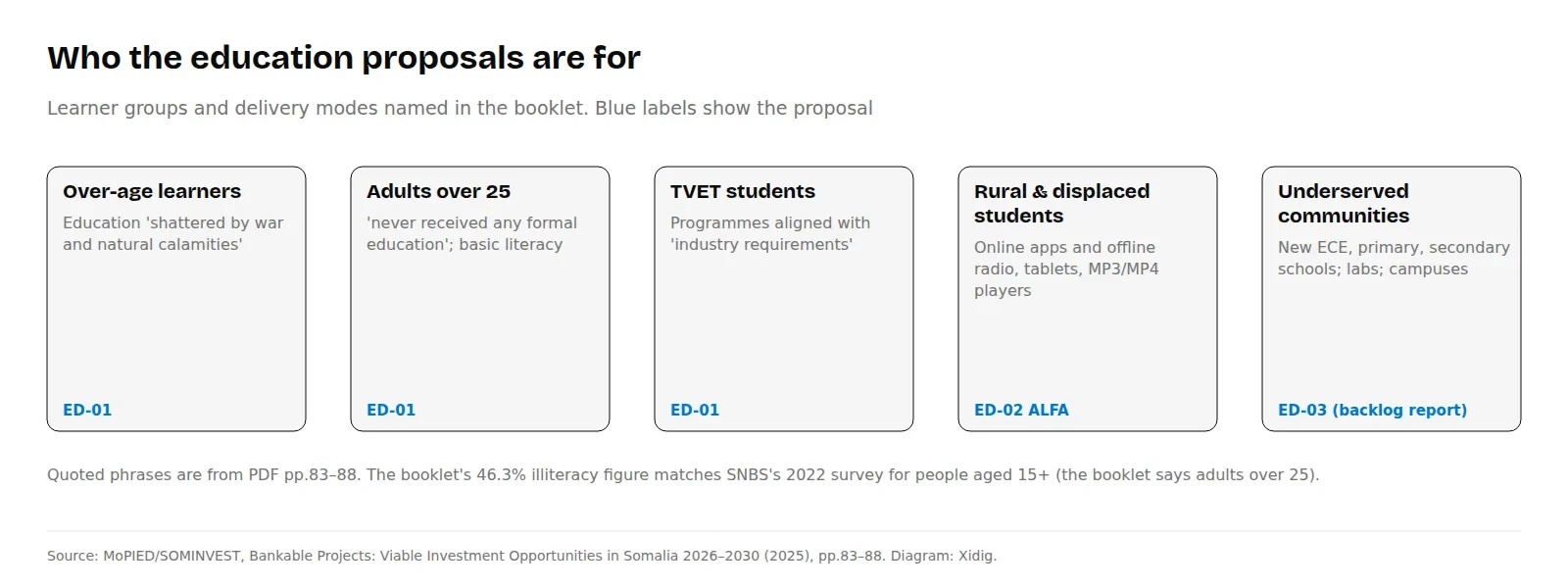
Who each education proposal is aimed at.
Alternative Education Pathways and Skill Development (ED-01, pp.83–84).
- Who: "over aged learners whose education was shattered by war and natural calamities", and "adults more than 25 years who have never received any formal education".
- What: "harmonization of Technical and Vocational Education and Training (TVET) programs with industry requirements".
- Key driver: "High adult illiteracy rate (46.3%)".
- Estimates: US$27.44M; 5 years.
Accessible Learning for All (ALFA): Digitalising Education (ED-02, pp.85–86).
- What: "online learning (apps/web based) and offline learning (radio/tablets)".
- Key drivers: "Rural and displaced students are especially affected by the lack of digital tools" and "Offline tools (preloaded MP3/MP4 players) offer a scalable, low-cost alternative for remote areas without internet".
- Existing infrastructure cited: "Partnerships with GPE and the Private Sector" and the "Data Protection Authority (DPA) for regulatory framework".
- Estimates: US$21.0M; 2 years.
New Education Infrastructure Development (ED-03, pp.87–88).
- What: "thousands of new ECE, primary, and secondary schools, 12 TVET centres, 1065 labs, 7 teacher training facilities, and 3 new university campuses across all regions".
- Key driver: "Student-to-teacher ratios far exceed the recommended 35:1".
- Estimates: US$298.0M; 4.5 years.
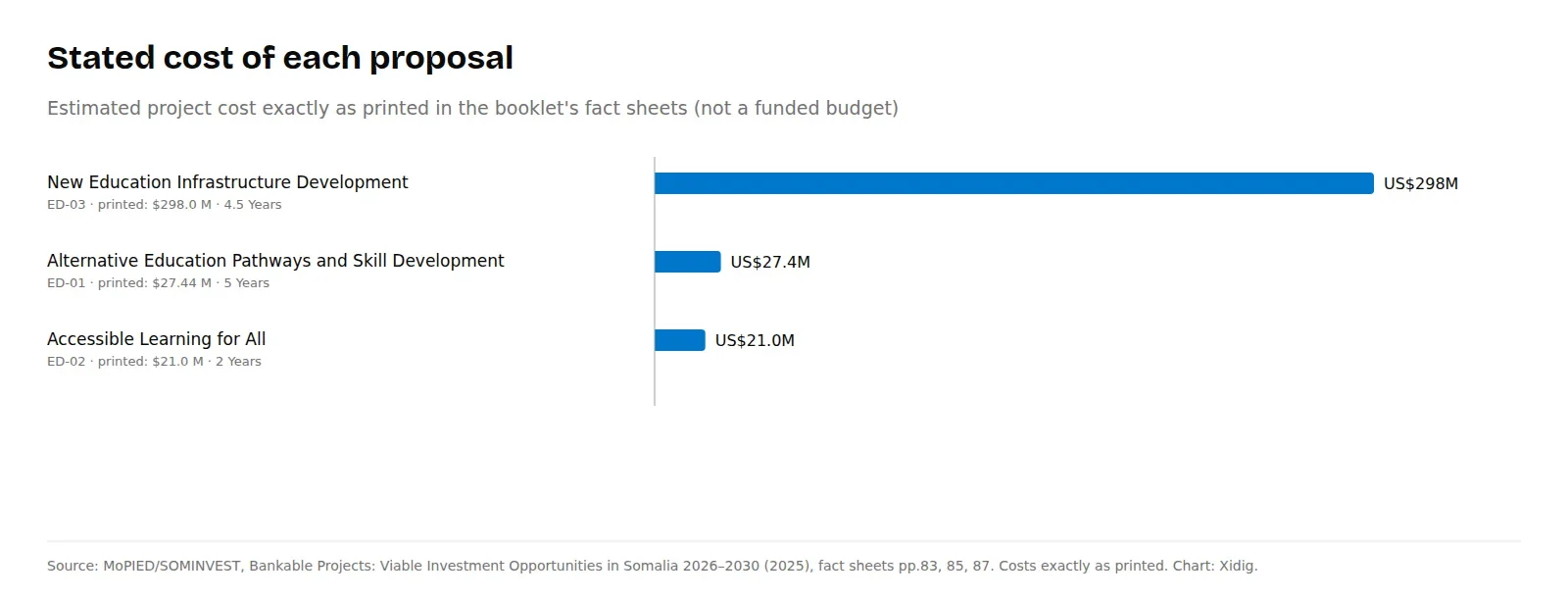
Estimated costs as printed. They are not approved or funded budgets.
- Primary source: MoPIED / SOMINVEST, Bankable Projects 2026–2030, posted 19 Nov 2025. Education section, PDF pp.83–88.
- Promoters: SOMINVEST and the Ministry of Education, Culture and Higher Education.
- Status: pre-feasibility on all three sheets.
Related reports
- Somalia's Bankable Projects 2026–2030, explained
- Connectivity, e-government and data centres in Somalia
- Hospitals, medicines and cancer care in Somalia
- Offline learning: radio, preloaded players and tablets
- TVET and industry: where professionals can help
- What it costs to build schools in Somalia
About this report
By Xidig members and collaborators.
Project codes. Codes such as EN-04 or AG-05 are Xidig's own shorthand for the booklet's fact sheets, by sector; the booklet itself does not number its projects.
How we researched it. We read the full 97-page booklet and checked every figure, page reference and quotation used here against it. We then compared the booklet's claims with the official, international and news sources listed below, and we say where they differ. We did not interview anyone for this report. Where the booklet's figures are unclear, we reproduce them as printed and explain the issue in the notes.
Corrections. If you spot an error, please tell us using the correction link on this page.
Sources
Primary
- MoPIED / SOMINVEST, Bankable Projects 2026–2030, PDF pp.83–88: https://sominvest.gov.so/bankable-projects-in-somalia-2026-2030/
Supporting
- Somali National Bureau of Statistics, Somalia Integrated Household Budget Survey 2022 (Feb 2023): https://nbs.gov.so/wp-content/uploads/2023/07/SOMALIA-INTEGRATED-HOUSEHOLD-BUDGET-SURVEY.pdf
- SNBS / UNFPA, Educational Characteristics of the Somali People (PESS 2014), Vol. 3 (2016): https://nbs.gov.so/wp-content/uploads/2023/07/Educational-Characteristics-of-the-Somali-People-%E2%80%93-Volume-3.pdf
- Ministry of Education, Culture and Higher Education, Education Sector Strategic Plan 2022–2026: https://web.archive.org/web/20260119112459/https://moe.gov.so/wp-content/uploads/2022/07/ESSP-2022-2026.pdf
- Global Partnership for Education, System Transformation Grant program document (Jan 2024): https://www.globalpartnership.org/node/document/download?file=document%2Ffile%2F2024-03-program-document-system-transformation-grant-federal-government-somalia.pdf
- GPE, "Somalia: giving more children the opportunity to learn during emergencies" (Jan 2022): https://www.globalpartnership.org/results/country-journeys/somalia-giving-more-children-opportunity-learn-during-emergencies
- GIZ, "Rehabilitation of Technical and Vocational Education and Training (TVET) in Somalia": https://www.giz.de/en/projects/rehabilitation-technical-and-vocational-education-and-training-tvet-somalia
- World Bank, "$52 million to increase access to education and skills training" (27 Jul 2022): https://www.worldbank.org/en/news/press-release/2022/07/27/somalia-world-bank-provides-an-additional-52-million-to-increase-access-to-education-and-skills-training-for-30-000-girl
- EDC, Somali Interactive Radio Instruction Program: https://www.edc.org/sites/default/files/EDC-Education-Fragility-Series-Somalia-SIRIP.pdf
- CIPIT (Strathmore University), Somalia Data Protection Act 2023: https://cipit.strathmore.edu/ushering-in-a-new-dawn-for-data-protection-unpacking-the-somalia-data-protection-act-of-2023/