Hospitals, medicines and cancer care in Somalia
Tusmada
- Summary
- Where Xidig members may contribute
- Possible services, research, supplier or collaboration roles
- Who may find this useful
- Health workers, hospitals and medicines today
- Geographic context
- Dependencies and implementation constraints
- Risks and unknowns
- Questions members should verify before acting
- What is confirmed, and what isn't
- Relevant next steps
- More about the source
- Related reports
- About this report
- Sources
Few health workers, limited cancer care and a medicines bill in progress. Where diaspora health professionals fit, and the four health proposals on the government's list.
Not investment advice, and not medical advice. Independent analysis of a government publication; not a tender, job or funding notice.
Summary
Somalia has very few health workers per person, and patients still travel abroad for specialist care. For members, and especially diaspora health professionals, the durable roles are in training, specialist clinical support, medicines quality and health data, always through recognised institutions and with the right licences.
What Xidig found:
- The workforce is small. The latest World Bank data show 0.048 physicians per 1,000 people (2014) and 0.87 hospital beds per 1,000 (2019). Most secondary and tertiary care is provided privately.
- Cancer care is limited. A report based on 2023 fieldwork found no cancer treatment available at the two Mogadishu hospitals it assessed. The President said in February 2025 that 100 to 150 people leave the country by plane for medical treatment every day.
- Medicines regulation is arriving. An interim medicines regulator was set up in 2023, and a Medicines Bill passed the House of the People in January 2026, still needing Upper House approval and presidential assent at that point.
- Programmes are under way. World Bank, WHO and UNOPS projects cover hospital rehabilitation and emergency care; as of July 2025, UNOPS listed six hospitals for rehabilitation.
The government has also listed four early-stage health proposals: 18 regional hospital upgrades (US$95M), eight referral hospitals (US$230.6M), local medicine production (US$11M) and a cancer centre (US$50M). Their sheets contain copy errors and claims other sources contradict; details are under More about the source.
Where Xidig members may contribute
These are learning opportunities first. Health is a regulated field, and any clinical role needs the right licences.
- Training and mentoring: diaspora doctors, nurses and pharmacists supporting training programmes, through recognised institutions.
- Specialist support: oncology, radiology and emergency care expertise, for example through tele-consultation arranged with hospitals.
- Medicines quality: pharmacists and regulatory specialists supporting quality assurance as the new medicines law comes in.
- Health data: analysts helping improve basic health statistics, which are badly out of date.
Possible services, research, supplier or collaboration roles
- Continuing professional education in partnership with hospitals and training institutions.
- Biomedical equipment maintenance.
- Research on the cost and scale of travel abroad for treatment. Xidig found no authoritative estimate.
Who may find this useful
- Doctors, nurses, midwives and pharmacists, in Somalia and in the diaspora.
- Health managers and hospital administrators.
- Public-health researchers and students.
- Families trying to understand what care is available locally. This report is not a guide to current services, which change; check directly with hospitals or the Ministry of Health.
Health workers, hospitals and medicines today
Workforce and facilities.
- Doctors and beds: World Bank data (latest available) shows 0.048 physicians per 1,000 people (2014) and 0.87 hospital beds per 1,000 (2019).
- Nurses and midwives: a 2024 WHO report cites a 2014 estimate of "just 4 nurses and 1 midwife per 20 000 people".
- Spending: current health spending was about US$22 per person in 2023. About 31% of it was paid out of pocket, down from 47% in 2020 (World Bank).
Who provides care. The Ministry of Health's Health Sector Strategic Plan 2022–2026 says "most of the tertiary and secondary level centres are provided by the private sector". WHO (2024) puts the private sector's share at "about 80% of all curative care services".
Referral hospitals.
- The government's claim: that Mogadishu has "the country's only existing referral hospital".
- The Ministry's description: the Ministry of Health's website described Banadir Hospital in Mogadishu as "a referral hospital for the entire country" (page archived in December 2022). Mogadishu also has the Turkish-built Recep Tayyip Erdoğan hospital, described as a tertiary centre with 24 specialties.
- Other referral and regional hospitals: in September 2023 WHO described a World Bank-funded project to strengthen emergency services at "federal and state referral hospitals". As of July 2025, UNOPS listed six hospitals for rehabilitation: Bay, Bosaso, Forlanini (in Mogadishu), the Galmudug Regional Referral Hospital, Jowhar and Kismayo. A regional referral hospital in Galmudug also sits uneasily with the proposal's "only existing referral hospital".
Cancer care and travel abroad.
- Mogadishu: a medical-information report published in February 2025, based on fieldwork at two Mogadishu hospitals from 29 October to 10 November 2023, found "no cancer treatment available at the two hospitals" it assessed, and "only very limited access to chemotherapy".
- Somaliland: a study dated 30 November 2023 notes that Somaliland "has no radiotherapy services".
- Travel abroad: at the opening of a new Mogadishu hospital in February 2025, the President said "100 to 150 individuals leave the country by plane for medical treatment" every day.
- The cancer-centre figure: Xidig found no authoritative estimate for the government proposal's "over US$100 million annually" (p.80).
Medicines.
- Supply: WHO (2024) reports that "about 60–80% of the country's medicines are imported and distributed by the private sector". This is the closest authoritative figure to the booklet's 70% claim, but it measures private supply, not import share alone. AUDA-NEPAD (December 2024) reports that "approximately 70% of medicines procured by the private sector are unregulated". That may be the source of the booklet's 70%, but it is about regulation, not imports.
- Regulation: Somalia set up an Interim National Medicines Regulatory Authority in 2023. Its Medicines Bill passed the House of the People in January 2026; at that point it still needed Upper House approval and presidential assent. A directive announced in December 2024 introduced import controls and pre-shipment inspection to keep out "substandard and falsified products".
Programmes already under way.
- Damal Caafimaad: a World Bank health services project approved in 2021 (originally US$100M, including a US$75M IDA grant; US$104.25M in total after a 2025 restructuring, which also moved its closing date to June 2026). A September 2026 review discussed a next phase.
- Hospital rehabilitation and emergency care: the UNOPS and WHO work above.
- Hodan Hospital: a US$12M hospital opened in February 2025, alongside an announced plan for six hospitals over five years.
Geographic context
None of the four proposals names its sites, so no map is included. The Ministry of Health launched a national Master Health Facility List in August 2026, with WHO support. It may become the best public source on where facilities are.
Dependencies and implementation constraints
- Health workers: new hospitals need doctors, nurses and technicians, and the workforce is small.
- Regulation: medicine production depends on the medicines law being completed, and on quality standards.
- Power, water and equipment maintenance for hospitals.
- Financing model: PPP is ticked on three sheets. The Ministry's 2022–2026 plan says most secondary and tertiary care is provided privately.
Risks and unknowns
- Copy errors on two sheets: the duplicated description and the "commercial farming zones" incentive.
- Population baseline: the government's 16.9 million is below World Bank figures, based on UN estimates, of 19.0 million (2024) and 19.65 million (2025).
- Return claim: a stated return on investment with no basis. Not repeated here.
Questions members should verify before acting
- Which 18 regional hospitals, and which eight referral-hospital sites, are meant?
- How do these proposals relate to the World Bank, WHO and UNOPS hospital work already under way?
- What will the Medicines Bill require of a local manufacturer?
- For any clinical volunteering or employment: what registration or licensing is required? Check with the Ministry of Health.
What is confirmed, and what isn't
Confirmed
- The four proposals, printed costs and status.
- The copy errors on the sheets.
- Workforce and bed indicators, some of which date from 2014.
- The Ministry's description of Banadir Hospital.
- The WHO, UNOPS and World Bank hospital programmes.
- Medicines regulation milestones.
Our interpretation
- The binding constraint is people and systems more than buildings.
- Diaspora health professionals can add value through recognised institutions.
Not yet verified
- The US$100M-a-year figure.
- The "70% imports" claim as worded.
- Hospital site lists.
- Any feasibility work on the four proposals.
Relevant next steps
- Health professionals: contact recognised hospitals or training institutions directly about teaching or tele-consultation.
- Follow the Ministry of Health and the medicines regulator for the Medicines Bill and facility-list updates.
More about the source
The government's investment booklet, Bankable Projects 2026–2030 (MoPIED / SOMINVEST), is one of the sources for this report. The details it gives are summarised here as printed.
Upgrading & Rehabilitation of 18 Existing Secondary Regional Hospitals (HE-01, pp.74–75).
- What: "Reinvigorate 18 regional hospitals into fully operational healthcare hubs through PPP model and improved infrastructure, co-location, modern equipment's and capacity building".
- Listed as existing infrastructure: "200-bed hospitals", upgraded water, sanitation and energy, "Added private wings", labs, and "Emergency care, ICU". These read like planned features; the sheet does not say whether they already exist or are planned.
- Incentive listed: "10 Years tax exemption for investors operating in these three commercial farming zones". This appears to be copied from another project.
- Estimates: US$95M; 5 years.
Domestic Pharmaceutical Production (HE-02, pp.76–77).
- What: "Have a strong pharmaceutical supply chain so that there is regular access to good quality essential medicines and medical devices".
- Key driver: "Somalia currently relies on imports for 70% of its essential medicines". The same page also refers to "Somalia's 70% reliance on international and NGO sectors".
- Estimates: US$11M; 3 years.
Development of Eight (8) New Referral Hospitals (HE-03, pp.78–79).
- Description: repeats the pharmaceutical description word for word (p.78). The hospital-specific content appears only on p.79.
- Key drivers: "Somalia's population is projected to grow significantly, from 16.9 million to 20.4 million by 2030" and "The country's only existing referral hospital is located in Mogadishu".
- Estimates: US$230.6M; 3 years.
Cancer Treatment Centre in Somalia (HE-04, pp.80–81).
- What: "Somalia lacks a specialized cancer treatment facility, forcing patients to travel abroad (primarily to India, Turkey, and Kenya)". The sheet says this "results in over US$100 million annually spent by Somali patients overseas".
- Estimates: US$50M; 16 months.
- Return figure: the sheet states a return on investment. Xidig does not repeat it, because no basis is given.
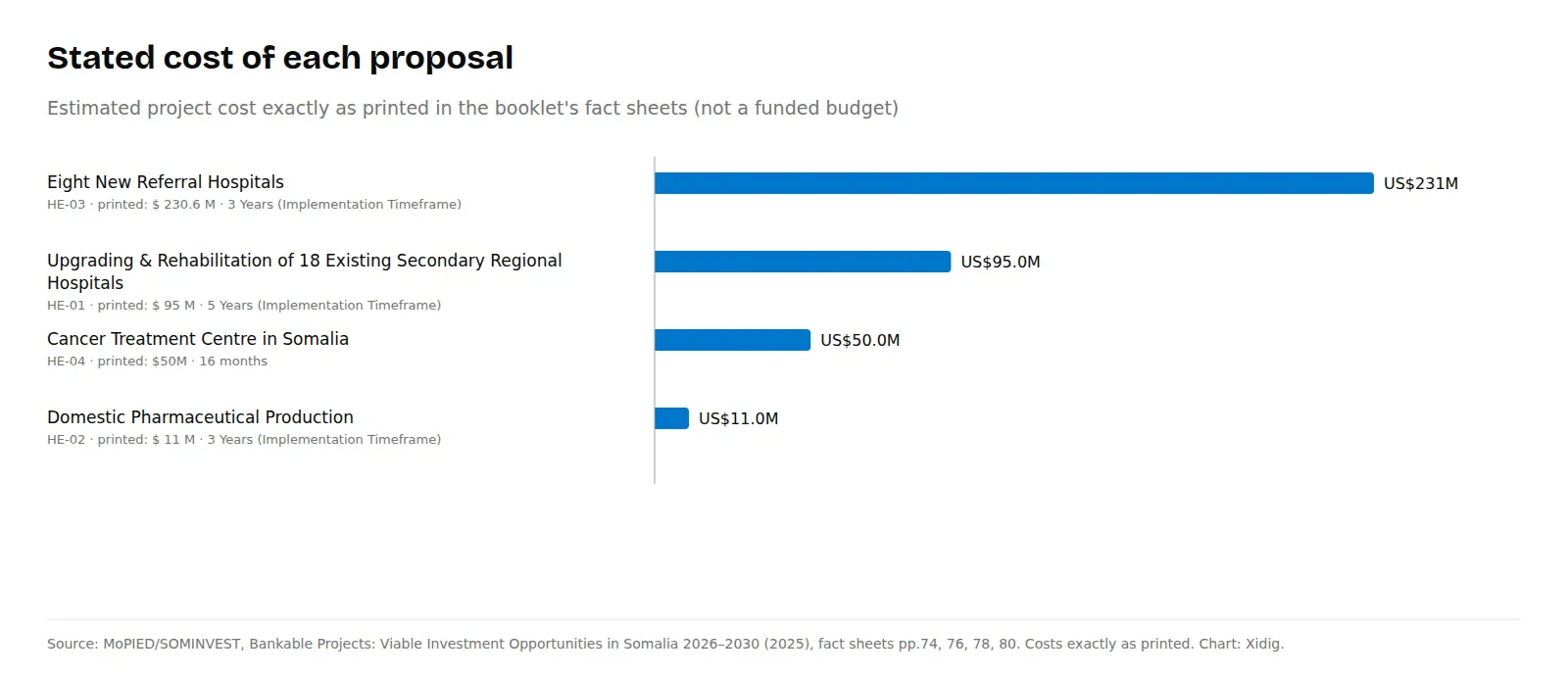
Estimated costs as printed. They are not approved or funded budgets.
- Primary source: MoPIED / SOMINVEST, Bankable Projects 2026–2030, posted 19 Nov 2025. Health section, PDF pp.74–81.
- Promoters: SOMINVEST and the Ministry of Health.
- Status: pre-feasibility on all four sheets.
Related reports
- Somalia's Bankable Projects 2026–2030, explained
- Digital learning, adult literacy and TVET in Somalia
- Why electricity costs so much in Somalia
- Travelling abroad for cancer care: what is known
- Making medicines locally: quality and regulation
- Regional hospitals and PPPs in Somali health care
About this report
By Xidig members and collaborators.
Project codes. Codes such as EN-04 or AG-05 are Xidig's own shorthand for the booklet's fact sheets, by sector; the booklet itself does not number its projects.
How we researched it. We read the full 97-page booklet and checked every figure, page reference and quotation used here against it. We then compared the booklet's claims with the official, international and news sources listed below, and we say where they differ. We did not interview anyone for this report. Where the booklet's figures are unclear, we reproduce them as printed and explain the issue in the notes.
Corrections. If you spot an error, please tell us using the correction link on this page.
Sources
Primary
- MoPIED / SOMINVEST, Bankable Projects 2026–2030, PDF pp.74–81: https://sominvest.gov.so/bankable-projects-in-somalia-2026-2030/
Supporting
- World Bank, Damal Caafimaad restructuring paper (Apr 2025): https://documents1.worldbank.org/curated/en/099042525084533447/pdf/P172031-015acafd-8905-4f18-9e2f-933ad1775660.pdf
- World Bank, World Development Indicators: physicians (SH.MED.PHYS.ZS), hospital beds (SH.MED.BEDS.ZS), health expenditure (SH.XPD.CHEX.PC.CD) and population (SP.POP.TOTL); updated 13 Jul 2026: https://data.worldbank.org/country/somalia
- WHO EMRO, Understanding the private health sector in Somalia (2024): https://applications.emro.who.int/docs/9789292742041-eng.pdf
- Ministry of Health, Health Sector Strategic Plan 2022–2026 (HSSP III): https://moh.gov.so/en/wp-content/uploads/2022/10/SOMALIA-Health-Sector-Strategic-Plan-2022-2026-HSSP-III.pdf
- Ministry of Health, Banadir Hospital page (archived Dec 2022): https://web.archive.org/web/20221215222500/https://moh.gov.so/en/banadir-hospital/
- Daily Sabah, "Türkiye's medical partnership strengthens Somalia's health system" (12 Oct 2025): https://www.dailysabah.com/turkiye/turkiyes-medical-partnership-strengthens-somalias-health-system/news
- WHO EMRO, "Somalia launches US$11.4 million project to strengthen emergency care services at regional hospitals" (29 Sep 2023): https://www.emro.who.int/somalia/news/somalia-launches-us-114-million-project-to-strengthen-emergency-care-services-at-regional-hospitals.html
- UNOPS, "UNOPS and Somalia's Ministry of Health to rehabilitate six regional hospitals" (4 Aug 2023, updated 30 Jul 2025): https://www.unops.org/news-and-stories/news/unops-and-somalias-ministry-of-health-to-rehabilitate-six-regional-hospitals
- Danish Immigration Service, MedCOI: Health care services in Mogadishu v2.0 (Feb 2025): https://us.dk/media/4emech21/medcoi-report_somalia_health-care-services-in-mogadishu_20.pdf
- Hagos et al., "Cancer care in Needle Hospital, Hargeisa, Somaliland", ecancermedicalscience (30 Nov 2023): https://ecancer.org/en/journal/article/1642-cancer-care-in-needle-hospital-hargeisa-somaliland
- SONNA, "President Hassan Sheikh inaugurates modern hospital in Mogadishu" (17 Feb 2025): https://sonna.so/en/article/president-hassan-sheikh-inaugurates-modern-hospital-in-mogadishu
- AUDA-NEPAD, "Somalia adopts resolutions for its Interim National Medicines Regulatory Authority" (17 Dec 2024): https://www.nepad.org/news/somalia-adopts-resolutions-interim-national-medicines-regulatory-authority-ensure-it
- National Medicines Regulatory Authority, "House of the People approves the Somalia Medicines Bill" (3 Jan 2026): https://nmra.gov.so/somalias-house-of-the-people-approves-the-somalia-medicines-bill-in-a-major-legislative-milestone/
- Ministry of Health / Interim NMRA, import control announcement (5 Dec 2024; effective Jan 2025): https://moh.gov.so/so/wp-content/uploads/2024/12/Announcement-English-05thDecember-20241.pdf
- World Bank, Damal Caafimaad Project Appraisal Document (8 Jun 2021): https://documents1.worldbank.org/curated/en/671481625191487648/txt/Somalia-Improving-Healthcare-Services-in-Somalia-Damal-Caafimaad-Project.txt
- Dawan Africa, "Somalia reviews Damal Caafimaad health project, eyes next phase" (27 Sep 2026): https://www.dawan.africa/news/somalia-reviews-damal-caafimaad-health-project-eyes-next-phase
- Ministry of Health, launch of the national Master Health Facility List (Aug 2026): https://moh.gov.so/en/ministry-of-health-officially-launches-the-national-master-health-facility-list-mhfl/