Travelling abroad for cancer care: what is known
Tusmada
- Summary
- Where Xidig members may contribute
- Possible services, research, supplier or collaboration roles
- Who may find this useful
- What the evidence shows
- Dependencies and implementation constraints
- Risks and unknowns
- Questions members should verify before acting
- What is confirmed, and what isn't
- Relevant next steps
- More about the source
- Related reports
- About this report
- Sources
Why Somali cancer patients go to India, Türkiye and Kenya, what the numbers show, what exists at home, and where members can help. A learning report, not medical advice.
Not investment advice, and not medical advice. Independent analysis of a government publication and other public sources. The Government of Somalia has not endorsed it. For decisions about treatment, speak to a qualified clinician.
Summary
Families across Somalia raise money, get visas and fly patients abroad for cancer diagnosis and treatment. At home, services are thin and nobody knows the true burden. For members, the most useful contributions are in cancer data, training, pathology and trustworthy information for families. Building a centre is a much longer road.
What Xidig found:
- The travel is real and large. India's government counted 11,506 arrivals from Somalia for medical purposes in 2025, the fourth-largest source country. That covers all conditions, not just cancer.
- Radiotherapy is missing at home. As of September 2026, Xidig found no source confirming any working radiotherapy machine in Somalia. Where cancer services exist, they are mostly chemotherapy and surgery.
- Nobody knows the true burden. There is no national cancer registry. International estimates and local hospital data disagree about which cancers are most common.
- A plan is coming. The Ministry of Health says it is preparing Somalia's first National Cancer Control Plan (2026–2030) and a cancer registry.
- The spending figure has no published basis. The government's cancer-centre proposal cites over US$100 million a year spent by Somali patients abroad, but Xidig could find no survey, dataset or method behind it. The earliest version Xidig found was a figure for all medical treatment in India, attributed to a health minister.
The government has proposed a US$50M national cancer treatment centre, at pre-feasibility stage; details are under More about the source.
Where Xidig members may contribute
These are learning and support opportunities first. Any clinical role needs the right registration and licences.
- Data: helping build a cancer registry, and research on how many patients travel, where and at what cost.
- Pathology and diagnosis: training and quality support for laboratories, since accurate diagnosis comes before treatment.
- Training: oncology nurses, pharmacists and doctors supporting teaching through recognised institutions.
- Trusted information: plain-language guidance, in Somali and English, on preparing for treatment abroad, checking providers and avoiding visa cartels or brokers.
- Palliative care: training and advocacy for pain relief and home care, which WHO's 2020 country profile (2019 data) found generally not available at community level.
Possible services, research, supplier or collaboration roles
- A study of cancer travel: patient numbers, destinations, costs and outcomes, which would give the first evidence-based figure for spending abroad.
- Tele-consultation and case review arranged with hospitals, within the relevant licensing rules.
- Biomedical engineering: maintenance of imaging and laboratory equipment.
- Patient-navigation services for families, if run transparently and without commissions from foreign hospitals.
Who may find this useful
- Somali and diaspora oncologists, pathologists, oncology nurses and pharmacists.
- Public-health researchers and students.
- Health managers and policymakers.
- Families supporting a relative with cancer. This report is not a guide to services, which change; check directly with hospitals and the Ministry of Health.
What the evidence shows
How many people travel.
- India: the Indian government's Press Information Bureau reported that Somalia was the fourth-largest source of medical travellers in 2025, with 11,506 arrivals, after Bangladesh, Iraq and Uzbekistan. In total, India recorded 507,244 foreign arrivals for medical treatment that year.
- What that number includes: all conditions, not only cancer. It counts arrivals, so a patient who travels twice counts twice. In Xidig's reading, it probably excludes relatives travelling as attendants, and Somalis travelling on other passports are counted under those countries.
- Visas: India's High Commission in Nairobi, which covers Somalia, says it issued 5,252 visas to Somali nationals in 2024 and calls India "one of the preferred destinations for Education and Medical Services for Somalis".
- Türkiye: Somalia is one of 29 target countries of Türkiye's state health-tourism agency (Anadolu Agency, 2024). Xidig found no published count of Somali patients in Türkiye.
- Kenya: Kenyan reporting says East African Community residents travel to Kenya for treatment, and one public referral hospital sees many oncology patients from across Africa. Xidig found no count for Somalia.
- The President's estimate: in February 2025 the President said that "100 to 150 individuals leave the country by plane for medical treatment" every day (SONNA).
Where the US$100 million comes from. The government's cancer-centre proposal (see More about the source) gives a figure of over US$100 million a year spent by Somali patients abroad.
- A Somali news site attributes the line "Somalis spend more than $100 million each year seeking medical treatment in India" to the then health minister, apparently during his official visit to India in April 2023 (the article is undated).
- Mainstream reports of that visit quote the minister saying "a large number of Somali people come to India for medical purposes", but give no figure.
- So the figure appears to have been about India and all medical treatment, while the government's proposal applies it to cancer in India, Türkiye and Kenya. Xidig found no survey, dataset or method behind it, and has not made its own estimate.
What services exist in Somalia.
- No confirmed radiotherapy. A 2023 journal article on a cancer clinic in Hargeisa states: "Cancer patients who need radiation therapy as part of their care must travel abroad." Xidig found no source confirming a working radiotherapy unit anywhere in Somalia in 2026.
- Mostly chemotherapy and surgery. A July 2026 study in BMC Cancer says that several institutions provide oncology-related services, but "their service is limited to chemotherapy and surgery".
- The Hargeisa clinic (as described in 2023): opened in June 2022 with "six beds for chemotherapy administration" and most chemotherapy drugs for solid tumours. Advanced pathology tests such as immunohistochemistry were "not yet available for clinical use" (2023).
- WHO's last country profile (2020, reporting 2019 data): no population-based cancer registry, and community or home-based palliative care "generally not available".
- Mogadishu: a medical-information report published in February 2025, based on fieldwork in October–November 2023, found no cancer treatment at the two Mogadishu hospitals it assessed, and "only very limited access to chemotherapy".
How big the burden is, and why estimates disagree.
- International estimates (GLOBOCAN 2022, WHO's cancer agency): about 9,983 new cases and 6,155 deaths a year. The most common are estimated to be breast, cervical, colorectal, prostate and oesophageal cancer.
- Local data: a 2026 study of 2,417 cancers confirmed by pathology or imaging at five diagnostic centres in Mogadishu and Hargeisa (January 2020 to July 2025) found oesophageal cancer was the most common, at 37.2%. A hospital study in Mogadishu (2017–2019 data, published 2020) also found oesophageal cancer first, at 21.7%.
- Why they differ: without a registry, international estimates for Somalia are modelled partly from neighbouring countries' data. Diagnostic-centre and hospital data cover only patients who reach a city diagnostic centre. Neither is a full picture.
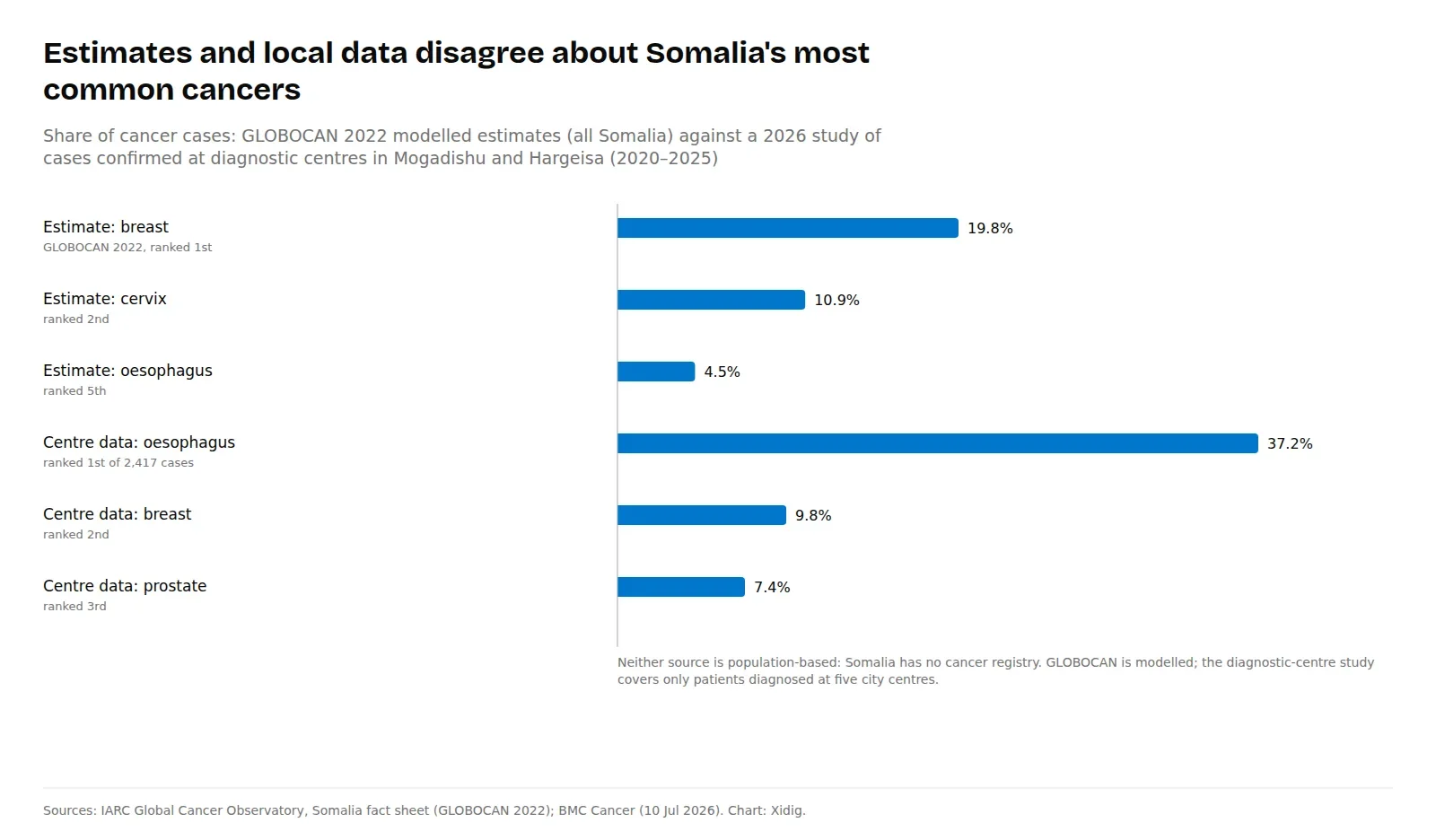
International estimates and local diagnostic data disagree about the most common cancers. Neither is population-based.
What is being planned.
- A national plan: the Ministry of Health's member profile with the Union for International Cancer Control (UICC), accessed September 2026, says it is "developing the first National Cancer Control Plan (2026–2030)" and "establishing the national cancer registry". Xidig found no published plan document.
- IAEA membership: Somalia joined the International Atomic Energy Agency on 15 November 2024. IAEA membership is the usual route to its technical support for radiotherapy, but Xidig found no confirmed IAEA radiotherapy project for Somalia.
What families face.
- Cost: households pay a large share of health costs directly. World Bank data put out-of-pocket spending at about 31% of current health spending in 2023, down from 47% in 2020; a 2026 analysis citing Somalia's 2024 National Health Accounts gives 46%. Xidig found no insurance or public scheme that covers cancer treatment abroad, and no reliable study of what families spend.
- Visa cartels: in 2024 Kenyan and Somali patients complained of paying "cartels" up to about US$1,500 (Ksh200,000) for Indian medical visas that normally cost about Ksh12,420 (Kenyans.co.ke, a single report).
- After returning: Xidig found no national referral protocol, and no evidence on how follow-up care is arranged once patients come home.
Dependencies and implementation constraints
- Specialist staff: radiotherapy needs radiation oncologists, medical physicists and radiation therapists, and training takes years.
- Radiation safety: a radiotherapy unit needs a nuclear and radiation safety regulator and licensing. IAEA membership is a first step.
- Diagnosis: pathology capacity and imaging.
- Medicines: a reliable supply of quality-assured cancer medicines and pain relief. See Making medicines locally.
- Power and maintenance: radiotherapy machines need stable power and service contracts.
- Financing: how patients would pay, given high out-of-pocket costs.
Risks and unknowns
- Unfounded demand estimates: planning a centre around "over US$100 million" a year of spending, which has no published basis.
- Equipment without staff: machines that sit idle for lack of trained people or maintenance.
- Affordability: a centre that only better-off families can use.
- Wrong priorities: if oesophageal cancer is as common as local diagnostic data suggest (they are not population-based), services and prevention may need a different mix from one modelled on breast and cervical cancer.
Questions members should verify before acting
- Has the National Cancer Control Plan been adopted, and what does it prioritise?
- Is any radiotherapy unit planned or installed, and who regulates radiation safety?
- Where would the proposed centre be, and who would run it?
- What registration does a foreign-trained clinician need to practise or teach in Somalia? Check with the Ministry of Health and the health professions council.
- What is the evidence behind any figure for spending abroad?
What is confirmed, and what isn't
Confirmed
- India's count of 11,506 medical arrivals from Somalia in 2025.
- Somalia's IAEA membership since November 2024.
- The absence of a national cancer registry.
- GLOBOCAN 2022 estimates and the 2020 hospital study and the 2026 diagnostic-centre study.
Our interpretation
- The "over US$100 million" figure appears to have started as an estimate for all medical treatment in India.
- Diagnosis, data and training are the most practical places for members to help.
Not yet verified
- Any working radiotherapy unit in Somalia in 2026.
- Patient numbers for Türkiye and Kenya.
- What Somali families spend on cancer treatment abroad.
- The status of the National Cancer Control Plan.
Relevant next steps
- Follow the Ministry of Health for the National Cancer Control Plan and registry.
- Researchers: a transparent study of cancer travel and costs would fill the biggest gap in this report.
- Clinicians: contact recognised hospitals or training institutions about teaching or tele-consultation.
More about the source
The government's investment booklet, Bankable Projects 2026–2030 (MoPIED / SOMINVEST), is one of the sources for this report. The details it gives are summarised here as printed.
Cancer Treatment Centre in Somalia (HE-04, pp.80–81).
-
The problem it describes: "Somalia lacks a specialized cancer treatment facility, forcing patients to travel abroad (primarily to India, Turkey, and Kenya) for diagnosis and treatment."
-
The cost claim: this "results in over US$100 million annually spent by Somali patients overseas".
-
Aim: "a national cancer treatment center that can provide affordable, accessible, and quality care".
-
Estimates as printed: US$50M; implementation 16 months; project lifetime 10 years.
-
Ticked boxes: greenfield; PPP, joint venture and private are all ticked; pre-feasibility. No site is named.
-
Promoters: SOMINVEST and the Ministry of Health.
-
The sheet also states a return on investment. Xidig does not repeat it, because no basis is given.
-
Primary source: MoPIED / SOMINVEST, Bankable Projects 2026–2030, posted 19 Nov 2025. Cancer centre fact sheet at PDF pp.80–81.
-
Other drivers listed on p.81: "Huge demand for cancer diagnostic and treatment" and "Abundant human resources". "Land availability" is listed as existing infrastructure.
-
Incentives listed: partial import tax exemption, "5 Years tax exemption for secondary investors for this project", entry facilitation and residence and work permits for senior staff.
Related reports
- Hospitals, medicines and cancer care in Somalia
- Regional hospitals and PPPs in Somali health care
- Making medicines locally: quality and regulation
- Somalia's Bankable Projects 2026–2030, explained
About this report
By Xidig members and collaborators.
Project codes. Codes such as EN-04 or AG-05 are Xidig's own shorthand for the booklet's fact sheets, by sector; the booklet itself does not number its projects.
How we researched it. We read the full 97-page booklet and checked every figure, page reference and quotation used here against it. We then compared the booklet's claims with the official, international, academic and news sources listed below, and we say where they differ. We did not interview anyone for this report.
Corrections. If you spot an error, please tell us using the correction link on this page.
Sources
Primary
- MoPIED / SOMINVEST, Bankable Projects 2026–2030, PDF pp.80–81: https://sominvest.gov.so/bankable-projects-in-somalia-2026-2030/
Supporting
- Press Information Bureau, Government of India, Medical and Wellness Tourism in India (2 May 2026): https://static.pib.gov.in/WriteReadData/specificdocs/documents/2026/may/doc202652862301.pdf
- High Commission of India, Nairobi, India–Somalia bilateral relations: https://www.hcinairobi.gov.in/eoinrb_pages/MzI4
- ThePrint (ANI), "India, Somalia have historical relations…" (27 Apr 2023): https://theprint.in/india/india-somalia-have-historical-relations-we-want-to-strengthen-our-collaboration-somalia-health-minister/1543263/
- FTL Somalia, "Somalis spend over $100 million annually seeking medical treatment in India" (undated): https://www.ftlsomalia.com/somalis-spend-over-100-million-annually-seeking-medical-treatment-in-india/
- Anadolu Agency, "Türkiye among top 10 health tourism countries in world" (16 Apr 2024): https://www.aa.com.tr/en/health/turkiye-among-top-10-health-tourism-countries-in-world/3193079
- Daily Nation, "How Kenyan hospitals are drawing patients from across Africa" (undated; accessed Sep 2026): https://nation.africa/kenya/health/how-kenyan-hospitals-are-drawing-patients-from-across-africa-5261094
- SONNA, "President Hassan Sheikh inaugurates modern hospital in Mogadishu" (17 Feb 2025): https://sonna.so/en/article/president-hassan-sheikh-inaugurates-modern-hospital-in-mogadishu
- IARC Global Cancer Observatory, Somalia fact sheet (GLOBOCAN 2022): https://gco.iarc.who.int/media/globocan/factsheets/populations/706-somalia-fact-sheet.pdf
- "The state of cancer in Somalia: a comprehensive six-year retrospective study", BMC Cancer (10 Jul 2026): https://link.springer.com/article/10.1186/s12885-026-16519-9
- "Cancer incidence and distribution at a tertiary care hospital in Somalia", Cancer Management and Research (28 Sep 2020): https://www.dovepress.com/cancer-incidence-and-distribution-at-a-tertiary-care-hospital-in-somal-peer-reviewed-fulltext-article-CMAR
- WHO, Somalia cancer country profile (2020): https://cdn.who.int/media/docs/default-source/country-profiles/cancer/som-2020.pdf
- Hagos et al., "Cancer care in Needle Hospital, Hargeisa, Somaliland", ecancermedicalscience (30 Nov 2023): https://ecancer.org/en/journal/article/1642-cancer-care-in-needle-hospital-hargeisa-somaliland
- Danish Immigration Service, MedCOI: Health care services in Mogadishu v2.0 (Feb 2025): https://us.dk/media/4emech21/medcoi-report_somalia_health-care-services-in-mogadishu_20.pdf
- UICC, member profile: Ministry of Health, Somalia (updated 8 Jul 2026; accessed Sep 2026): https://www.uicc.org/membership/ministry-health-somalia
- IAEA Office of Legal Affairs, country fact sheet: Somalia: https://ola.iaea.org/Applications/FactSheets/Country/Detail?code=SO
- Abdi et al., "Building resilient primary health care in Somalia…", BMC Health Services Research (22 Jun 2026): https://link.springer.com/article/10.1186/s12913-026-15003-1
- World Bank, World Development Indicators, out-of-pocket expenditure (% of current health expenditure), SH.XPD.OOPC.CH.ZS (updated 13 Jul 2026): https://data.worldbank.org/indicator/SH.XPD.OOPC.CH.ZS?locations=SO
- Kenyans.co.ke, "Kenyans, Somalis lament over high medical visa fees to India" (26 Apr 2024): https://www.kenyans.co.ke/news/100116-kenyans-somalis-lament-over-high-medical-visa-fees-india
Source notes
- GLOBOCAN figures are modelled estimates; Somalia has no population-based registry.
- The 2026 BMC Cancer study draws on records from five diagnostic centres in Mogadishu and Hargeisa. Xidig does not name them.
- Xidig does not name or profile private hospitals, clinics or facilitators. The Hargeisa clinic is described only as its own authors reported it in 2023.