Reading the jobs numbers in the booklet
Tusmada
- Summary
- Where Xidig members may contribute
- Possible services, research, supplier or collaboration roles
- Who may find this useful
- The eleven job figures
- How to read the numbers
- Dependencies and implementation constraints
- Risks and unknowns
- Questions members should verify before acting
- What is confirmed, and what isn't
- Relevant next steps
- More about the source
- Related reports
- About this report
- Sources
How many jobs could Somalia's proposed investment projects create? Eleven of the 37 give a number, from 50 to 9,000, none with a source or method. How to read them, how they compare with the labour market, and which look doubtful.
Not investment advice. Independent analysis of a government publication and other public sources. The Government of Somalia has not endorsed it. The calculations marked "Xidig's arithmetic" are ours, not official estimates.
Summary
Somalia needs jobs: its labour force is about 3.56 million people (ILO modelled estimates), it grew by about 114,000 between 2024 and 2025 (Xidig's arithmetic), and youth unemployment is estimated at 34.2%.
Jobs are also one of the main promises of the Bankable Projects 2026–2030 booklet. But only 11 of its 37 proposals give a number, and none says how it was estimated, whether the jobs are temporary or permanent, or whether they are direct or indirect (except three sheets that say direct).
What Xidig found:
- A wide range: from 50 jobs (Mogadishu dry dock) to 9,000 direct and 12,000 indirect (three deep seaports).
- Huge differences in jobs per dollar: by Xidig's arithmetic, the sheets imply anything from under one job to about 580 jobs per US$1 million of stated cost.
- One figure looks doubtful: about 2,900 direct jobs from a US$5 million solar panel factory is far above what international benchmarks suggest for module assembly.
- The scale: even the largest figure, 9,000 direct jobs for the deep seaports, is less than one-tenth of one year's growth in the labour force.
For members, the lesson is simple: read the booklet's job figures as ambitions, not forecasts, ask how any figure was calculated before relying on it, and remember that jobs need trained people.
Where Xidig members may contribute
- Better estimates: economists and project analysts can show how to estimate jobs transparently.
- Sector checks: members in fisheries, energy or ports can say whether a figure is realistic.
- Skills matching: jobs need trained people. See Skills map.
Possible services, research, supplier or collaboration roles
- A simple, open method for estimating project jobs, with direct, indirect, temporary and permanent jobs shown separately.
- Research on how many jobs completed projects in Somalia actually created.
- Training in jobs-impact assessment for project planners.
Who may find this useful
- Journalists and researchers quoting job figures.
- Investors reviewing proposals.
- Young people and job seekers wondering what these projects could mean.
- Officials preparing future project sheets.
The eleven job figures
The eleven job figures, as printed:
| Sheet | Proposal | Stated cost | Jobs as printed |
|---|---|---|---|
| AG-01 (p.13) | Seed production | $0.7M | "creating 144 jobs" |
| AG-02 (p.15) | Fodder production | $1.9M | "create 218 jobs" |
| AV-01 (p.25) | Four regional airports | $16.5M | "Create 400 new jobs" |
| EN-02 (p.31) | Gas processing plant | $169.5M | "create around 165 jobs" |
| EN-06 (p.39) | Solar panel manufacturing | $5M | "approximately 2900 direct jobs" |
| FI-01 (p.44) | Fishing vessels | $24.75M | "create 4,762 jobs" |
| FI-02 (p.46) | Fish processing hubs | $12.6M | "create over 620 jobs" |
| LI-03 (p.56) | Three deep seaports | $ 1,008.3 B¹ | "Create 9,000 direct and 12,000 indirect jobs" |
| LI-04 (p.58) | Fishing jetties | $20.7M | "Create over 300 jobs and support 420+ fishing families" |
| LI-05 (p.60) | Port modernisation | $551.2M | "Create 2,000 direct jobs" |
| LI-06 (p.62) | Mogadishu dry dock | $112.2M | "Create 50 new jobs" |
¹ The deep-seaport cost is printed in a notation that needs confirmation; see Reader's notes.
Other sheets mention "Job creation" or "employment opportunities" without a number, including meat processing, dairy, poultry, the Mogadishu Stadium and waste management. The other 26 sheets give no job number.
How to read the numbers
What the words mean.
- Direct jobs are jobs in the project itself. Indirect jobs are in its suppliers. Induced jobs come from workers spending their wages. The World Bank defines direct impacts as those "in/for treated entity(ies)" and indirect impacts as those "beyond" it.
- Gross versus net: the International Labour Organization notes that most such models are "not designed to capture 'net' job creation", because new projects may "displace their competitors". A new fish plant may take workers and customers from existing traders.
- Temporary versus permanent: the World Bank's guidance asks: "Are the jobs being created likely to remain after the intervention is completed?" Construction jobs end; operating jobs continue.
- A comparison point: a proper estimate compares the situation with and without the project, not just before and after.
None of the eleven sheets says which of these it means, except that three say "direct" (and one of them also gives "indirect" jobs).
Jobs per dollar vary enormously (Xidig's arithmetic).
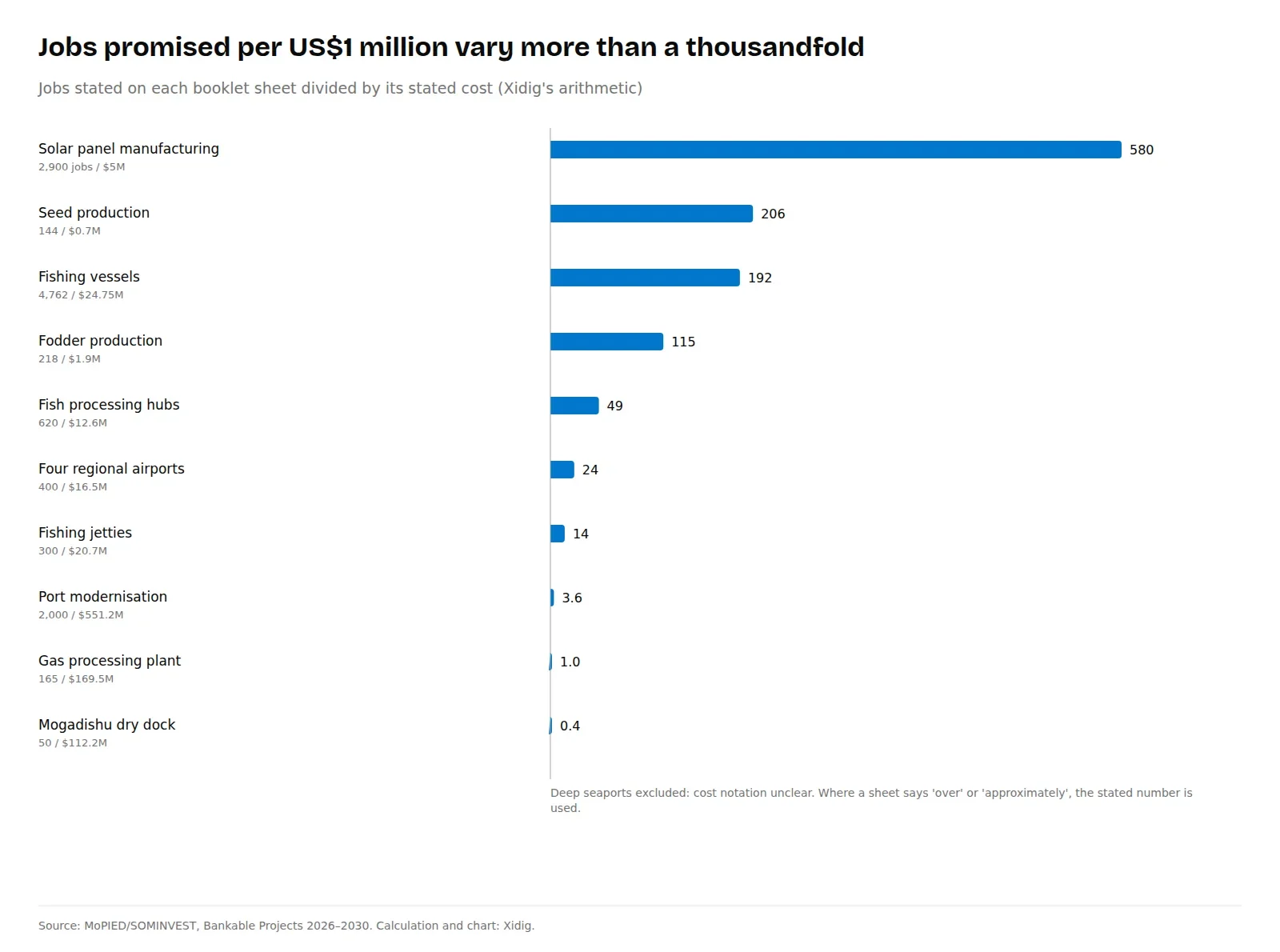
Jobs promised per US$1 million of stated cost, by sheet. The deep seaports are excluded because their cost notation is unclear.
- Some variation is normal: a dry dock or gas plant needs a lot of capital per worker, while farming or fishing needs more people.
- But a range from under one to about 580 jobs per million dollars suggests the figures were not made with a common method.
One figure to question: the solar panel factory.
- The sheet promises "approximately 2900 direct jobs" from a US$5 million plant.
- An International Renewable Energy Agency study found that assembling the solar modules for a 50 MW plant takes about 10,535 person-days of work.
- By Xidig's arithmetic, that is roughly one full-time job per megawatt of modules made each year. On that basis, 2,900 assembly jobs would mean making roughly 2,500 MW of panels a year, which is far beyond what a US$5 million plant could produce. The IRENA data are from 2017; automation has since reduced the labour needed per megawatt, which makes the figure even less plausible.
- The figure may include installers or sellers, or may be a typing error. It is a question to put to the promoters.
Somalia's labour market.
- Official survey (2019): the Somali National Bureau of Statistics found "The total unemployment rate for those aged 15 and over for Somalia was 21.4 percent", and youth (15–24) unemployment of 37.4%. Only 32.4% of working-age people were in the labour force. The survey covered accessible areas, and no newer labour force survey has been published.
- Modelled estimates (ILO, via the World Bank, 2025): unemployment of 18.9% and youth unemployment of 34.2%. The labour force is about 3.56 million people.
- Growth: by Xidig's arithmetic from the same modelled data, the labour force grew by about 114,000 people between 2024 and 2025.
- Scale: even the largest booklet figure, 9,000 direct jobs for the deep seaports, is less than one-tenth of one year's growth in the labour force.
- Youth: the booklet says people under 35 are about 70% of the population (p.7). Survey measures of youth unemployment use ages 15–24, so the two figures are not comparable.
The national plan's jobs targets. The NTP Executive Summary aims to cut youth unemployment "from 30.1% in 2024 to 25%" by 2029. It sets sector job targets: over 23,800 in fisheries, 15,000 in energy and extractives and over 35,000 in infrastructure and logistics. The summary does not say where the 30.1% baseline comes from.
- By Xidig's arithmetic, the deep-seaport sheet alone (21,000 direct and indirect jobs) equals about 60% of the NTP's infrastructure jobs target.
What is known about job creation so far. The World Bank's evaluation of its Somalia programme (2025) says job creation, anticipated in its country strategies, has "yet to see greater engagement by the World Bank". Xidig found no independent evaluation measuring jobs created by investment projects in Somalia.
Dependencies and implementation constraints
- Jobs appear only if a project is financed and built.
- Skills: many jobs need trained workers.
- Local hiring rules: the 2015 Foreign Investment Law requires at least half of a foreign investor's staff to be local citizens.
Risks and unknowns
- Overstated promises that create false expectations.
- Displacement: new projects may replace existing jobs.
- Temporary work: construction jobs that end when building finishes.
- Adding up: summing figures made with different methods gives a misleading total.
Questions members should verify before acting
- How was a job figure estimated, and by whom?
- Are the jobs direct or indirect, construction or operation, full-time or seasonal?
- How many would go to local workers, and with what skills?
- What would happen to existing jobs in the sector?
What is confirmed, and what isn't
Confirmed
- The eleven job figures, as printed.
- The 2019 labour force survey results and ILO modelled estimates.
- The NTP's jobs targets.
Our interpretation
- The figures were not produced with a common method.
- The solar panel factory figure looks far too high.
Not yet verified
- How any of the booklet's figures were calculated.
- Newer official labour-market data.
Relevant next steps
- When quoting a booklet job figure, call it "the booklet's estimate" and give the sheet.
- Ask the promoting ministry or SOMINVEST for the basis of any figure you plan to use.
More about the source
- Primary source: MoPIED / SOMINVEST, Bankable Projects 2026–2030, posted 19 Nov 2025. Job figures appear in the descriptions (first page) or key drivers (second page) of the sheets listed above.
Related reports
- Somalia's Bankable Projects 2026–2030, explained
- Skills map: which member skills recur across the 37 proposals
- The National Transformation Plan 2025–2029 in brief
- Somalia's economy at a glance: the latest figures, with sources
- Reader's notes: inconsistencies in the booklet, page by page
- Solar power and battery storage in Somalia
About this report
By Xidig members and collaborators.
Project codes. Codes such as EN-04 or AG-05 are Xidig's own shorthand for the booklet's fact sheets, by sector; the booklet itself does not number its projects.
How we researched it. We read the full 97-page booklet and checked every figure, page reference and quotation used here against it. We then compared the booklet's claims with the official, international, academic and news sources listed below, and we say where they differ. We did not interview anyone for this report.
Corrections. If you spot an error, please tell us using the correction link on this page.
Sources
Primary
- MoPIED / SOMINVEST, Bankable Projects 2026–2030: https://sominvest.gov.so/bankable-projects-in-somalia-2026-2030/
Supporting
- World Bank, Measuring Jobs Impacts: A Decision Framework and Available Methods, Jobs Guide Issue 8 (Nov 2023): https://documents1.worldbank.org/curated/en/099630212122331579/pdf/IDU1c6d6f901139e31431019a2516e2d7f42d9ca.pdf
- International Labour Organization, A Brief Review of Input-Output Approaches to Employment Impact Assessment: https://www.ilo.org/media/520916/download
- IRENA, Renewable Energy Benefits: Leveraging Local Capacity for Solar PV (Jun 2017): https://www.irena.org/-/media/Files/IRENA/Agency/Publication/2017/Jun/IRENA_Leveraging_for_Solar_PV_2017.pdf
- Somali National Bureau of Statistics, Somalia Labour Force Survey 2019: https://nbs.gov.so/wp-content/uploads/2023/05/Somali-Labour-Force-survey-2019.pdf
- World Bank, World Development Indicators (ILO modelled estimates): unemployment https://data.worldbank.org/indicator/SL.UEM.TOTL.ZS?locations=SO · youth unemployment https://data.worldbank.org/indicator/SL.UEM.1524.ZS?locations=SO · labour force https://data.worldbank.org/indicator/SL.TLF.TOTL.IN?locations=SO
- MoPIED, NTP Executive Summary (dated 23 Feb 2025): https://mop.gov.so/wp-content/uploads/2026/07/NTP-Executive-Summary.pdf
- World Bank Independent Evaluation Group, Somalia Country Program Evaluation (Mar 2025): https://ieg.worldbankgroup.org/sites/default/files/Data/Evaluation/files/report-evaluation-Somalia_CPE.pdf
- UNCTAD Investment Laws Navigator, Somalia Foreign Investment Law 2015 (text): https://investmentpolicy.unctad.org/investment-laws/laws/538/somalia-foreign-investment-law
Source notes
- Jobs per US$1 million are Xidig's arithmetic: the booklet's job figure divided by its printed cost. They are not official estimates.