Eggs and chicken in Mogadishu: imports, local farms and the gap
Tusmada
- Summary
- Where Xidig members may contribute
- Possible services, research, supplier or collaboration roles
- Who may find this useful
- Eggs and chicken in Somalia
- Dependencies and implementation constraints
- Risks and unknowns
- Questions members should verify before acting
- What is confirmed, and what isn't
- Relevant next steps
- More about the source
- Related reports
- About this report
- Sources
Recorded egg imports now exceed estimated local output. What limits Mogadishu's poultry farms, where members fit, and the commercial egg farm on the government's list.
Not investment advice. Independent analysis of a government publication and other public sources. It is not an offer or a tender notice, and the Government of Somalia has not endorsed it.
Summary
Recorded egg imports to Somalia exceeded estimated local production in 2024, and local poultry farms in Mogadishu struggle with the basics. The openings for members are in the links the farms are missing: feed, chicks, veterinary care and cooling.
What Xidig found:
- Imports exceed local output. Recorded egg imports, mostly from Türkiye, reached about 4,800 tonnes in 2024, more than FAO's estimate of Somalia's own production (about 2,700 tonnes).
- Low consumption. FAO data put egg supply at about 0.3 kg per person a year, and poultry meat at about 0.8 kg (2022).
- Local farm problems. In a small 2022 study of Mogadishu farms, incubation and management were the most-cited problem, followed by heat, feed shortage and disease.
- Missing links. The Ministry of Livestock's 2019 strategy recommended exploring a feed mill and, if demand is sufficient, hatcheries. Türkiye's development agency has supported a university hatchery and feed production centre in Mogadishu.
The government has also proposed a US$5.4M commercial egg farm in Mogadishu, aimed at reducing reliance on imported poultry products; details are under More about the source.
Where Xidig members may contribute
Service, skills and learning openings, not confirmed contracts or tenders:
- Feed: sourcing, formulation and small-scale milling.
- Hatcheries and chick supply: incubation and management were the most-cited problem.
- Poultry veterinary care: vaccination and disease control.
- Housing and cooling: ventilation and solar-powered fans for hot climates.
- Marketing: egg grading, packaging and supply to shops and hotels.
Possible services, research, supplier or collaboration roles
- A shared hatchery or incubation service for small farms.
- A feed-buying group to cut costs.
- Research: egg prices in Mogadishu markets, local versus imported.
Who may find this useful
- Poultry farmers and veterinarians.
- Animal nutritionists.
- Agricultural engineers.
- Food retailers and hotel suppliers.
Eggs and chicken in Somalia
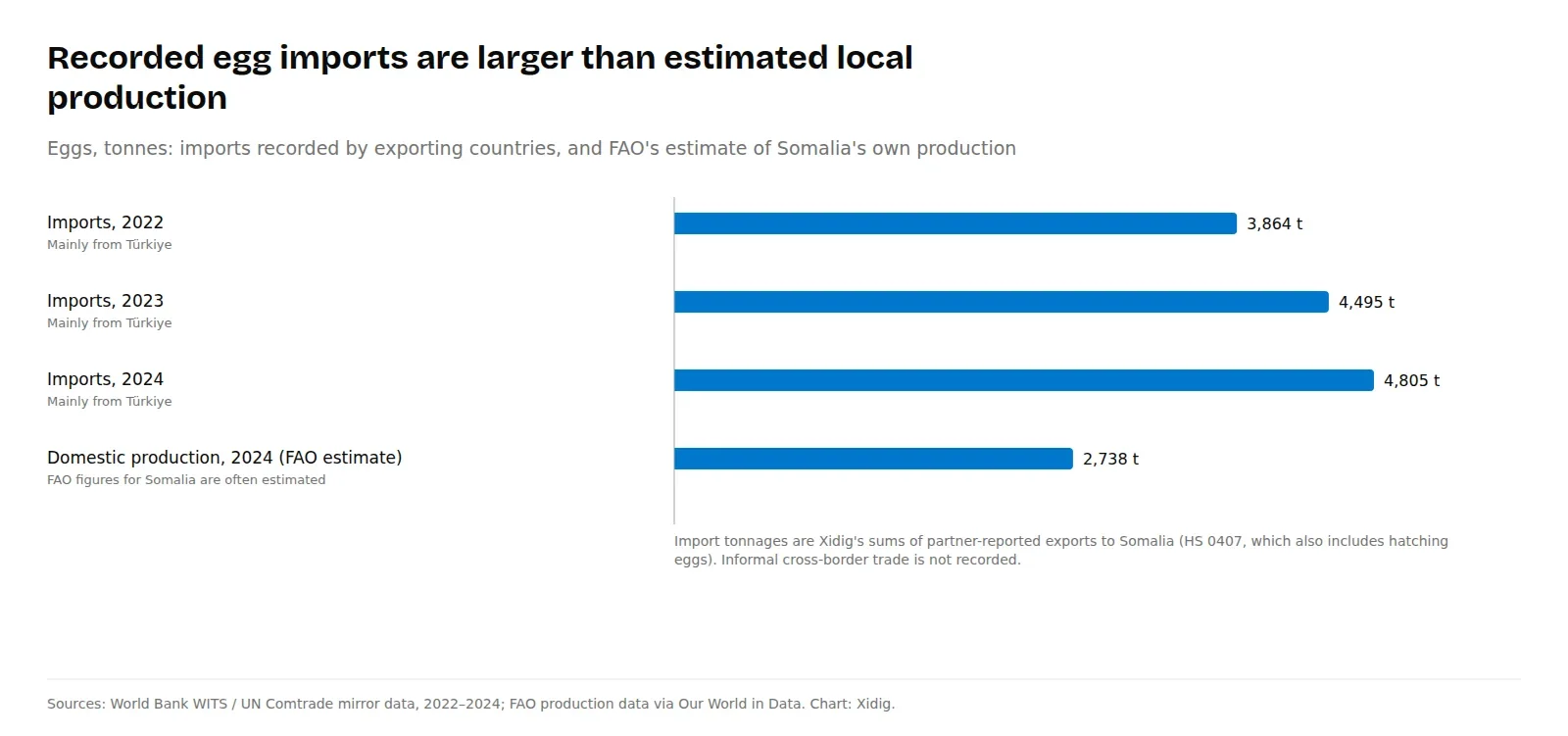
Recorded egg imports are larger than FAO's estimate of local production.
Imports.
- Mirror data: Somalia does not report its own egg imports, but exporting countries do.
- Volumes: they recorded about 3,900 tonnes in 2022, 4,500 in 2023 and 4,800 in 2024. In 2024 that was worth about US$6.8M (World Bank WITS, Xidig's sums).
- Sources: Türkiye supplied most of it, about 90% by weight in 2024, with India and Yemen next. Kenya appears in small amounts; informal cross-border trade is not recorded.
- Chicks: recorded imports of day-old chicks are very small.
Local production.
- FAO estimates: Somalia produced about 2,700 tonnes of eggs and 4,100 tonnes of poultry meat in 2024. These are FAO estimates, which for Somalia are often imputed.
- Ministry assessment (2019): poultry "has become increasingly important to Somalia's food security", but "The poultry subsector remains underdeveloped, with poor linkages between producers, market and consumers, and minimal external donor support".
- Ministry recommendations: "Explore PPP arrangements for the development of a local chicken feed mill industry" and "Promote investments in hatcheries, if it is determined that there is sufficient demand".
Consumption. FAO data put egg supply at about 0.3 kg per person a year, and poultry meat at about 0.8 kg (2022), far below sheep and goat meat.
What holds farms back. A small 2022 study at three poultry farm sites in Mogadishu (100 samples; published 2023) reported:
- Challenges overall: about 83%.
- Incubation and management: 47%, the most cited.
- Hot environment: 32%.
- Feed shortage: 23%.
- Disease: 15%.
- Breeds: about 58% of birds were indigenous breeds.
Recorded imports of soybean meal, a main protein source in poultry feed, were only about 200 tonnes in 2023 (partner data).
Programmes. Türkiye's development agency (TİKA) has supported poultry in Mogadishu:
- 2021: a layer unit with 1,200 chicks.
- 2024: a broiler breeding project with universities in Mogadishu, alongside a university hatchery and feed production centre it has supported. It aims to "reduce Somalia's reliance on imported chicken meat".
Xidig found no current FAO, IFAD or World Bank poultry programme with published results.
A regional comparison.
- Feed costs: in Kenya, feed "contributes to about 60–70 per cent of the total production costs" of livestock farms.
- Egg prices: a Nation spot check found egg prices in Kenya rose in 2026.
What this means.
- What the farm needs: a large egg farm in Mogadishu would compete with Turkish imports. To succeed it would need reliable feed, chicks and cooling.
- Wider benefit: those same links would help every small poultry farm in the city.
Dependencies and implementation constraints
- Feed ingredients: maize and protein, mostly imported.
- Reliable, affordable electricity for incubators and cooling.
- Veterinary services and vaccines.
- Price competition from imports.
Risks and unknowns
- Disease outbreaks: Xidig found no recent data for Somalia.
- Feed price swings.
- Import data: it may include hatching eggs, and informal trade is not recorded.
- Production figures are estimates.
Questions members should verify before acting
- What do local and imported eggs cost in Mogadishu today?
- Where do farms get day-old chicks and feed?
- What vaccines are available locally?
- Who would buy eggs in bulk?
What is confirmed, and what isn't
Confirmed
- Partner-reported egg exports to Somalia, 2022–2024.
- The Ministry of Livestock's assessment and recommendations.
- The 2022 Mogadishu farm survey findings.
- The TİKA projects.
Our interpretation
- Feed, chicks and cooling matter more than farm size.
Not yet verified
- Actual local egg production and prices.
- Informal imports from neighbouring countries.
- Poultry meat imports (data not available).
Relevant next steps
- Follow the Ministry of Livestock, Forestry and Range for poultry and feed-mill plans.
- Share egg and chicken prices in your area through Xidig.
More about the source
The government's investment booklet, Bankable Projects 2026–2030 (MoPIED / SOMINVEST), is one of the sources for this report. The details it gives are summarised here as printed.
- Poultry: Commercial Broilers and Layers Farming (AG-05, pp.21–22). "a commercial poultry project in Mogadishu Tow" [sic] "for the production of eggs and marketing of the eggs in Somalia". US$5.4M; 2 years; private.
- Key drivers (p.22): "Reducing reliance on imported poultry products", "Enhancing food security" and "Modernization of farming techniques".
The sheet names a private sponsor and a Nairobi-based consultancy. This report does not profile them.
- Primary source: MoPIED / SOMINVEST, Bankable Projects 2026–2030, posted 19 Nov 2025. Fact sheet at PDF pp.21–22.
- Promoters: SOMINVEST, the Ministry of Livestock, Forestry and Range, and a named private sponsor.
- Stage: pre-feasibility.
Related reports
- Seed, fodder, meat, dairy and poultry in Somalia
- Mogadishu's new airport, port and other planned projects
- Edible oil refining and PET preforms in Somalia
- Somalia's Bankable Projects 2026–2030, explained
About this report
By Xidig members and collaborators.
Project codes. Codes such as EN-04 or AG-05 are Xidig's own shorthand for the booklet's fact sheets, by sector; the booklet itself does not number its projects.
How we researched it. We read the full 97-page booklet and checked every figure, page reference and quotation used here against it. We then compared the booklet's claims with the official, international, academic and news sources listed below, and we say where they differ. We did not interview anyone for this report.
Corrections. If you spot an error, please tell us using the correction link on this page.
Sources
Primary
- MoPIED / SOMINVEST, Bankable Projects 2026–2030, PDF pp.21–22: https://sominvest.gov.so/bankable-projects-in-somalia-2026-2030/
Supporting
- World Bank WITS / UN Comtrade, eggs (HS 040700) exported to Somalia, 2024: https://wits.worldbank.org/trade/comtrade/en/country/ALL/year/2024/tradeflow/Exports/partner/SOM/product/040700 (also 2022 and 2023)
- World Bank WITS / UN Comtrade, soybean meal (HS 230400) exported to Somalia, 2023: https://wits.worldbank.org/trade/comtrade/en/country/ALL/year/2023/tradeflow/Exports/partner/SOM/product/230400
- World Bank WITS / UN Comtrade, day-old chicks (HS 010511) exported to Somalia, 2023: https://wits.worldbank.org/trade/comtrade/en/country/ALL/year/2023/tradeflow/Exports/partner/SOM/product/010511
- Our World in Data (FAO), egg production: https://ourworldindata.org/grapher/egg-production-thousand-tonnes
- Our World in Data (FAO), poultry production: https://ourworldindata.org/grapher/poultry-production-tonnes
- Our World in Data (FAO), per capita egg consumption: https://ourworldindata.org/grapher/per-capita-egg-consumption-kilograms-per-year
- Our World in Data (FAO), per capita meat by type: https://ourworldindata.org/grapher/per-capita-meat-type
- Ministry of Livestock, Forestry and Range, Livestock Sector Development Strategy (2019, published 2020): https://molfr.gov.so/wp-content/uploads/2024/06/LSDS-Final-Book-livestock-sector-development-strategy-published-2020-1-1.pdf
- Barre et al., Animal and Veterinary Sciences 11(6) (Dec 2023): https://www.sciencepg.com/article/10.11648/j.avs.20231106.13
- TİKA, "TİKA implements breeding broiler production project in Somalia" (19 Sep 2024): https://tika.gov.tr/en/tika-implements-breeding-broiler-production-project-in-somalia/
- WATTPoultry, "Turkish agency builds layer farm in Somalia" (7 Oct 2021): https://www.wattagnet.com/egg/article/15534426/turkish-agency-builds-layer-farm-in-somalia
- The Standard (Kenya), FarmKenya, on feed costs (Feb 2022): https://www.standardmedia.co.ke/farmkenya/article/2001437199/time-to-save-farmers-from-pinch-of-high-cost-of-livestock-feeds
- Daily Nation, "As milk and maize shortages persist, egg prices rise in Kenya's worsening food problem" (Jul 2026): https://nation.africa/kenya/business/egg-prices-rise-as-milk-maize-shortages-persist-5583908
Source notes
- Import tonnages are Xidig's sums of partner-reported data; the HS code includes hatching eggs.
- Poultry meat import data could not be retrieved.