Garacad: the port Somali investors built
Tusmada
- Summary
- Where Xidig members may contribute
- Possible services, research, supplier or collaboration roles
- Who may find this useful
- What exists in Garacad today
- Geographic context
- Dependencies and implementation constraints
- Risks and unknowns
- Questions members should verify before acting
- What is confirmed, and what isn't
- Relevant next steps
- More about the source
- Related reports
- About this report
- Sources
A small Mudug port town where Somali investors built a port themselves. What exists, what is still missing, and where members fit.
Not investment advice. Independent analysis of a government publication and other public sources. It is not an offer or a tender notice, and the Government of Somalia has not endorsed it.
Summary
Garacad (also written Gara'ad), a small port town on the Indian Ocean coast of Mudug, has a port that Somali private investors built themselves. It opened in October 2022, and new facilities, including cargo storage, were reported opened in August 2026. For members, Garacad is both a place with gaps to fill and an example of Somali investors pooling money to build shared infrastructure.
What Xidig found:
- Private investors built it. The US State Department says Somali private investors completed the first phase of the port in 2022, and the Somali Ports Authority describes a private-sector-led investment model. Xidig found no public information on how many investors hold shares, or on what terms.
- Management is unsettled. Investors were reported in 2024–2025 to be in talks with a UAE-based company over the port. Xidig found no signed agreement.
- The road inland is not finished. A foundation stone for the highway to Galkayo and Galdogob was laid in October 2022, but Xidig found no evidence the road is paved end to end or confirmed financing.
- Basic data is missing. Xidig found no public figures on the town's population, electricity, water, fish landings or port traffic.
- Openings: power for the port and town, ice and cold storage for fish, logistics to Galkayo, and local data collection.
Garacad also appears in three of the federal government's proposals, an HFO power plant, a new fishing port and a port upgrade, none with a cost for Garacad alone; details are under More about the source.
Where Xidig members may contribute
Learning and collaboration openings, not confirmed contracts or tenders:
- Learning from the model: how the port's investors pooled money, took decisions and got government approval is directly relevant to members planning shared projects.
- Power for the port and town: solar with storage is more likely at this scale than a 100 MW plant.
- Fish landing and cold storage: ice and chilling for a fishing port (see Cold chain for fish, milk and meat in Somalia).
- Logistics: livestock handling, warehousing and trucking to Galkayo.
- Local data: population, prices and power costs are missing from public sources.
Possible services, research, supplier or collaboration roles
- A case study: members who took part in the Garacad investment could share, with their consent, how it was organised.
- A solar-and-storage study for the port area.
- An ice plant serving boats that land at the port.
- Research: the status and funding of the Garacad–Galkayo road.
Who may find this useful
- Diaspora members from Mudug and central Somalia.
- Members interested in pooled or community investment.
- Port, marine and logistics professionals.
- Solar and electrical engineers.
- Fish and livestock traders.
What exists in Garacad today
Who built the port.
- Opening: the port was inaugurated on 22 October 2022. Hiiraan Online described it as a "community and privately-funded" project.
- Official description: the US State Department's 2025 investment climate statement says "Somali private investors completed the first phase of the Garacad Port in 2022". The Somali Ports Authority says it "is being developed through a Somali private-sector-led investment model".
- Developer: the engineering firms that reviewed the design name the developer as Wadaagsan Company. The company's own site says the venture was "undertaken with the approval of the government".
- Ownership: Xidig found no public information on how many investors hold shares, or on what terms.
Size and cost.
- Planned berths: before the opening, the developer told Bloomberg that the "first two deep-water berths" would take "40,000-ton container ships", with "Another two berths" to follow, as part of "a $531 million investment plan". The design engineers described the first stage as a new berth (Rendel, November 2022).
- August 2026 facilities: Kaab TV and Puntland Post both reported that Berth C had been added and Berth D was under development, and that cargo storage was opened.
- Traffic: Xidig found no throughput figures.
Planned cargo. The port's backers told Bloomberg they plan to handle livestock, fish, minerals and farm produce, with "refrigerated storage facilities and feeding grounds for animals". Bloomberg reported the aim of serving Ethiopia's south-eastern region; the developer's site also names central Somalia. These are plans, not observed trade.
Management talks. In June 2024 the port's investors were reported to be negotiating an investment in the port with a UAE-based company, described as a private firm not affiliated with the UAE government (Halqabsi). In July 2025 WardheerNews reported that the port would be handed to a UAE-based company, quoting Puntland's president as saying the discussions were solely between the port's investors and the Emirati company, and that the government stayed out of them. Xidig found no signed agreement. In January 2026 the federal government announced the cancellation of all agreements with the UAE, including at ports, and Puntland's administration said it rejected the decision (Middle East Eye, 12 Jan 2026); Xidig found no report on whether this affects Garacad.
Road inland.
- Foundation stone: in October 2022 the federal and Puntland presidents laid the foundation stone for Highway 3, linking Garacad, Galkayo and Galdogob (Puntland Highway Authority).
- Funding: a 2025 analysis describes a proposed 270 km corridor costing about US$216 million and refers to African Development Bank "backing". Xidig found no AfDB project document confirming financing.
- Status: Xidig found no evidence that the road is paved end to end.
Sea security. In April 2026 a cement carrier was hijacked "6 nautical miles (11km) northeast of the Somali coastal town of Garacad" (Al Jazeera). In March 2024 a hijacked Bangladeshi cargo ship anchored "20 miles off the Somalian port of Garacad" (The Daily Star).
Gaps. Xidig found no public figures for Garacad's population, electricity supply, water supply or fish landings. Garacad is among the sites of the World Bank's BADMAAL fisheries project (see Somalia's fisheries: vessels, processing and landing sites).
What this means.
- The government's proposals: they would add power, a fishing port and more berths to a port that Somali investors have already built. They do not say how they would work with its owners.
- What matters most for trade: the road inland and a power supply may matter more than new berths.
Geographic context
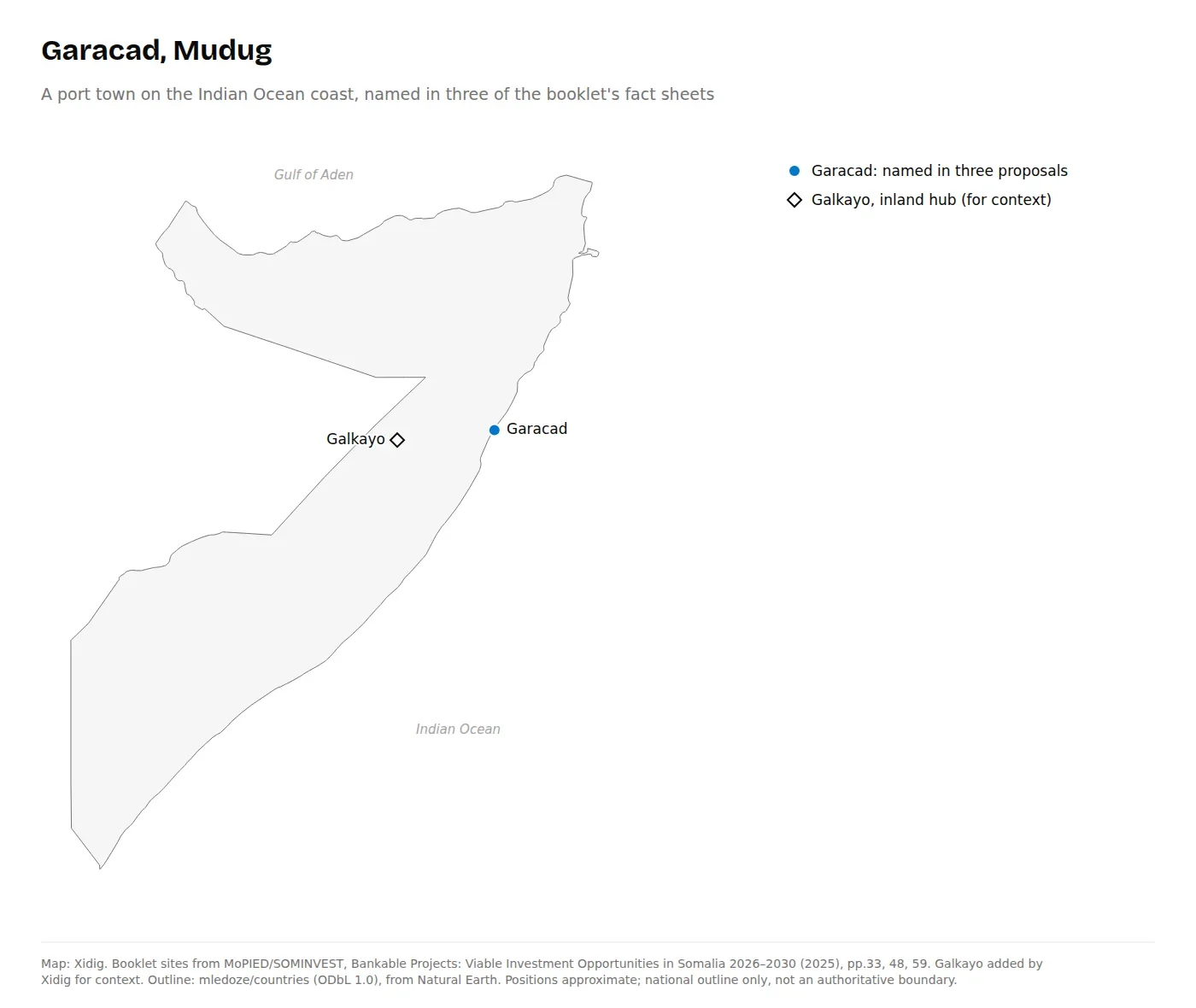
Garacad is on the central Indian Ocean coast. Galkayo, the main inland trading town of Mudug, is shown for context; it is not a booklet site.
Garacad sits between Hobyo to the south and Eyl to the north. Its location on the central coast is why its backers see it as a route to central Somalia and eastern Ethiopia. That depends on the road through Galkayo.
Dependencies and implementation constraints
- The road to Galkayo and beyond.
- Power and water at the port and in the town.
- Agreement with the port's private owners for any upgrade.
- Government roles: the proposals are promoted by federal institutions, and the port and road are in Puntland.
- Maritime security along the coast.
Risks and unknowns
- Costs: none of the shared proposals gives a cost for Garacad.
- Investment figures: reported figures vary widely.
- Management: who will manage or invest in the port after the 2024–2025 talks.
- Demand: no traffic data to show demand for more berths.
Questions members should verify before acting
- Who owns and manages Garacad port today?
- How much cargo, and what kind, passes through it?
- Is the road to Galkayo funded, and when would it be built?
- How is the port powered?
- How many boats land fish at Garacad?
What is confirmed, and what isn't
Confirmed
- The three proposals, their printed costs and their pre-feasibility stage.
- The port's opening in October 2022 and its private-investor model (US State Department, Somali Ports Authority).
- The foundation stone for the Garacad–Galkayo–Galdogob highway (October 2022).
- The April 2026 hijacking off Garacad.
Our interpretation
- The road and power matter more for trade than new berths.
- The port's investment model is a useful example for members.
Not yet verified
- The port's ownership structure and total investment.
- The outcome of the management talks.
- The specifications of the berths added since 2022.
- Any data on the town's population, power, water or fish catch.
Relevant next steps
- Follow the Puntland Highway Authority for the road.
- Garacad and Mudug members: share what you know about the port's trade, power and fishing through Xidig.
- Note your skills and location in Xidig so groups working on central Somalia can find you.
More about the source
The government's investment booklet, Bankable Projects 2026–2030 (MoPIED / SOMINVEST), is one of the sources for this report. The details it gives are summarised here as printed.
- Mogadishu, Kismayu, Garacad and Bosasso HFO Power Plant (EN-03, pp.33–34).
- What: an "HFO power plant based on Rolls Royce Bergen Engines" of 100 MW in each of four towns.
- Existing infrastructure: the sheet lists "Existing ports HFO imports" and "Existing grid, distribution and retail infrastructure".
- Cost: US$450M for all four.
- Construction of New Fishing Ports (FI-03, pp.48–49).
- What: new fishing ports "with adequate facilities for landing, processing, and transporting fish in 3 sites: Mogadishu Port, Kismayo Port, and Gara'ad Port".
- Partners: the sheet says it is in "highly confidential discussions with private partners".
- Cost: US$20.7M for all three.
- Modernisation of Existing Ports (LI-05, pp.59–60).
- What: "Upgrading existing ports in Bosaso, Gara'ad, and Kismayo with modern mechanization, new berths, warehousing, & enhanced cargo handling capacity."
- Existing infrastructure: listed as "Existing facilities at Bosaso, Gara'ad, and Kismayo ports".
- Cost: US$551.2M for all three.
The port sheet does not say who owns or runs Garacad port.
- Primary source: MoPIED / SOMINVEST, Bankable Projects 2026–2030, posted 19 Nov 2025. Fact sheets at PDF pp.33–34, 48–49 and 59–60.
- Promoters: SOMINVEST with the Ministry of Energy and Water Resources (EN-03), the Ministry of Fisheries and Blue Economy (FI-03) and the Ministry of Public Works, Reconstruction and Housing (LI-05).
- Spelling: the booklet uses both "Garacad" (EN-03) and "Gara'ad" (FI-03, LI-05).
- Stage: pre-feasibility on all three sheets. The HFO sheet's tick box says "Feasibility Started".
Related reports
- Somalia's seaports and a proposed Mogadishu dry dock
- Somalia's fisheries: vessels, processing and landing sites
- Why electricity costs so much in Somalia
- How fishing cooperatives work in Somalia
- Somalia's Bankable Projects 2026–2030, explained
About this report
By Xidig members and collaborators.
Project codes. Codes such as EN-04 or AG-05 are Xidig's own shorthand for the booklet's fact sheets, by sector; the booklet itself does not number its projects.
How we researched it. We read the full 97-page booklet and checked every figure, page reference and quotation used here against it. We then compared the booklet's claims with the official, international, academic and news sources listed below, and we say where they differ. We did not interview anyone for this report.
Corrections. If you spot an error, please tell us using the correction link on this page.
Sources
Primary
- MoPIED / SOMINVEST, Bankable Projects 2026–2030, PDF pp.33–34, 48–49, 59–60: https://sominvest.gov.so/bankable-projects-in-somalia-2026-2030/
Supporting
- Middle East Eye, "Somalia cancels all agreements with the UAE, including at major ports" (12 Jan 2026): https://www.middleeasteye.net/news/somalia-cancels-all-agreements-uae-including-major-ports
- Hiiraan Online, "Somali President inaugurates Gara'ad Port in Puntland's Mudug region" (23 Oct 2022): https://www.hiiraan.com/news4/2022/Oct/188378/somalia_president_inaugurates_gara_ad_port_in_puntland_s_mudug_region.aspx
- US Department of State, 2025 Investment Climate Statement: Somalia (Sep 2025): https://www.state.gov/wp-content/uploads/2025/09/638719_2025-Somalia-Investment-Climate-Statement.pdf
- Somali Ports Authority, Garacad port: https://spa.gov.so/garaad-port/
- Rendel, "Garacad Seaport, Somalia, passes first milestone" (9 Nov 2022): https://rendel-ltd.com/2022/11/09/garacad-seaport-somalia-passes-first-milestone/
- Rendel, Garacad Sea Port project page: https://rendel-ltd.com/portfolio/garacad-sea-port/
- Garacad port, investors page: https://dekadagaracad.com/investors/
- Bloomberg via AJOT, "Deep-water Somali port gives landlocked Ethiopia new trade route" (8 Sep 2022): https://www.ajot.com/news/deep-water-somali-port-gives-landlocked-ethiopia-new-trade-route
- Kaab TV, "Puntland President inaugurates new facilities during Garacad port visit" (26 Aug 2026): https://en.kaabtv.com/puntland-president-inaugurates-new-facilities-during-garacad-port-visit/
- Puntland Post (Somali), on the opening of the port's cargo storage (26 Aug 2026): https://puntlandpost.net/2026/08/26/madaxweyne-deni-oo-xarigga-ka-jaray-qaybta-kaydinta-badeecadaha-dekedda-garacad/
- Halqabsi News, "Garacad Port eyes UAE investment amidst controversy" (30 Jun 2024): https://halqabsi.com/2024/06/garacad-port-eyes-uae-investment/
- WardheerNews, "Puntland to hand over Garacad Port to UAE-based company, President Deni confirm" (4 Jul 2025): https://wardheernews.com/puntland-to-hand-over-garacad-port-to-uae-based-company-president-deni-confirm/
- World Bank, BADMAAL Project Appraisal Document (20 May 2024): https://documents1.worldbank.org/curated/en/099052324161040631/pdf/BOSIB108b9787807018d6d1e665f996841d.pdf
- World Bank, BADMAAL Implementation Status & Results Report (15 Apr 2025): https://documents1.worldbank.org/curated/en/099041525113034681/pdf/P178032-1b6ba979-3fa4-456a-8f0a-e5136d58776f.pdf
- Puntland Highway Authority, "Laying foundation stone on the Garacad–Galkacyo–Goldogob road" (Oct 2022): https://pha.pl.so/laying-foundation-stone-on-the-garacad-galkackayo-goldogob-road/
- Horn Review, "Puntland's Garacad Corridor: a $216 million project…" (analysis, 9 Mar 2025): https://hornreview.org/2025/03/09/puntlands-garacad-corridor-a-216-million-project-transforming-regional-connectivity-and-economic-growth/
- Al Jazeera, "Suspected pirates steer cargo vessel towards Somalia" (27 Apr 2026): https://www.aljazeera.com/news/2026/4/27/suspected-pirates-steer-cargo-vessel-towards-somalia
- The Daily Star (Bangladesh), "Hijacked Bangladeshi ship anchors near Somalian port: BMMOA" (14 Mar 2024): https://www.thedailystar.net/news/bangladesh/crime-justice/news/hijacked-bangladeshi-ship-anchors-near-somalian-port-bmmoa-3566511
Source notes
- The port's own news pages and several company sites could not be opened.
- Reported investment figures and berth counts differ between sources; Xidig reports each as attributed.