Livestock exports: why the figures don't match
Tusmada
- Summary
- Where Xidig members may contribute
- Possible services, research, supplier or collaboration roles
- Who may find this useful
- What the numbers show
- Dependencies and implementation constraints
- Risks and unknowns
- Questions members should verify before acting
- What is confirmed, and what isn't
- Relevant next steps
- More about the source
- Related reports
- About this report
- Sources
Live animals are Somalia's biggest export, and exports peak in the Hajj season. What the head counts show, and why the same year is reported as US$917M, US$951M or US$970M.
Not investment advice. Independent analysis of a government publication and other public sources. The Government of Somalia has not endorsed it.
Summary
Live animals are Somalia's largest export. The central bank reports about US$923 million of livestock exports and 5.9 million head in 2025, mostly sheep and goats. That is about 73% of goods exports. Openings around the trade include animal health certification, feed and holding yards, logistics and market research, but the trade depends on one season and a few Gulf buyers.
What Xidig found:
- A Hajj-season trade. Exports peak in the quarter of Hajj and Eid al-Adha: US$329.7 million in April–June 2025, against US$164 million in the third quarter.
- Early 2026 was up. First-quarter exports were US$257.8 million, 6% higher than a year earlier. The central bank noted pressure on Gulf trading partners after disruptions in the Strait of Hormuz.
- Importers record less. The main buyers in 2025 were Saudi Arabia, Oman and the United Arab Emirates, and they record noticeably less than Somalia reports. Xidig found no official reconciliation.
- One year, several values. For 2024, livestock exports are given as US$917M (constant 2022 prices), about US$951M (the statistics bureau's revised current-price value) and US$969.9M (the pre-revision value). Most of the gaps come from price basis and revisions.
For members, the lesson is to always say which figure, which year and which source you are using. The government's list also includes two proposals that build on the export trade, for live animals and meat processing (US$26.5M) and fodder (US$1.9M); details are under More about the source.
Where Xidig members may contribute
Learning and research openings:
- Data literacy: clear notes on which figure to use, for journalists, students and business plans.
- Export services: animal health certification, feed and holding yards, and logistics (see Fodder, drought and herd survival).
- Market research: tracking prices and volumes around Hajj.
Possible services, research, supplier or collaboration roles
- A members' "which number?" guide to Somali trade statistics, updated each year.
- A Hajj-season briefing on prices and shipping for traders.
- Research: comparing Somali and importer records, species by species.
Who may find this useful
- Economists and statisticians.
- Livestock traders and exporters.
- Journalists and researchers.
- Veterinarians and export-certification specialists.
What the numbers show
For 2024 alone, the value is reported differently depending on the source:
| Figure | Source | What it measures |
|---|---|---|
| US$917M | The government's investment booklet (p.7) | Matches the statistics bureau's value at constant 2022 prices |
| US$951M (US$950.9M) | Somali National Bureau of Statistics (SNBS, June 2026); central bank's 2025 report | Revised current-price value |
| US$969.9M (US$970M) | Central Bank of Somalia, Annual Report 2024; SNBS June 2025 release | Pre-revision current-price value |
| US$974M | Bloomberg, October 2025 | Press figure |
Why the values differ.
- Real versus current prices:
- SNBS publishes GDP tables at constant 2022 prices (to remove price changes) and at current prices. In the constant-price table, livestock exports were US$917 million in 2024. That value was first published in SNBS's June 2025 release, reproduced by the central bank, and is unchanged in the June 2026 revision. The government's US$917M figure matches it.
- At current prices, SNBS's June 2026 release gives about US$951 million.
- Revisions:
- SNBS's June 2025 release and the central bank's 2024 report gave about US$970 million. The central bank's 2025 report uses the revised US$950.9 million in the text but keeps 969.9 in a chart based on its own valuation series.
- For 2023, the central bank gives US$860.8 million at current prices, while the constant-price table gives US$1,023 million.
- Share of exports: estimates range from 62% of all exports (central bank, 2024) to about 73% of goods exports (central bank, 2025) and "75–78 percent" (World Bank, 2018). The difference depends on what the total includes and the year.
Head counts (central bank).
- 2024: "exceeded 6.4 million heads, comprising more than 5.9 million heads of goats and sheep, followed by 291,692 heads of cattle, and 212,616 heads of camels".
- 2025: "exceeded 5.9 million head, comprising more than 5.5 million head of sheep and goats, followed by 222,010 head of cattle and 193,013 head of camels". The main buyers were "Saudi Arabia, Oman, and the United Arab Emirates".
- Volume versus value: the number of animals fell about 8% in 2025, while value fell 3–5%, depending on the 2024 figure used.
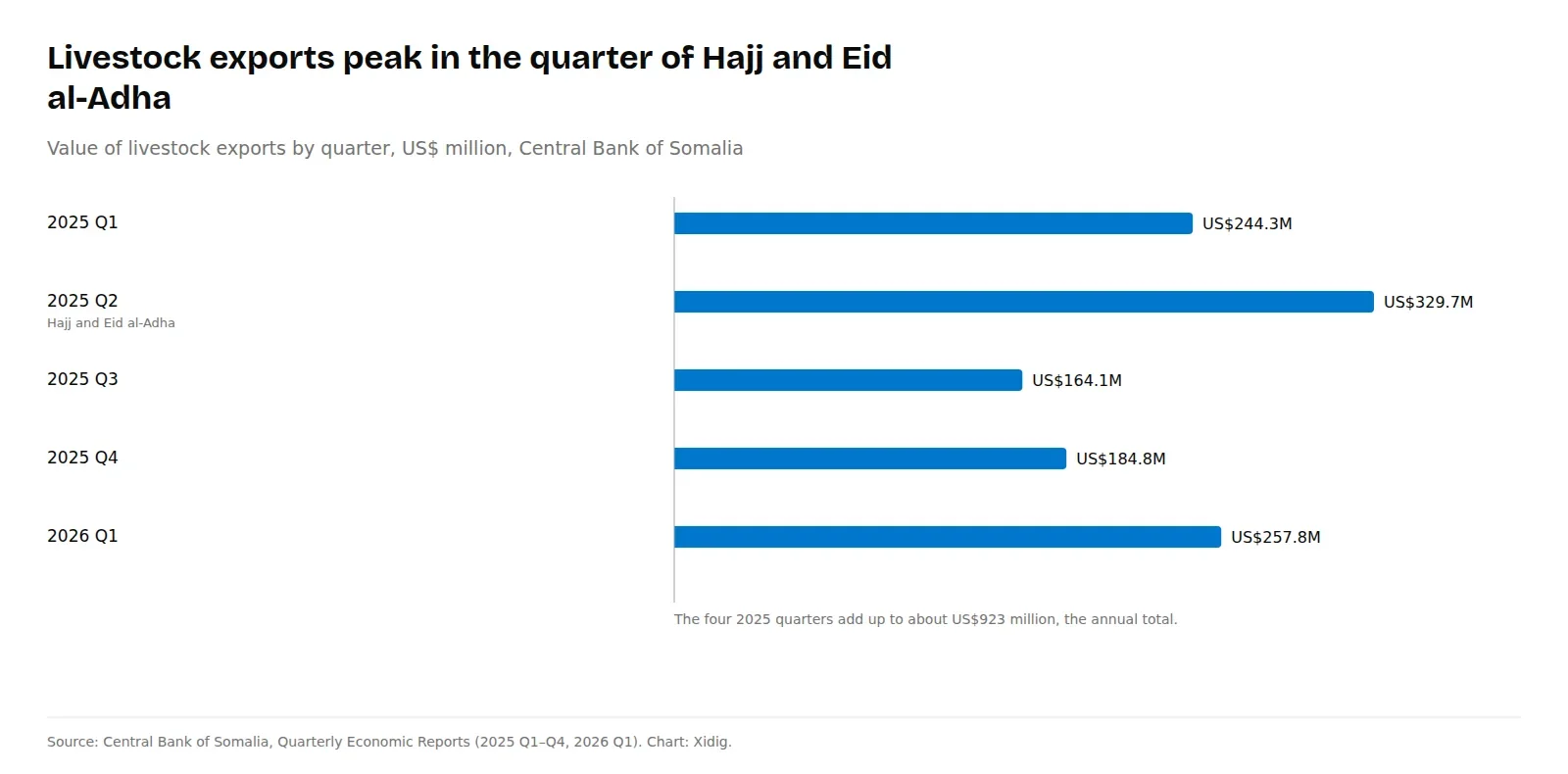
Exports peak in the quarter of Hajj and Eid al-Adha.
The Hajj peak.
- 2025: the central bank's quarterly reports show US$329.7 million in the second quarter (April–June, when Hajj and Eid al-Adha fell), against US$164 million in the third.
- 2017: a 2025 journal article found that "56% of Somalia's small-stock exports occurred during the month leading up to the Hajj date".
Early 2026.
- First quarter: livestock exports were US$257.8 million, 6% higher than a year earlier.
- Shipping and demand: the central bank noted pressure on Gulf trading partners after "disruptions in the Strait of Hormuz".
- By port: FEWS NET reported that exports through Bosaso fell about 22% in January–May 2026, while Berbera exported 13% more.
What importers record.
- Saudi Arabia: UN trade data show US$325.9 million of live animals imported from Somalia in 2025.
- Oman and the UAE: they recorded US$210.4 million and US$21.5 million in 2024.
- Why lower: in the years checked, these are well below Somalia's own totals, although Bloomberg reported that Saudi Arabia "alone took $715 million of live animals in 2023". Differences in valuation, timing and recording may explain the gap. Xidig found no official reconciliation.
Meat. Meat exports are small by comparison: about US$9 million in the third quarter of 2025 and again in the first quarter of 2026 (central bank).
What this means.
- Mostly explainable: most of the gaps are explained by price basis and revisions, but the central bank's 2025 report is internally inconsistent, and the constant-price series moves unusually.
- The main risks to the trade: it depends on one season and a few Gulf buyers.
Dependencies and implementation constraints
- Access to importing markets, which depends on animal health certification.
- Shipping routes through the Red Sea and Gulf.
- Feed and water for animals held before export.
Risks and unknowns
- Drought: it reduces herd numbers and the condition of export animals.
- Import bans: Saudi Arabia's last ban on Somali livestock ran from 2016 until July 2018 (The EastAfrican).
- Shipping disruption in 2026.
- Revisions: figures change with each release.
Questions members should verify before acting
- Which source and price basis does a figure use?
- Is the year a calendar year?
- Does a total include all ports?
- What do importing countries record for the same period?
What is confirmed, and what isn't
Confirmed
- The central bank head counts and quarterly values for 2025 and early 2026.
- SNBS's current and constant-price figures.
- The booklet's US$917M matches SNBS's constant-price value for 2024.
Our interpretation
- The main differences come from price basis and revisions.
Not yet verified
- Port-by-port head counts for 2023–2025.
- Why importer records are lower.
- Recent changes to health certification rules.
Relevant next steps
- Use the central bank's quarterly reports for the latest values and head counts.
- When citing a figure, state the source, year and whether it is at current or constant prices.
More about the source
The government's investment booklet, Bankable Projects 2026–2030 (MoPIED / SOMINVEST), is one of the sources for this report. The details it gives are summarised here as printed.
The booklet's economic snapshot (p.7) gives: "Livestock exports = US $917M (2024) 8.1% of GDP Expenditure approach".
Two proposals build on the export trade:
-
Live Animals and Meat Processing (AG-03, pp.17–18). It aims at "Driving export revenues" and "Boosting Somali export competitiveness". US$26.5M.
-
Fodder Production and Processing (AG-02, pp.15–16). It aims to support "the livestock sector". US$1.9M.
-
Primary source: MoPIED / SOMINVEST, Bankable Projects 2026–2030, posted 19 Nov 2025. Economic snapshot at PDF p.7; livestock fact sheets at pp.15–18.
Related reports
- Seed, fodder, meat, dairy and poultry in Somalia
- Somalia's economy at a glance: the latest figures, with sources
- Fodder, drought and herd survival in Somalia
- Somalia's Bankable Projects 2026–2030, explained
About this report
By Xidig members and collaborators.
Project codes. Codes such as EN-04 or AG-05 are Xidig's own shorthand for the booklet's fact sheets, by sector; the booklet itself does not number its projects.
How we researched it. We read the full 97-page booklet and checked every figure, page reference and quotation used here against it. We then compared the booklet's claims with the official, international, academic and news sources listed below, and we say where they differ. We did not interview anyone for this report.
Corrections. If you spot an error, please tell us using the correction link on this page.
Sources
Primary
- MoPIED / SOMINVEST, Bankable Projects 2026–2030, PDF pp.7, 15–18: https://sominvest.gov.so/bankable-projects-in-somalia-2026-2030/
Supporting
- Somali National Bureau of Statistics, Somalia GDP 2025 (30 Jun 2026): https://nbs.gov.so/somalia-gross-domestic-product-gdp-2025/ · PDF: https://nbs.gov.so/wp-content/uploads/2026/06/Somalia-GDP-2025.pdf
- SNBS, Somalia GDP 2024 release (June 2025), Tables 1 and 3: https://nbs.gov.so/wp-content/uploads/2025/06/Somalia-GDP-2024-release-text-v3-2025.pdf
- Central Bank of Somalia, Annual Report 2024 (Jul 2025): https://centralbank.gov.so/wp-content/uploads/2025/08/CBS-Annual-Report_2024_-28-July-2025-1.pdf
- Central Bank of Somalia, Annual Report 2025 (2026): https://centralbank.gov.so/wp-content/uploads/2026/08/Annual-Report_2025.pdf
- Central Bank of Somalia, Quarterly Economic Report Q2 2025: https://centralbank.gov.so/wp-content/uploads/2025/11/Quarterly-Economic-Report_Q2_2025.pdf
- Central Bank of Somalia, Quarterly Economic Report Q3 2025: https://centralbank.gov.so/wp-content/uploads/2026/03/Quarterly-Economic-Report_Q3_2025_3-1-Final-315.pdf
- Central Bank of Somalia, Quarterly Economic Report Q4 2025: https://centralbank.gov.so/wp-content/uploads/2026/04/Quarterly-Economic-Report-Q4-2025.pdf
- Central Bank of Somalia, Quarterly Economic Report Q1 2026: https://centralbank.gov.so/wp-content/uploads/2026/09/Quarterly-Economic-Report_Q1_2026.pdf
- FEWS NET, Somalia Food Security Outlook (Jun 2026): https://fews.net/east-africa/somalia/food-security-outlook/june-2026
- Thompson and Mohamed, Review of African Political Economy (2025): https://www.scienceopen.com/hosted-document?doi=10.62191/ROAPE-2025-0016
- Trading Economics (UN Comtrade), Saudi Arabia imports of live animals from Somalia: https://tradingeconomics.com/saudi-arabia/imports/somalia/live-animals
- Trading Economics (UN Comtrade), Oman imports of live animals from Somalia: https://tradingeconomics.com/oman/imports/somalia/live-animals
- Trading Economics (UN Comtrade), UAE imports of live animals from Somalia: https://tradingeconomics.com/united-arab-emirates/imports/somalia/live-animals
- World Bank, Somalia Country Economic Memorandum: Agriculture, overview (2018): https://documents1.worldbank.org/curated/en/803231522165074948/txt/124653-Somalia-CEM-Agriculture-Report-Overview-English-Revised-July-2018.txt
- The EastAfrican, "Saudi Arabia lifts Somalia livestock ban" (Jul 2018): https://www.theeastafrican.co.ke/business/Saudi-Arabia-lifts-Somalia-livestock-ban/2560-4644498-btrqap/index.html
- Bloomberg via WardheerNews, "Australia sheep export ban helps Somalia win $1 billion of sales" (Oct 2025): https://wardheernews.com/australia-sheep-export-ban-helps-somalia-win-1-billion-of-sales/
Source notes
- The first-quarter 2025 value (US$244.3M) comes from the central bank's quarterly series; the four 2025 quarters sum to the annual total.
- Importer figures are drawn from UN Comtrade via Trading Economics.