Hobyo's port plans and the road inland
Tusmada
- Summary
- Where Xidig members may contribute
- Possible services, research, supplier or collaboration roles
- Who may find this useful
- What has happened in Hobyo
- Geographic context
- Dependencies and implementation constraints
- Risks and unknowns
- Questions members should verify before acting
- What is confirmed, and what isn't
- Relevant next steps
- More about the source
- Notes on figures
- Related reports
- About this report
- Sources
A small Mudug coastal town that has seen several port deals since 2018. What was announced, what was built, what the road needs, and the proposals on the federal government's list.
Not investment advice. Independent analysis of a government publication and other public sources. It is not an offer or a tender notice, and the Government of Somalia has not endorsed it.
Summary
Hobyo, a small coastal town in Mudug administered by Galmudug State, has seen several port deals since 2018. Construction was reported to have started in late 2025, but only by a few outlets, and the road inland is not yet built. For now the openings for members are in tracking and verifying what is actually built, and in small services that don't depend on the deep port, such as power, ice and cold storage for the town's fishers.
What Xidig found:
- A long record of announcements. A foundation stone was laid in January 2018; an agreement with Qatar in 2019 did not go ahead; the outcome of a 2020 deal with a UK-based consortium is unknown.
- A new agreement. An 80-year agreement with a Turkish company was signed in Mogadishu in October 2024. Xidig found no official or wire-service confirmation of the reported start of construction.
- The road is the bottleneck. Of the 241 km Galkayo–Hobyo road, only a 100 km section has reached the design stage, and no timetable for construction has been given.
- Power has held fishers back. In January 2020 nearly 100 fishermen were reported to have stopped going to sea after two of the three power companies supplying the town pulled out, leaving it with no working cold storage.
The federal government's list also names Hobyo as one of three proposed new deep seaports and as a site for an industrial cluster, both at pre-feasibility stage, with costs printed in a notation that needs confirmation; details are under More about the source.
Where Xidig members may contribute
Learning openings at this stage, not confirmed contracts or tenders:
- Tracking: following the port and road projects and sharing verified updates.
- Local knowledge: members from Hobyo and Mudug can report what is actually being built.
- Small-scale services that don't depend on the deep port: power, ice and cold storage for fishers (see Cold chain for fish, milk and meat in Somalia).
- Engineering review: road and port specialists can help members read environmental and design documents when they are published.
Possible services, research, supplier or collaboration roles
- A verified timeline of the Hobyo port, updated by members with photos and documents.
- A solar and ice project for Hobyo's fishers, whose power supply has been unreliable.
- Research: what the "industrial cluster" in the government's proposal would contain, and who would build it.
Who may find this useful
- Diaspora members from Hobyo, Mudug and Galmudug.
- Port and road engineers.
- Environmental and social specialists.
- Fish traders and cooperatives.
What has happened in Hobyo
Port announcements since 2018.
- January 2018: the then federal president laid a foundation stone for Hobyo port. Chinese engineers were later sent to assess the site (Goobjoog, February 2018).
- August 2019: Qatar announced an agreement with Somalia to build the port. Trade press reported about US$170M. By June 2020 Garowe Online reported that "nothing is yet to take place". It added that Galmudug business people had pledged US$90M.
- November 2020: Galmudug signed a deal in London with what Hiiraan Online described as "a UK-based consortium"; Galmudug's ports minister said it was made up of Turkish, British and Somali companies. Xidig found no later news of it.
- October 2024: an 80-year agreement between the Hobyo Investment Company and Turkey's Metag Holding was signed in Mogadishu, with Galmudug's president present. The Africa Report said the project had "an initial budget of $70m for its first phase".
- November 2025 to February 2026: Suna Times reported that construction "has officially commenced", with heavy machinery on site. In February 2026 Africa One News reported that "Cranes, heavy machinery and construction teams have begun shaping the port's infrastructure." Xidig found no official or wire-service confirmation.
The road inland.
- Funding: the Galkayo–Hobyo road is a "241km, 7.3m wide feeder road" in an African Development Bank-managed programme worth US$66.36M, co-funded by the EU and Italy and approved in 2019.
- Design: in June 2026 the Ministry of Public Works signed a contract for studies and design of a 100 km section, from Galkayo to Elgula, to "compacted gravel standard". Dawan Africa reported that "The ministry did not provide a timetable for completing the studies or starting construction."
- Status: the road is not yet built.
The town.
- Population: figures are old. A 2024 construction-industry report described Hobyo as "the small settlement of 11,000 people".
- Fishing and power: in January 2020 Radio Ergo reported that nearly 100 fishermen had stopped going to sea after "Two of the three power companies that had been providing electricity to Hobyo pulled out". Without power, the town had no working cold storage.
- Fish sellers: in 2024 a local-government project funded by Galmudug's Ministry of Ports and Fisheries trained and equipped 30 women from displacement camps to sell fish.
- World Bank fisheries project: Hobyo is among the sites of the BADMAAL project (see Somalia's fisheries: vessels, processing and landing sites).
Security. The EU asylum agency reported that al-Shabaab controlled "a narrow section in the south of Hobyo district" and neighbouring Harardhere district, as of November 2022. In January 2023 the federal government said its forces, supported by clan militias, had taken control of Harardhere (ACLED).
What this means.
- The port: the government's list names Hobyo as a new deep seaport and does not mention the port agreement signed in 2024. Whether the government's proposal is the same project, an addition or a replacement is not stated.
- The road: without the road to Galkayo, a port at Hobyo would serve mainly the coast.
Geographic context
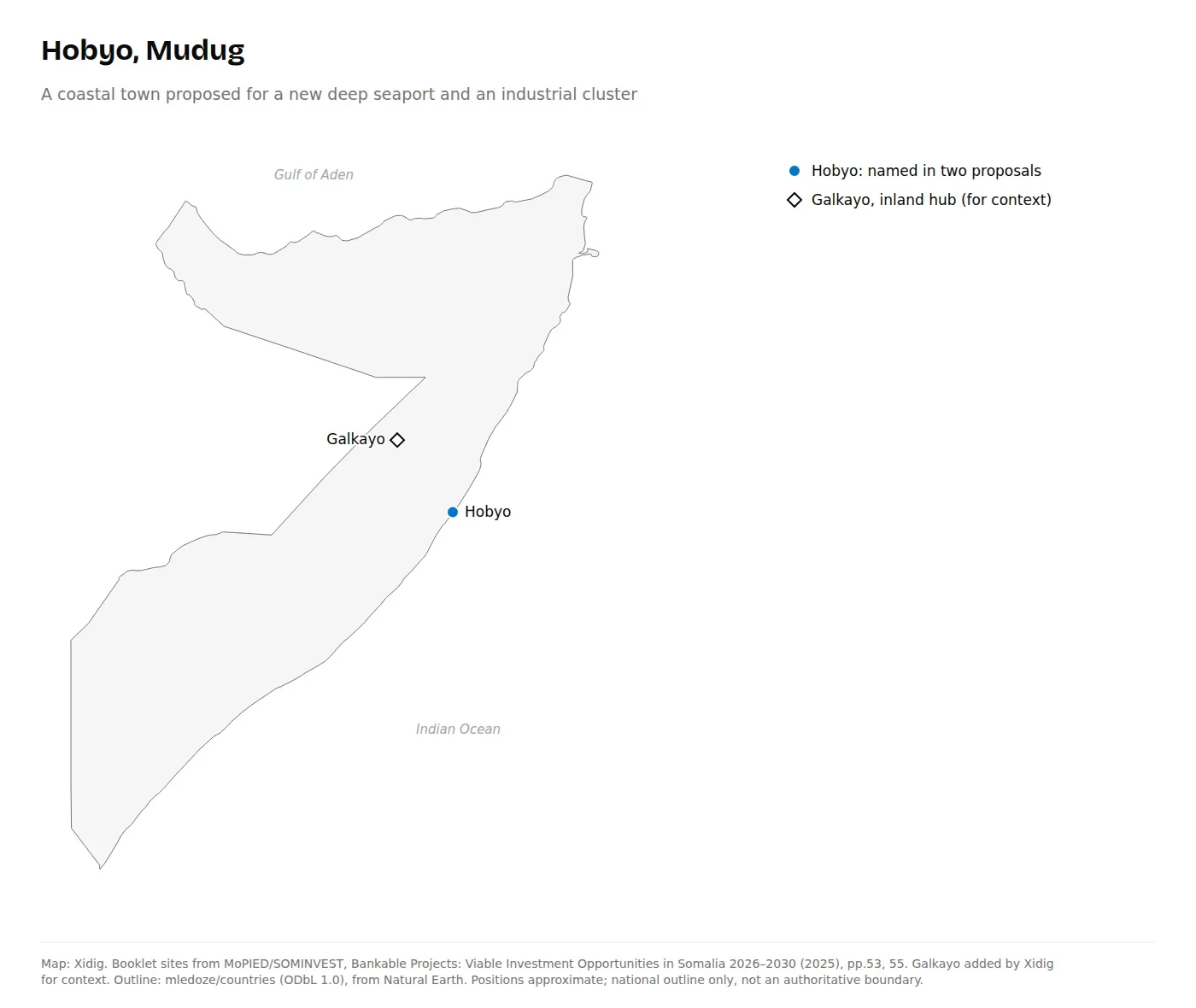
Hobyo is on the central Indian Ocean coast, south of Garacad. Galkayo, at the inland end of the planned road, is shown for context; it is not one of the proposed sites.
Hobyo and Garacad are both in Mudug, about 200 km apart in a straight line. Hobyo's backers present it as an alternative outlet for Ethiopia, and Garacad's developer names central Somalia and eastern Ethiopia as its market. Garacad already has a working port (see Garacad: the port Somali investors built).
Dependencies and implementation constraints
- The Galkayo–Hobyo road, with only one section at design stage.
- Security in parts of the district.
- The 2024 agreement: how the government's proposal relates to it.
- Power and water for a port and any industrial cluster.
- Government roles: the proposals are promoted by federal institutions; the port agreement involves Galmudug.
Risks and unknowns
- Cost notation: the printed costs need confirmation¹.
- Track record: earlier port deals were announced but not carried out.
- Construction: the reported start of construction relies on a few outlets.
- Competition: Garacad, nearby, may compete for the same inland trade.
Questions members should verify before acting
- Is construction at Hobyo port under way today, and what has been built?
- Is the government's Hobyo proposal the same as the 2024 agreement?
- When will the Galkayo–Hobyo road be built, and to what standard?
- What would the "industrial cluster" include?
- What is the security situation along the road?
What is confirmed, and what isn't
Confirmed
- The two proposals, their printed costs and their pre-feasibility stage.
- The 2019 Qatar announcement and the October 2024 signing.
- The AfDB-managed road programme and the June 2026 design contract.
Our interpretation
- The road matters as much as the port.
- The government's proposal overlaps with the 2024 agreement.
Not yet verified
- The start and progress of construction since late 2025.
- The outcome of the 2020 consortium deal.
- The town's current population.
Relevant next steps
- Follow the Ministry of Public Works and the AfDB for the Galkayo–Hobyo road.
- Hobyo members: share verified updates on the port with photos and dates through Xidig.
- Note your skills and location in Xidig so groups working on central Somalia can find you.
More about the source
The government's investment booklet, Bankable Projects 2026–2030 (MoPIED / SOMINVEST), is one of the sources for this report. The details it gives are summarised here as printed.
- Construction of New Deep Seaports (LI-03, pp.55–56).
- What: "Development of three new deep seaports in Mogadishu, Hobyo, and Barawe with modern mechanization, handling, and storage capacity." It "will position Somalia as a major regional trading hub".
- Drivers: "Create 9,000 direct and 12,000 indirect jobs" (for all three).
- Existing infrastructure: the sheet lists "Road link" and "Small-scale jetties and landing sites (Barawe)". It says nothing specific about Hobyo.
- Cost and timing: printed "$ 1,008.3 B"¹; 5 years.
- Construction of New Trade Corridors (LI-02, pp.53–54).
- What: "Development of 2,075 km of new asphalt roads connecting border towns with major port cities."
- Drivers: "Reduce travel time to ports for landlocked regions from 1+ day to 5 hours" and "Support industrial clusters in Hobyo, Kismayo, and Mogadishu".
- Cost: printed "$1,209 B"¹.
What the booklet leaves out. Neither sheet mentions the October 2024 agreement, the investors behind it or the Galkayo–Hobyo road. The booklet does not describe what the "industrial cluster" in Hobyo would contain.
- Primary source: MoPIED / SOMINVEST, Bankable Projects 2026–2030, posted 19 Nov 2025. Fact sheets at PDF pp.53–56.
- Promoters: SOMINVEST and the Ministry of Public Works, Reconstruction and Housing.
- Stage: pre-feasibility on both sheets.
Notes on figures
¹ Printed as "$ 1,008.3 B" (deep seaports, PDF p.55) and "$1,209 B" (trade corridors, p.53). The booklet gives its other costs in millions ("M"), for example "$551.2 M" for port modernisation on p.59. Read literally, each would be more than a thousand billion US dollars, so they are most likely formatting errors, possibly for US$1.008 billion and US$1.209 billion. Xidig has not changed the figures; they should be confirmed with the Ministry of Public Works, Reconstruction and Housing.
Related reports
- Somalia's seaports and a proposed Mogadishu dry dock
- Somalia's roads and trade corridors
- Garacad: the port Somali investors built
- Somalia's Bankable Projects 2026–2030, explained
About this report
By Xidig members and collaborators.
Project codes. Codes such as EN-04 or AG-05 are Xidig's own shorthand for the booklet's fact sheets, by sector; the booklet itself does not number its projects.
How we researched it. We read the full 97-page booklet and checked every figure, page reference and quotation used here against it. We then compared the booklet's claims with the official, international, academic and news sources listed below, and we say where they differ. We did not interview anyone for this report.
Corrections. If you spot an error, please tell us using the correction link on this page.
Sources
Primary
- MoPIED / SOMINVEST, Bankable Projects 2026–2030, PDF pp.53–56: https://sominvest.gov.so/bankable-projects-in-somalia-2026-2030/
Supporting
- Goobjoog English, "Somali federal government dispatches foreign engineers to Hobyo town" (5 Feb 2018): https://en.goobjoog.com/somali-federal-government-dispatches-foreign-engineers-to-hobyo-town/
- Al Jazeera, "Qatar to build new port in Somalia's Hobyo" (20 Aug 2019): https://www.aljazeera.com/amp/economy/2019/8/20/qatar-to-build-new-port-in-somalias-hobyo
- Ship-Technology, "Mwani Qatar to build Hobyo port in Somalia" (Aug 2019): https://www.ship-technology.com/news/mwani-qatar-hobyo-port-somalia/
- Garowe Online, "Galmudug businessmen contribute $90 million for construction of port in Somalia" (21 Jun 2020): https://www.garoweonline.com/en/news/somalia/galmadug-businessmen-contribute-90-million-for-construction-of-port-in-somalia
- Hiiraan Online, "Anglo-Turkish consortium signs deal to build and operate Somalia's Hobyo port" (5 Nov 2020): https://hiiraan.com/news4/2020/Nov/180587/anglo_turkish_consortium_signs_deal_to_build_and_operate_somalia_s_hobyo_port.aspx
- SONNA, "Hobyo port construction agreement signed in Mogadishu" (7 Oct 2024): https://sonna.so/en/hobyo-port-construction-agreement-signed-in-mogadishu/
- The Africa Report (Oct 2024), as republished by Hobyo port's news site: https://hobyoport.info/news/view/15
- Türkiye Today, "Turkish companies invest $70M in air, seaports in Africa" (14 Oct 2024): https://www.turkiyetoday.com/business/turkish-companies-invest-70m-in-air-seaports-in-africa-65010/
- Suna Times, "Construction of Hobyo Port officially begins" (16 Nov 2025): https://sunatimes.com/articles/6459/SomaliaOfficial-Report-Construction-of-Hobyo-Port-Officially-Begins
- Africa One News, "Somalia's Hobyo port advances amid strategic trade push" (26 Feb 2026): https://africaone.com/articles/somalias-hobyo-port-advances-amid-strategic-trade-push/
- African Development Bank, Road Infrastructure Programme (Somalia Infrastructure Fund): https://www.afdb.org/en/initiatives-partnerships/multi-partner-somalia-infrastructure-fund-sif/portfolio-overview/road-infrastructure-programme
- Dawan Africa, "Somalia: ministry signs contract for Galkayo–Hobyo road design" (23 Jun 2026): https://www.dawan.africa/news/somalia-ministry-signs-contract-for-galkayo-hobyo-road-design
- Global Construction Review, "Turkish contractor to create regional port hub in Somalia" (9 Oct 2024): https://www.globalconstructionreview.com/turkish-contractor-to-create-regional-port-hub-in-somalia/
- World Bank, BADMAAL Project Appraisal Document (20 May 2024): https://documents1.worldbank.org/curated/en/099052324161040631/pdf/BOSIB108b9787807018d6d1e665f996841d.pdf
- Radio Ergo via SOOHA, "Somali fishermen in Hobyo down tools as power companies pull out" (17 Jan 2020): https://sooha.org/en/2020/01/17/somali-fishermen-in-hobyo-down-tools-as-power-companies-pull-out/
- Radio Ergo, "Displaced women in Hobyo set up businesses selling fish" (8 May 2024): https://radioergo.org/en/2024/05/displaced-women-in-hobyo-set-up-businesses-selling-fish/
- European Union Agency for Asylum, Country Guidance: Somalia (Aug 2023), Mudug: https://euaa.europa.eu/country-guidance-somalia-2023/mudug
- ACLED, "Somalia situation update, March 2023" (24 Mar 2023): https://acleddata.com/2023/03/24/somalia-situation-update-march-2023-conflict-expands-to-galmudug-state/
Source notes
- Several pages could not be opened, including Bloomberg's October 2024 report and The Africa Report's 2026 article on the port.
- The reported start of construction comes from regional outlets; no official statement was found.