Camel milk and dairy in Somalia: a big producer that imports its milk powder
Tusmada
- Summary
- Where Xidig members may contribute
- Possible services, research, supplier or collaboration roles
- Who may find this useful
- Where the value goes
- Dependencies and implementation constraints
- Risks and unknowns
- Questions members should verify before acting
- What is confirmed, and what isn't
- Relevant next steps
- More about the source
- Related reports
- About this report
- Sources
Somalia is one of the world's largest camel milk producers, yet spends around US$200M a year on imported dairy. Where the value is lost, and where members can help.
Not investment advice. Independent analysis of a government publication and other public sources. It is not an offer or a tender notice, and the Government of Somalia has not endorsed it.
Summary
Somalia is one of the world's largest camel milk producers, and women run much of the milk trade. Yet value is lost between the herd and the customer: fresh milk often travels unchilled, traders surveyed in Mogadishu sold it untested, and the country spends heavily on imported milk powder. The practical openings are small and close to the herd: milk collection and chilling, hygiene testing and simple processing.
What Xidig found:
- A major producer. FAO data, as cited in a 2024 Codex paper, put Somalia's camel milk output at about 988,000 tonnes in 2022, second after Kenya. The figures are estimates.
- Women run the trade. 91% of the 100 milk traders and smallholders surveyed in a 2023 Mogadishu study were women.
- A big importer. FAO estimates that Somalia imports over $200 million of dairy products a year, mainly powdered milk. Trading partners recorded about US$181M of whole milk powder shipped to Somalia in 2023, much of it from the UAE and Oman.
- Milk is lost on the way. In Mogadishu, traders surveyed sold milk without any quality testing and much unsold milk is dumped; a 2021 UNIDO study found milk carried by pick-up van without refrigeration.
The government has also proposed a US$7.4M dairy investment in farms, processing plants and cold chain; details are under More about the source.
Where Xidig members may contribute
Service, collaboration and skills openings, not confirmed contracts or tenders:
- Milk collection and chilling points on routes into towns, run with women's collector groups.
- Hygiene and testing: simple quality tests, clean containers and training.
- Small-scale processing: pasteurised milk, yoghurt and ghee for local shops.
- Packaging and branding for fresh camel milk.
- Finance: savings groups or microloans for women traders to buy cool boxes and cans.
Possible services, research, supplier or collaboration roles
- A pilot solar-chilled collection point with a women's milk traders' group.
- A food-safety course in Somali for milk sellers.
- Research: how much milk is lost on one route, and what chilling would save.
Who may find this useful
- Dairy technologists and food-safety specialists.
- Refrigeration technicians.
- Women's cooperatives and milk traders.
- Veterinarians.
- Small food businesses.
Where the value goes
Production.
- Camels: FAO estimates Somalia's herd at 6.6 million camels (2025).
- Camel milk output: a 2024 UAE-led discussion paper to the international food-standards body, Codex Alimentarius, citing FAO data, puts Somalia's camel milk production at about 988,000 tonnes in 2022, second after Kenya. An earlier Codex paper (2023) gave 850,000 tonnes and ranked Somalia first. The figures are estimates.
- Yields: FAO says lactating camels in Africa "generally produce between 1 000 and 2 700 litres per lactation".
Women run the trade.
- Collection: in a Puntland case study, FAO wrote: "Milk and its marketing are managed mainly by women, even though men own the camels", and the women collectors' networks are the system's "backbone".
- Distance: herders walk "an average of nearly 9 km each day" to bring milk to collectors.
- Mogadishu: 91% of the 100 milk traders and smallholders surveyed in a 2023 study were women.
Losses.
- No testing: the Mogadishu study found traders "sell milk without conducting any kind of quality or quantity testing", and "64% of the residual milk is dumped" (of milk left unsold).
- Lower prices: a 2021 UNIDO study found spoiled milk sells at a "25% to 40% lower price".
- No refrigeration: milk moves "by pick-up vans without any refrigeration facility" (UNIDO, 2021; see Cold chain for fish, milk and meat in Somalia).
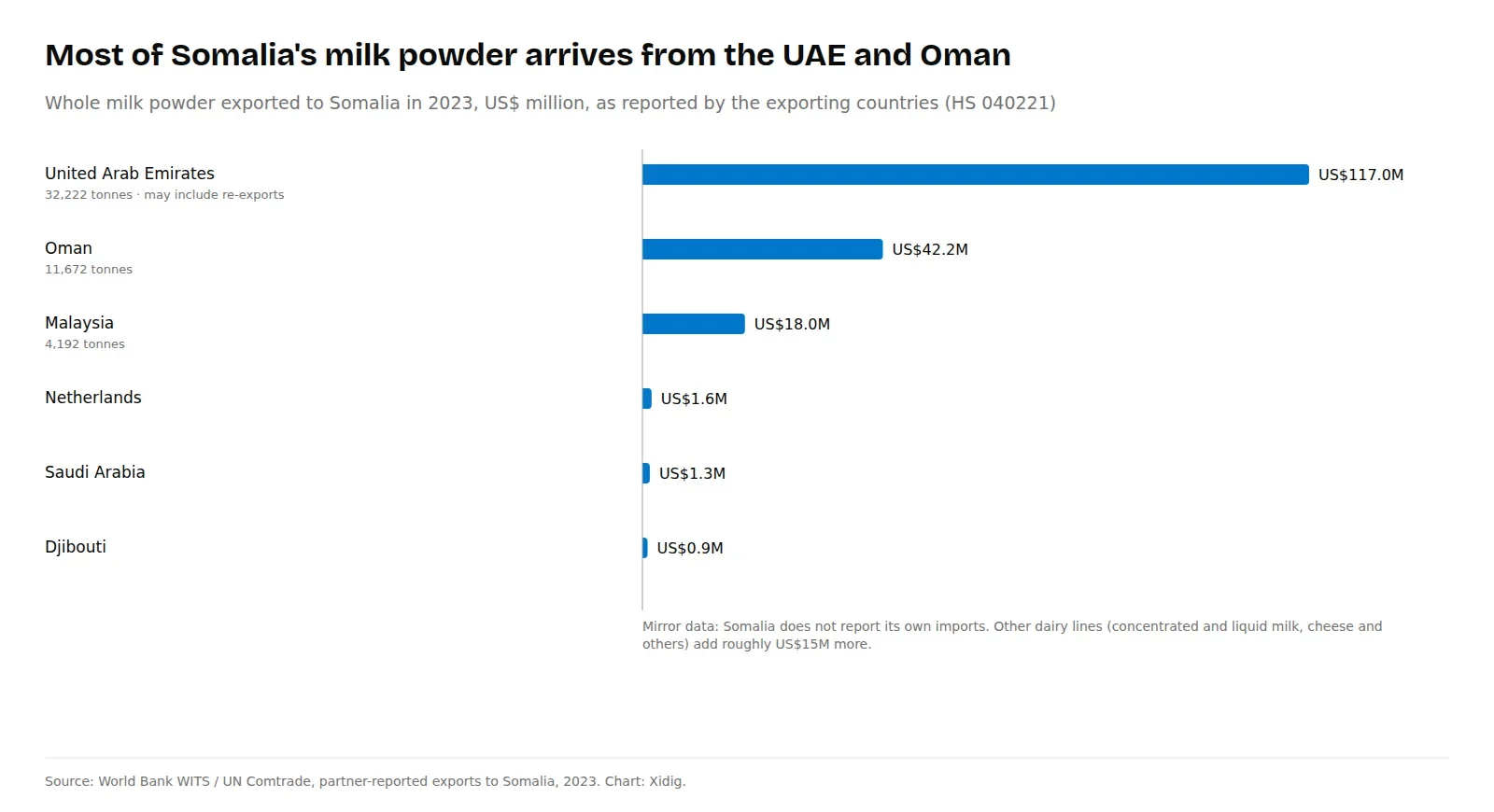
Most imported milk powder arrives from the UAE and Oman, some of it probably re-exported.
Imports.
- Milk powder: Somalia does not report its own imports, but its trading partners do. In 2023 they recorded about US$181M of whole milk powder (about 49,000 tonnes) shipped to Somalia. Other dairy lines add about US$15M (World Bank WITS, Xidig's sums).
- Consistency: that is broadly consistent with FAO's "over $200 million" estimate.
- Why powder: in Xidig's reading, powder keeps without refrigeration, which is exactly what fresh local milk lacks.
Cow milk is low-yielding. FAO's 2025 investment case for dairy notes yields of 1 to 2 litres per cow per day, against 5 to 10 litres elsewhere in the region. It proposes US$4.8M to raise fresh milk supply "from 3,460 liters/day in 2025 to 7,900 liters/day by 2029" in Lower Juba and Lower Shabelle, with collection centres and cold chain.
Markets abroad.
- Market size: estimates of the global camel milk market vary widely, from about US$7.5bn to US$14bn (as cited in a 2025 review in Small Ruminant Research).
- Standards: the Codex Alimentarius Commission agreed in 2025 to start work on a standard for pasteurised camel milk.
- Somali exports: Xidig found no official record of Somali camel milk exports.
Programmes. The World Bank's Food Systems Resilience Project (US$150M, 2023–2029) lists dairy as one of its value chains, with matching grants.
What this means.
- Where the money is lost: the gap is between the herd and the customer: chilling, testing and packaging.
- Where it could start: a large new processing plant is less urgent than reliable collection and cooling near towns, which would also help any processor that follows.
Dependencies and implementation constraints
- Power for cooling: solar or grid (see Solar power and battery storage in Somalia).
- Clean water and containers.
- Standards and testing capacity.
- Distance: herds are mobile and often far from towns.
Risks and unknowns
- Production figures are estimates.
- Price competition: imported powder is cheap and shelf-stable.
- Animal health: brucellosis and other risks; Xidig found no recent Somali data.
- The "old factories" in the government's proposal: their condition is not described.
Questions members should verify before acting
- How far does milk travel to your town, and how is it kept cool?
- What do traders pay pastoralists, and what do customers pay?
- Who tests milk quality, if anyone?
- Which of the "old factories" listed in the government's proposal still exist?
What is confirmed, and what isn't
Confirmed
- FAO's import estimate and the WITS mirror data for milk powder.
- The role of women in the milk trade (FAO Puntland case study and the 2023 Mogadishu survey).
- The losses reported in Mogadishu studies.
Our interpretation
- Collection and chilling matter more than a large new plant.
Not yet verified
- Current camel milk production and yields.
- Any exports of Somali camel milk.
- Animal-health and milk-safety data.
Relevant next steps
- Follow the Ministry of Livestock, Forestry and Range and the World Bank's Food Systems Resilience Project for dairy grants.
- Share milk prices and routes in your area through Xidig.
More about the source
The government's investment booklet, Bankable Projects 2026–2030 (MoPIED / SOMINVEST), is one of the sources for this report. The details it gives are summarised here as printed.
- Dairy Production & Value-Added Dairy Products (AG-04, pp.19–20). "projects will focus on developing modern dairy farms, processing plants, and cold chain infrastructure". US$7.4M; 3 years; private.
- Key drivers (p.20): "Enhancing pastoralist incomes", "Reducing dairy import dependency" and "Opening new export markets".
- Existing infrastructure: "Old factories".
The sheet does not say where, which animals, or which old factories.
- Primary source: MoPIED / SOMINVEST, Bankable Projects 2026–2030, posted 19 Nov 2025. Fact sheet at PDF pp.19–20.
- Promoters: SOMINVEST and the Ministry of Livestock, Forestry and Range.
- Stage: pre-feasibility.
Related reports
- Seed, fodder, meat, dairy and poultry in Somalia
- Cold chain for fish, milk and meat in Somalia
- Fodder, drought and herd survival in Somalia
- Somalia's Bankable Projects 2026–2030, explained
About this report
By Xidig members and collaborators.
Project codes. Codes such as EN-04 or AG-05 are Xidig's own shorthand for the booklet's fact sheets, by sector; the booklet itself does not number its projects.
How we researched it. We read the full 97-page booklet and checked every figure, page reference and quotation used here against it. We then compared the booklet's claims with the official, international, academic and news sources listed below, and we say where they differ. We did not interview anyone for this report.
Corrections. If you spot an error, please tell us using the correction link on this page.
Sources
Primary
- MoPIED / SOMINVEST, Bankable Projects 2026–2030, PDF pp.19–20: https://sominvest.gov.so/bankable-projects-in-somalia-2026-2030/
Supporting
- FAO, Hand-in-Hand Investment Forum 2025, Somalia: https://www.fao.org/hand-in-hand/previous-editions/hih-investment-forum-2025/somalia/en
- Codex Alimentarius, CAC47 CRD03, discussion paper on camel milk (Nov 2024): https://www.fao.org/fao-who-codexalimentarius/sh-proxy/ru/?lnk=1&url=https://workspace.fao.org/sites/codex/Meetings/CX-701-47/CRDs/CRD03/cac47_crd03e.pdf
- Codex Alimentarius, CCNE11 CRD05 (Sep 2023): https://www.fao.org/fao-who-codexalimentarius/sh-proxy/en/?lnk=1&url=https://workspace.fao.org/sites/codex/Meetings/CX-734-11/CRD/ne11_CRD05e.pdf
- FAO, Dairy production and products: camels: https://www.fao.org/dairy-production-products/dairy/camels/en
- FAO, Adding value to livestock diversity, Part 3, "Milk" (c. 2010): https://www.fao.org/4/i1283e/i1283e03.pdf
- Muse, Awow and Mohamed, "Marketing and processing challenges of milk in Mogadishu" (Oct 2023): https://www.questjournals.org/jraas/papers/v10-i10/10101925.pdf
- UNIDO / Ministry of Commerce and Industry, livestock sub-sector value chain analysis (Jan 2021): https://downloads.unido.org/ot/21/18/21186798/6_UNIDO_MoCI%20Report%20livestock%20subsector_final.pdf
- World Bank WITS / UN Comtrade, whole milk powder (HS 040221) exported to Somalia, 2023: https://wits.worldbank.org/trade/comtrade/en/country/ALL/year/2023/tradeflow/Exports/partner/SOM/product/040221
- Ait El Alia et al., Small Ruminant Research 243 (Feb 2025): https://www.sciencedirect.com/science/article/abs/pii/S0921448825000148
- Keller and Heckman, outcome of the 48th Codex Alimentarius Commission (Dec 2025): https://tomorrowsfoodandfeed.khlaw.com/2025/12/codex-alimentarius-commission-main-outcome-of-the-48th-session-cac48/
- Food Systems Resilience Project, Project Implementation Manual (Jun 2023): https://fsrp.gov.so/assets/uploads/media-uploader/somalia-fsrp-pim-june-2023-version-cleared-by-wb1737470440.pdf
Source notes
- Camel milk production figures are estimates and differ between sources.
- UAE export figures to Somalia may include re-exports.