Somalia's fish-catch figures: why they differ and how to read them
Tusmada
- Summary
- Where Xidig members may contribute
- Possible services, research, supplier or collaboration roles
- Who may find this useful
- What each catch figure measures
- Dependencies and implementation constraints
- Risks and unknowns
- Questions members should verify before acting
- What is confirmed, and what isn't
- Relevant next steps
- More about the source
- Notes on figures
- Related reports
- About this report
- Sources
Estimates of Somalia's fish catch range from 30,000 to 180,000 tonnes a year. What each figure measures, why the official series jumped in 2017, and how better data is being collected.
Not investment advice. Independent analysis of a government publication and public sources. The Government of Somalia has not endorsed it.
Summary
Anyone planning a fisheries business, project or study in Somalia soon meets a problem: published estimates of the catch range from about 30,000 to about 180,000 tonnes a year. The figures differ because they measure different things, and most are estimates rather than counts. Better data is a practical contribution members can make.
What Xidig found:
- The international series jumps. The figure published by FAO and the World Bank was exactly 30,000 tonnes every year from 2006 to 2016, then about 106,000 tonnes in 2017. Xidig reads this as a change in the estimate, not a real tripling of the catch.
- Somalia stopped reporting long ago. Researchers noted in 2019 that Somalia had not reported its catch to FAO since 1988, so international figures are estimates.
- Foreign fleets are a large, separate share. Research estimates suggest foreign vessels catch as much as, or more than, Somali fishers, and that catch is normally not counted as Somalia's.
- The ministry is building its own data. The fisheries ministry samples catches at six landing sites and scales them up to national estimates. Its estimate rose to about 76,000 tonnes in 2024, which it attributes partly to better monitoring; in 2024 it cautioned that its data was not yet comprehensive enough for national estimates.
- The "potential" figures are about 50 years old. The large estimates of what Somali waters could yield trace back to research surveys in the 1970s and 1980s.
- Better data now has an export payoff. Somalia and China signed a protocol in July 2026 for duty-free access for Somali fish and seafood. Under China's rules, seafood plants must be recommended by the exporting country's authority and registered with China's customs agency, which puts a premium on traceable catch and processing records.
The government has also listed a US$24.75M proposal to modernise fishing vessels, which it expects to add 28,441 tonnes a year. Xidig found no published basis for that figure; details are under More about the source.
Where Xidig members may contribute
These are learning and collaboration opportunities, not confirmed jobs or contracts.
- Data collection: mobile data-entry tools, landing-site surveys and price monitoring, working with the ministry and fishing communities.
- Statistics and analysis: turning samples into sound national estimates, with clear margins of error.
- Marine science: stock assessment, which has not been done in Somali waters at scale for decades.
- Explaining the numbers: helping investors, journalists and officials cite the right figure for the right purpose.
- Export traceability: catch, cold-chain and processing records of the kind that export markets, including China under the 2026 protocol, ask for.
Possible services, research, supplier or collaboration roles
- A public guide to Somali fisheries figures, updated each year, showing what each source measures.
- Support for landing-site enumerators: training, tablets and data-quality checks.
- Price and catch monitoring in fish markets, shared openly.
- Partnerships with universities for stock-assessment and vessel-tracking research.
Who may find this useful
- Fisheries investors and cooperatives.
- Statisticians, data scientists and marine scientists.
- Journalists and researchers who cite catch figures.
- Officials and development partners working on fisheries.
- Seafood traders and buyers, including those looking at exports to China.
What each catch figure measures
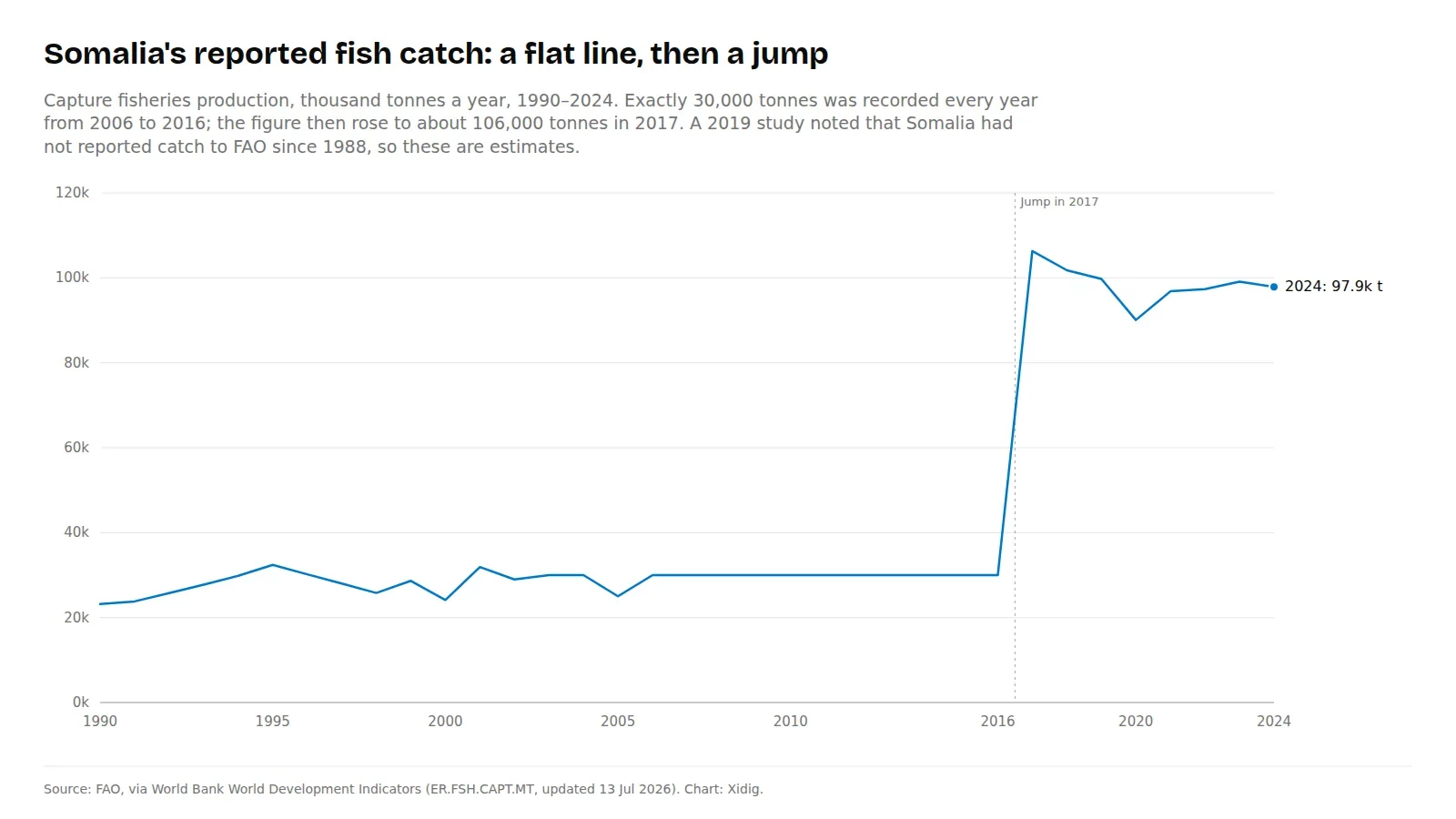
Somalia's reported catch was flat for eleven years, then rose more than threefold in one year. The change reflects how the figure is estimated, not what fishers caught.
The figures side by side. Xidig plans to update this table each year when the ministry's national report to the IOTC is published (usually in November).
| Figure | Year | Source | What it covers | Type |
|---|---|---|---|---|
| 97,871 t | 2024 | FAO, via the World Bank | Catch attributed to Somalia; foreign-flagged vessels normally excluded | International estimate |
| 76,026 t | 2024 | Ministry, IOTC report (2025) | National catch | Landing-site samples, scaled up |
| 58,322 t | 2023 | Ministry, IOTC report (2025) | National catch | Landing-site samples, scaled up |
| 49,049 t | 2019 | Ministry, IOTC report (2025) | National catch | Landing-site samples, scaled up |
| About 180,000 t | Not stated (2024 report) | Ministry, IOTC report (2024) | Small-scale (about 120,000 t) plus foreign industrial fleets (about 60,000 t) | Headline figure, method not stated |
| 120,000 t → 240,000 t | 2025–2029 | National Transformation Plan | Total fish production, baseline and target | Planning figure |
| About 50,000 t domestic; about 100,000 t foreign | Domestic: since 2010; foreign: not stated | World Bank (2024) | Somali fishers and foreign fleets | Estimate |
| 54,177 t domestic; 92,537 t foreign | 2014 | Peer-reviewed study (2019) | Somali fishers and foreign vessels | Catch reconstruction |
| 30,000 t every year | 2006–2016 | FAO, via the World Bank | Catch attributed to Somalia; foreign-flagged vessels normally excluded | International estimate |
1. The international series (FAO, published by the World Bank).
- What it counts: "the volume of fish catches landed by a country for all commercial, industrial, recreational and subsistence purposes". Under FAO's statistical standards, catch is assigned to "the country of the flag flown by the fishing vessel", so foreign vessels fishing in Somali waters are normally counted under their own flag, not Somalia. There are exceptions for vessels chartered by, or fishing under joint ventures for, the host country.
- The figures: 30,000 tonnes every year from 2006 to 2016; 106,303 tonnes in 2017; 97,871 tonnes in 2024.
- Why it is an estimate: a peer-reviewed study (2019) says Somalia has "not reported catch to the UN Food and Agriculture Organization (FAO) since 1988". A ministry paper to the Indian Ocean Tuna Commission (IOTC) in 2017 says "national annual fisheries statistics reports, specifically for the artisanal sector, have not been produced" since the 1980s. A 2014 fisheries profile by FAO's SmartFish programme with the Indian Ocean Commission, funded by the EU, reported that "there is no data collection going on", describing the situation reported at a 2012 FAO meeting.
- The 2017 jump: Xidig found no published FAO note explaining it.
2. The ministry's own figures.
- Headline figures: in its 2024 report to the IOTC, the Ministry of Fisheries and Blue Economy says small-scale fishers contribute "around 120,000 metric tons annually" and foreign industrial fleets "approximately 60,000 MT, bringing the total annual fish catch to about 180,000 MT". The report does not say how these were calculated.
- A caution in the same report: "the data is not sufficiently comprehensive to allow extrapolation to nationwide estimates".
- Sample-based estimates: the ministry's 2025 report gives national estimates from its landing-site sampling, rising from 49,049 tonnes in 2019 to 58,322 tonnes in 2023, then "A notable 30% increase in total national annual catch to 76,026 mt was recorded in 2024, driven primarily by yellowfin tuna". The ministry says this "reflects both improved monitoring and potential shifts in fishing effort and oceanographic conditions".
- Planning figures: the National Transformation Plan 2025–2029 says "fish production is set to double from 120,000 to 240,000 metric tons (MT)". The plan uses 120,000 tonnes for total production; the ministry's 2024 report uses the same number for small-scale catch only.
3. Research estimates that include foreign fleets.
- World Bank (2024): "annual domestic catch is around 50,000 tons since 2010" and "catches by foreign fleets are estimated to be around 100,000 tons". The same document says "Reliable data is scarce".
- A peer-reviewed study (2019): "In 2014, foreign vessels caught 92,537 mt, nearly twice as much as the Somali domestic catch of 54,177 mt." It estimated catch by combining published sources, vessel numbers, licensing records and satellite tracking of some vessels, a method called catch reconstruction. It classifies "as unsustainable 10 of 17 fish groups included in our analysis".
- Earlier reconstruction: the ministry's 2017 paper cites an estimate by the Sea Around Us research project of about 60,000 tonnes, "almost double as compared to the FAO's estimation".
4. "Potential" catch.
- Where it comes from: the World Bank says "Surveys in the 70s and 80s estimated potential production to be significantly higher, with the latest estimates at 600,000 and 835,000 tons".
- The original surveys: research vessel surveys in 1975–76 estimated "the average level of 570 thousand tonnes for the small pelagic fish and 400 thousand tonnes for demersal fish". These are estimates of fish in the sea, not of how much can be caught safely each year.
- A more cautious figure: FAO's 2005 country profile says pelagic stocks could provide "sustainable annual catches of the order of 200 000 t".
- No recent surveys: a 2015 report noted "no scientific surveys of Somali marine resources since the 1980s". Xidig found no later survey.
How data is collected now.
- Landing sites: the ministry's 2024 report names six monitored sites (Bosaso, Hobyo, Adale, Mogadishu, Marka and Kismayo), each with two enumerators, "supervised by a Landing Site Data Collection Coordinator".
- Methods: the ministry's 2025 report says its port observers and enumerators were "initially trained since 2015 with FAO support" and use mobile e-forms aligned with IOTC standards. It notes uncertainty from "partial district coverage".
- Fishing boats: the 2024 report counts about 5,800 inboard-engine and 7,200 outboard-engine boats in 2023, with average lengths of about 7 to 9 metres.
- Licences: the World Bank says licences for 30 Chinese longliners were "generating to date approximately US$4 million in annual revenue" (2024). Xidig found no published series of licence revenue.
- Coming work: the World Bank-funded BADMAAL project plans stock assessments for priority species "twice during project implementation".
Exports, and the China protocol.
- What was signed: on 13 July 2026 (reported 14–16 July), Fisheries Minister Ahmed Hassan Aden and China's ambassador, Wang Yu, signed a protocol in Mogadishu giving Somali fish and seafood products duty-free access to China. The minister said: "This is the first time that Somali fishery products have officially gained access to the Chinese market by benefiting from duty-free access" (Radio Dalsan, via AllAfrica; Dawan).
- Export value: those reports put Somalia's fish exports at US$9.9M in 2017 and US$51.3M in 2022, and post-harvest losses at 30–40% because of too little cold storage. Xidig has not checked these figures against trade data.
- What exporters must do: China's customs administration requires overseas seafood producers to be registered before they export. Aquatic products are on the list that needs a recommendation from the exporting country's competent authority. New rules (Decree 280) replaced the earlier ones (Decree 248) on 1 June 2026. Firms may now apply directly once they have that authority's inspection report and recommendation letter.
- Status: Xidig could not confirm whether any Somali establishment had been registered by 30 September 2026.
- Why it matters for data: an exporter has to show where fish came from and how it was handled. Landing-site records, catch documentation and cold-chain logs are the same data the ministry is building.
Where to see the data yourself.
- International series: World Bank indicator ER.FSH.CAPT.MT (source FAO), yearly. Linked under Sources.
- Ministry reports: national reports to the IOTC Scientific Committee, usually published in November on iotc.org.
- Foreign and industrial vessel activity: the Global Fishing Watch map (globalfishingwatch.org/map) shows "apparent fishing activity based on changes in vessel speed and direction" for vessels that broadcast their position (AIS). Many smaller vessels, and any that switch their transponders off, do not appear. It shows activity, not tonnes caught.
- Reconstructed catch: the Sea Around Us project (seaaroundus.org) publishes reconstructed catch for Somali waters, including foreign fleets, up to about 2019.
- Stock assessments: BADMAAL's planned assessments (see "Coming work" above) are the next expected source.
How to read a catch figure (Xidig's interpretation). Before using any number, ask three questions. Does it cover only Somali fishers, or foreign fleets too? Is it a count, a sample scaled up, or a reconstruction from other sources? And is it about catch, or about how many fish there might be? Most confusion comes from comparing figures that answer these questions differently.
Dependencies and implementation constraints
- Ministry leadership: any data effort needs to fit the ministry's own system and standards.
- Funding for enumerators and their equipment beyond donor projects.
- Access to landing sites along a long coast, some of it insecure.
- Cooperation from fishers and traders, who may worry about taxes or licences.
Risks and unknowns
- Wrong figures in business plans: using a "potential" figure as if it were current catch.
- Overfishing: a 2019 study rated most fish groups it assessed as unsustainably fished.
- Unexplained changes: jumps in a series can reflect better monitoring rather than more fish.
- Foreign catch: licensed and illegal catch by foreign vessels is hard to measure.
- Export claims running ahead of registration: a protocol is not the same as live exports; each plant still has to be recommended and registered.
Questions members should verify before acting
- Which figure does a proposal or partner use, and what does it cover?
- Has the ministry published a national catch estimate with its method?
- When will the planned stock assessments report?
- Where does the 28,441-tonne figure in the government's vessel proposal come from?
- Has any Somali seafood establishment been recommended and registered with China's customs administration under the 2026 protocol?
What is confirmed, and what isn't
Confirmed
- The international series and its jump in 2017.
- The ministry's headline figures, its sample-based estimates and its caution about them.
- The World Bank and research estimates of domestic and foreign catch.
- The origin of the large "potential" figures in 1970s–1980s surveys.
- The China fishery-products protocol (signed 13 July 2026) and China's registration rule for seafood plants (Decree 280, from 1 June 2026).
Our interpretation
- The 2017 jump reflects a change of estimate, not a change in catch.
- Figures should be compared only when they measure the same thing.
Not yet verified
- FAO's reason for the 2017 change.
- Any recent stock survey of Somali waters.
- The basis of the government's 28,441-tonne and 4,762-job estimates.
- The reported export values (US$9.9M in 2017, US$51.3M in 2022) and whether any Somali plant is registered for China.
Relevant next steps
- Ask the Ministry of Fisheries and Blue Economy for its method for national catch estimates.
- Data and marine-science professionals: follow BADMAAL's stock-assessment and information-system work.
- Anyone citing a figure: name its source, year and what it covers.
- Would-be exporters to China: ask the ministry how plants are recommended under the 2026 protocol.
More about the source
The government's investment booklet, Bankable Projects 2026–2030 (MoPIED / SOMINVEST), lists this as a proposal. Its details are summarised here as printed.
Modernisation of Vessels and Fishing Practices (FI-01, pp.44–45).
- What: "To modernize Somalia's fisheries by providing training on sustainable fishing, supplying modern equipment, establishing cooperatives, and attracting investment for technology adoption."
- Expected results: "This is expected to create 4,762 jobs and result in an additional annual catch of 28,441 MT."
- Why: "The fisheries sector is mainly artisanal and small-scale."
- Estimates as printed: US$24.75M; implementation 5 years; project lifetime 2025–2029.
- Tick boxes: greenfield; PPP; pre-feasibility.
- Promoters: SOMINVEST and the Ministry of Fisheries and Blue Economy.
The sheet does not say which catch figure it starts from, how the extra catch was calculated, or whether the stocks can sustain it.
- Primary source: MoPIED / SOMINVEST, Bankable Projects 2026–2030, posted 19 Nov 2025. Fact sheet at PDF pp.44–45.
- Status: pre-feasibility.
Notes on figures
- The 28,441 tonnes would be about 29% of the international series for 2024 (97,871 tonnes), about 37% of the ministry's sample-based 2024 estimate (76,026 tonnes) and about 24% of the 120,000-tonne planning baseline. These are Xidig's calculations.
- The ministry's 2019–2024 estimates are not limited to tuna: its table also includes sharks, lobsters, jacks and an "Other" category, which is the largest single line. They are sample-based estimates raised to national level, with incomplete coverage of districts.
- Boat counts are for boats operating in the IOTC area, as reported by the ministry. Part of the rise since 2017 may reflect better counting (Xidig's interpretation).
Related reports
- Somalia's fisheries: vessels, processing and landing sites
- How fishing cooperatives work in Somalia
- Cold chain for fish, milk and meat in Somalia
- The National Transformation Plan 2025–2029 in brief
- Somalia's economy at a glance: the latest figures, with sources
About this report
By Xidig members and collaborators.
Project codes. Codes such as EN-04 or AG-05 are Xidig's own shorthand for the booklet's fact sheets, by sector; the booklet itself does not number its projects.
How we researched it. We read the full 97-page booklet and checked every figure, page reference and quotation used here against it. We then compared the booklet's claims with the official, international, academic and news sources listed below, and we say where they differ. We did not interview anyone for this report.
Corrections. If you spot an error, please tell us using the correction link on this page.
Sources
Primary
- MoPIED / SOMINVEST, Bankable Projects 2026–2030, PDF pp.44–45: https://sominvest.gov.so/bankable-projects-in-somalia-2026-2030/
Supporting
- World Bank, World Development Indicators, capture fisheries production (ER.FSH.CAPT.MT; source FAO; updated 13 Jul 2026; World Bank licence CC BY 4.0): https://api.worldbank.org/v2/country/SOM/indicator/ER.FSH.CAPT.MT?format=json&per_page=80
- Glaser, S. M., Roberts, P. M. and Hurlburt, K. J., "Foreign Illegal, Unreported, and Unregulated Fishing in Somali Waters Perpetuates Conflict", Frontiers in Marine Science (6 Dec 2019): https://www.frontiersin.org/journals/marine-science/articles/10.3389/fmars.2019.00704/full
- Ministry of Fisheries and Marine Resources, paper to the IOTC Working Party on Data Collection and Statistics (2017): https://iotc.org/sites/default/files/documents/2017/11/IOTC-2017-WPDCS13-17_-_SOM.pdf
- Ministry of Fisheries and Blue Economy, national report to the IOTC Scientific Committee (Nov 2024): https://iotc.org/sites/default/files/documents/2024/11/IOTC-2024-SC27-NR23E_Somali.pdf
- Ministry of Fisheries and Blue Economy, national report to the IOTC Scientific Committee (Nov 2025): https://iotc.org/sites/default/files/documents/2025/11/IOTC-2025-SC28-NR23E-Somalia.pdf
- World Bank, BADMAAL Project Appraisal Document (P178032, May 2024): https://documents1.worldbank.org/curated/en/099052324161040631/pdf/BOSIB-08b97878-d848-4270-8d6d-e665f996841d.pdf
- FAO SmartFish / Indian Ocean Commission, Fisheries in the ESA-IO Region: Profile and Trends – Somalia (2014): https://www.nairobiconvention.org/clearinghouse/sites/default/files/Fisheries%20in%20the%20ESA-IO%20Region%20-%20Profile%20and%20Trends%20-%20Somalia.pdf
- FAO, Fishery Country Profile: Somalia (Jan 2005): https://www.fao.org/fishery/docs/DOCUMENT/fcp/en/FI_CP_SO.pdf
- FAO / Institute of Marine Research, The Pelagic and Demersal Fish Resources off North-East Somalia (1984): https://www.fao.org/4/x6037e/x6037e01.htm
- FAO Coordinating Working Party on Fishery Statistics, Handbook, "Nationality of catch and landings": https://www.fao.org/cwp-on-fishery-statistics/handbook/capture-fisheries-statistics/nationality-of-catch-and-landings/en/
- MoPIED, National Transformation Plan 2025–2029, executive summary: https://mop.gov.so/wp-content/uploads/2026/07/NTP-Executive-Summary.pdf
- One Earth Future, Securing Somali Fisheries (2015), record: https://agris.fao.org/search/es/records/6473af9d2437ad1e5b937d40
- Radio Dalsan via AllAfrica, "Somalia, China Sign Duty-Free Fishery Trade Deal" (16 Jul 2026): https://allafrica.com/stories/202607160270.html
- Dawan, "Somalia, China Sign Protocol Allowing Duty-Free Somali Sea-Food Exports" (14 Jul 2026): https://www.dawan.africa/news/somalia-china-sign-protocol-allowing-duty-free-somali-sea-food-exports
- Singapore Food Agency, trade circular on GACC Decree No. 280: https://www.sfa.gov.sg/news-publications/circulars-and-notices/circulars/trade-circular-on-update-on-china-s-revised-registration-requirements-for-overseas-food-manufacturers---gacc-decree-no--280
- China Briefing, "GAC New Overseas Food Manufacturer Registration Rules Effective June 1: A Guide for Exporters" (Decree 280, 2026): https://www.china-briefing.com/news/gac-overseas-food-manufacturer-registration-china-new-rules-2026/
- Global Fishing Watch, map and user guide: https://globalfishingwatch.org/map and https://globalfishingwatch.org/user-guide/
- Sea Around Us, University of British Columbia: https://www.seaaroundus.org/
Source notes
- Most figures are estimates. Each is quoted with its source and year; they should not be combined.