Remittances to Somalia: what the numbers mean
Tusmada
- Summary
- Where Xidig members may contribute
- Possible services, research, supplier or collaboration roles
- Who may find this useful
- What each remittance figure measures
- Dependencies and implementation constraints
- Risks and unknowns
- Questions members should verify before acting
- What is confirmed, and what isn't
- Relevant next steps
- More about the source
- Notes on figures
- Related reports
- About this report
- Sources
Why published figures for money sent to Somalia range from US$2.4 billion to over US$5 billion, what it costs to send, how transfers are regulated, and what changed in 2025–2026.
Not financial advice. Independent explanation of public figures and rules. The Government of Somalia has not endorsed it. Check current rules and fees with your provider and a qualified adviser before acting.
Summary
Money sent home by Somalis abroad supports households across the country and is one of the largest flows into Somalia's economy. But published figures range from about US$2.4 billion to more than US$5 billion a year, and they are often mixed up. This guide explains what each figure measures, what sending costs, and how the rules changed in 2025 and 2026.
What Xidig found:
- Three different measures are in use. The IMF estimates net private transfers, mainly remittances, at about US$2.4 billion in 2024, about a fifth of GDP. The Central Bank's secondary-income measure also includes aid, so it is larger. The Central Bank's gross transfer data includes business and NGO transfers too.
- The World Bank database has no values. Its series for personal remittances received is empty for Somalia, so figures attributed to it come from somewhere else.
- Sending is expensive. In the third quarter of 2025, sending the equivalent of US$200 cost 6.70% from the UK, 6.79% from Sweden and 5.60% from the US, above the international target of 5% for any corridor.
- Regulation has tightened. The Central Bank licenses 17 money transfer businesses, and Somalia's 2025 anti-money-laundering amendment requires institutions to identify and verify the sender of wire transfers of US$1,000 or more.
- New US rules affect senders. A 1% US federal tax on transfers paid in cash or similar instruments started on 1 January 2026.
The government's investment booklet quotes remittances of US$2.4 billion; details are under More about the source.
Where Xidig members may contribute
These are learning opportunities, not financial products or advice.
- Understanding the figures: citing the right measure, with its year and source, in business plans and advocacy.
- Research: how households use remittances, and how costs compare across countries and providers.
- Compliance and finance skills: anti-money-laundering, payments and banking professionals can help Somali institutions meet international standards.
- Diaspora investment: knowing the difference between sending money and investing it. See Investing in Somalia: registration, tax, land, visas and permits.
Possible services, research, supplier or collaboration roles
- A plain-language guide to sending money, covering costs, identification rules and taxes in the main sending countries.
- Periodic cost checks on corridors the World Bank does not survey, such as Canada, Norway or the Gulf.
- Training in compliance for staff of Somali banks and transfer businesses.
- Household research on how remittances are spent, with consent and privacy protections.
Who may find this useful
- Somalis abroad who send money home.
- Researchers, journalists and advocates who cite remittance figures.
- Banking, payments and compliance professionals.
- Diaspora organisations and investors.
What each remittance figure measures
The three main measures.
| Measure | Latest figure | What it covers | Source |
|---|---|---|---|
| Private transfers, including remittances (IMF) | About US$2.41 billion in 2024 (19.8% of GDP); US$2.49 billion projected for 2025 | Net private transfers, mainly money sent by the diaspora | IMF Country Report 25/335 (Dec 2025) |
| Secondary income (Central Bank) | US$5.09 billion gross and US$3.61 billion net in 2025; the net figure is 27% of GDP | Remittances plus official grants (aid) | Central Bank of Somalia, Annual Report 2025 |
| Gross inward transfers (Central Bank) | US$1.59 billion in the first quarter of 2026 alone | All transfers through banks and transfer businesses, including business and NGO money | Central Bank, quarterly report Q1 2026 |
- Why they differ: the measures differ in whether they are net or gross, whether they include aid or business payments, and whether they cover a quarter or a year.
- The quarterly breakdown: of the US$1.59 billion in the first quarter of 2026, the Central Bank records about US$875 million as individual remittances, US$490 million as business transfers, US$174 million as NGO transfers and US$49 million as other transfers. About half came through banks and half through transfer businesses. The total was "an 8 percent decline" from the previous quarter.
- Aid is larger than remittances in the IMF's figures: the IMF records official transfers of about US$3.98 billion in 2024, more than private remittances.
- The World Bank: its indicators for personal remittances received exist but have no value for Somalia in any year.
- The national statistics bureau (SNBS): its 2025 GDP release says "Overseas transfers—largely in the form of remittances from the Somali diaspora and international aid—provide significant support to household incomes", but Xidig did not find a separate remittance figure in it.
Why it matters. The IMF says growth in 2024 came "on the back of strong private consumption, largely financed by buoyant remittances and grants". The Central Bank's 2025 annual report says "Remittances from the diaspora underpinned the spending base and cushioned the pull-back in donor support."
How households use remittances.
- How many receive them: an analysis of the 2022 national household budget survey, in an abstract for a 2026 statistics conference, found that "one in five Somali households (20.7 percent) received remittances" in the previous year. Xidig found no official table from the survey.
- An older survey: the World Bank found in 2017–18 data that about 15% of households received remittances, and that "About 58 percent of households receiving international remittances are poor compare to 71 percent of households that do not". The surveys differ, so the two figures are not a trend.
What it costs to send money.
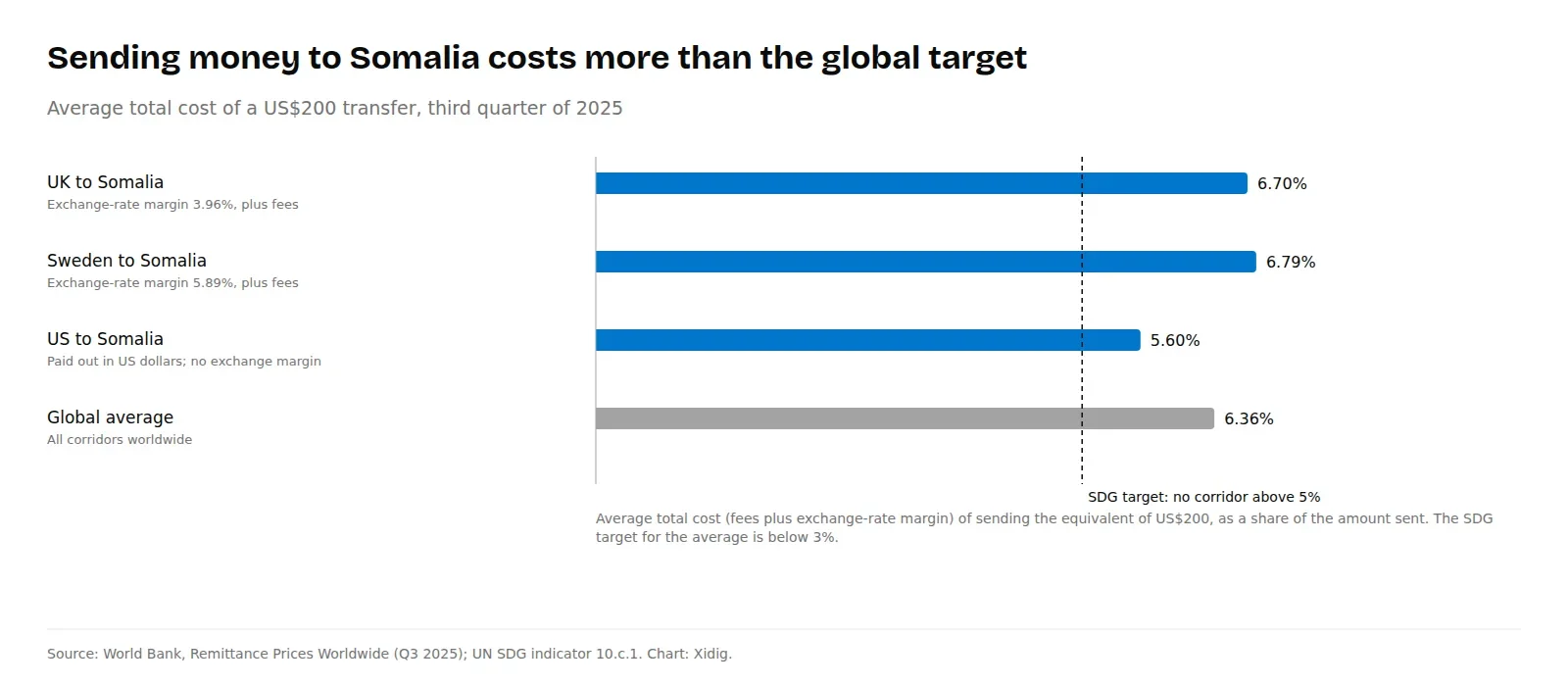
All three surveyed corridors cost more than the 5% ceiling in the UN Sustainable Development Goals. From the UK and Sweden, most of the cost is the exchange-rate margin rather than the fee.
- What "cost" means: the World Bank counts "the fee charged to the sender plus the exchange rate margin".
- Range: from the UK, costs among the providers surveyed ranged from 3.89% to 18.22%.
- The target: Sustainable Development Goal 10.c aims to "reduce to less than 3 per cent the transaction costs of migrant remittances and eliminate remittance corridors with costs higher than 5 per cent" by 2030.
How transfers are regulated in Somalia.
- Licensing: the Central Bank reported "15 licensed banks", "17 licensed money transfer businesses" and 6 mobile money operators in the first quarter of 2026. Its rules for transfer businesses date from 2014 and 2016, and for mobile money from 2020.
- Anti-money-laundering law: the AML/CFT Amendment Act 2025 names the Financial Reporting Center as "the central, national agency responsible for receiving, requesting and analyzing reports". For wire transfers of US$1,000 or more, institutions must "identify and verify the identity of the originator".
- International review: the Financial Reporting Center says the regional body MENAFATF adopted Somalia's technical compliance report in May 2025. The IMF notes that work is under way "addressing the recommendations" of the evaluation. Somalia was not on the FATF's lists of high-risk or monitored countries published in June 2026.
- Payments: the Central Bank launched an instant payment system in January 2025 and says "over two-thirds of payments in Somalia" already go through mobile money and other digital platforms. The planned return of the Somali shilling is covered in The new Somali shilling: what's changing, and when.
Rules in sending countries.
- Bank account closures: in 2014–2015, according to Oxfam, a major UK bank and a US bank closed the accounts of Somali money transfer operators, and the last major Australian bank providing them services was due to close them.
- US tax from 2026: the IRS says that "Beginning Jan. 1, 2026", transfer providers must collect a 1% excise tax on remittances the sender pays "with cash, a money order, a cashier's check, or a similar physical instrument". The IRS page lists only these payment methods.
- US reporting in Minnesota: in January 2026, AP reported that the US Treasury announced enhanced reporting on international transfers from two Minnesota counties, and Reuters reported extra reporting for transfers over US$3,000 by banks and money transmitters there. Xidig did not open the order itself.
Diaspora investment beyond remittances. The Ministry of Foreign Affairs' Department of Diaspora Affairs has a "Diaspora Direct Investment" unit, and Somalia ratified a National Diaspora Policy in 2023, according to an EU-funded diaspora facility. In September 2026 the Prime Minister's office held a conference to draft a Diaspora Engagement Roadmap. Xidig found no Somali diaspora bond and no official figure for diaspora deposits in Somali banks.
What this means (Xidig's interpretation). "US$2.4 billion" is a fair headline for money the diaspora sends home each year, as long as its source (the IMF) and year (2024) are named. Larger figures usually include aid or business payments. For senders, the practical issues are cost, identification rules and new taxes abroad.
Dependencies and implementation constraints
- Banking access abroad for Somali transfer businesses.
- Compliance costs of anti-money-laundering rules, which can raise fees.
- Data: a regular official remittance series, which Somalia does not yet publish separately.
- Currency change: the planned reintroduction of the Somali shilling may affect how money is paid out.
Risks and unknowns
- Misused figures: mixing the measures overstates or understates the diaspora's role.
- Rule changes abroad that raise costs or reduce access.
- Aid cuts: the Central Bank notes reduced donor support, which makes remittances more important.
- Fraud and scams targeting senders.
Questions members should verify before acting
- Which measure does a report or proposal use, and for which year?
- What is the full cost of a transfer, including the exchange rate, from your country?
- What identification and tax rules apply where you live?
- Is the transfer business licensed by the Central Bank of Somalia?
What is confirmed, and what isn't
Confirmed
- The IMF, Central Bank secondary-income and gross-transfer figures, and what each covers.
- Costs on the UK, US and Sweden corridors (third quarter of 2025).
- Licensing numbers, the 2025 anti-money-laundering amendment and the US 1% tax.
Our interpretation
- About US$2.4 billion is a fair headline for personal remittances, with source and year.
Not yet verified
- An SNBS publication giving US$2.4 billion.
- Official household-survey tables on remittances.
- The text and dates of the US Treasury order for Minnesota.
Relevant next steps
- The Central Bank of Somalia publishes a list of licensed money transfer businesses.
- The World Bank's Remittance Prices Worldwide site publishes total costs, including the exchange-rate margin, by corridor.
- Researchers: ask SNBS for published remittance tables from the 2022 household budget survey.
More about the source
The government's investment booklet, Bankable Projects 2026–2030 (MoPIED / SOMINVEST), gives a table of key figures at the start. Its remittance line is summarised here as printed.
Key figures (p.7).
-
As printed: "Remittances $2.4 billion. (SNBS)"
-
No year is given. The figure matches the IMF's estimate for 2024 (US$2.41 billion). Xidig did not find it in an SNBS publication.
-
Primary source: MoPIED / SOMINVEST, Bankable Projects 2026–2030, posted 19 Nov 2025. Key figures at PDF p.7.
Notes on figures
- Net and gross: net figures subtract money sent out of Somalia; gross figures do not.
- The quarterly total should not be multiplied by four to give an annual figure; flows vary by quarter.
- Costs are averages for a transfer of about US$200 across the providers surveyed; actual costs vary by provider, amount and payout method.
Related reports
- Somalia's economy at a glance: the latest figures, with sources
- The new Somali shilling: what's changing, and when
- Investing in Somalia: registration, tax, land, visas and permits
- Who does what in Somalia's investment institutions
- The National Transformation Plan 2025–2029 in brief
About this report
By Xidig members and collaborators.
How we researched it. We checked the booklet's remittance figure against the published sources listed below: the IMF, the Central Bank of Somalia, the national statistics bureau, the World Bank and the rules published by regulators. We say where they differ. We did not interview anyone for this report.
Corrections. If you spot an error, please tell us using the correction link on this page.
Sources
Primary
- MoPIED / SOMINVEST, Bankable Projects 2026–2030, PDF p.7: https://sominvest.gov.so/bankable-projects-in-somalia-2026-2030/
Supporting
- IMF, Somalia: Fourth Review under the Extended Credit Facility, Country Report No. 25/335 (Dec 2025): https://www.imf.org/-/media/files/publications/cr/2025/english/1somea2025002-source-pdf.pdf
- Central Bank of Somalia, Annual Report 2025 (Aug 2026): https://centralbank.gov.so/wp-content/uploads/2026/08/Annual-Report_2025.pdf
- Central Bank of Somalia, Quarterly Economic Report, Q1 2026 (Sep 2026): https://centralbank.gov.so/wp-content/uploads/2026/09/Quarterly-Economic-Report_Q1_2026.pdf
- SNBS, Somalia Gross Domestic Product 2025 (30 Jun 2026): https://nbs.gov.so/wp-content/uploads/2026/06/Somalia-GDP-2025.pdf
- World Bank, World Development Indicators, personal remittances received (BX.TRF.PWKR.CD.DT): https://api.worldbank.org/v2/country/SOM/indicator/BX.TRF.PWKR.CD.DT?format=json&per_page=40
- World Bank, Remittance Prices Worldwide, United Kingdom–Somalia: https://remittanceprices.worldbank.org/corridor/United-Kingdom/Somalia
- World Bank, Remittance Prices Worldwide, United States–Somalia: https://remittanceprices.worldbank.org/corridor/United-States/Somalia
- World Bank, Remittance Prices Worldwide, Sweden–Somalia: https://remittanceprices.worldbank.org/corridor/Sweden/Somalia
- World Bank, Remittance Prices Worldwide, global average: https://remittanceprices.worldbank.org/
- UN Statistics Division, SDG indicator 10.c.1 metadata: https://unstats.un.org/sdgs/metadata/files/Metadata-10-0c-01.pdf
- Central Bank of Somalia, regulatory guidelines: https://centralbank.gov.so/regulatory-guidelines/
- Central Bank of Somalia, AML/CFT Amendment Act 2025 (English translation): https://centralbank.gov.so/wp-content/uploads/2026/07/AML-CFT-Amendment-Act-2025-English-Translation.pdf
- Financial Reporting Center, MENAFATF technical compliance report (2025): https://frc.gov.so/?p=6299
- FATF, black and grey lists: https://www.fatf-gafi.org/en/countries/black-and-grey-lists.html
- Central Bank of Somalia, National Payment System: https://centralbank.gov.so/nps/
- Abdullahi, M. H., remittances and household welfare in Somalia, ICAS-X 2026 abstract: https://www.isi-next.org/media/abstracts/icas-x-2026_23856a9fa8ff6cc0f24800e04d7aa375.pdf
- World Bank, Somali Poverty and Vulnerability Assessment, summary of chapter 6, remittances: https://documents1.worldbank.org/curated/en/597711594118138283/pdf/Summary-of-Chapter-6-Remittances.pdf
- Oxfam Australia, "Cutting remittance lifeline will deepen Somali crisis" (19 Feb 2015): https://www.oxfam.org.au/media-releases/archive/cutting-remittance-lifeline-will-deepen-somali-crisis-oxfam/
- IRS, One Big Beautiful Bill provisions (remittance transfer tax): https://www.irs.gov/newsroom/one-big-beautiful-bill-provisions
- AP via WTOP, Treasury and Minnesota money services businesses (9 Jan 2026): https://wtop.com/business-finance/2026/01/as-tensions-flare-in-minnesota-treasury-secretary-bessent-pushes-a-crackdown-on-fraud/
- Reuters via Internazionale, overseas money transfers (10 Jan 2026): https://www.internazionale.it/ultime-notizie-reuters/2026/01/10/bessent-says-overseas-money-transfers-are-fine-if-people-can-prove-origin-of-funds
- Ministry of Foreign Affairs, Department of Diaspora Affairs: https://web.mfa.gov.so/diaspora-overview/
- EUDiF, Somalia diaspora engagement country factsheet (Dec 2023): https://diasporafordevelopment.eu/wp-content/uploads/2024/05/CF_Somalia-v.1.pdf
- Dawan Africa, "Somalia convenes diaspora leaders to draft engagement roadmap" (Sep 2026): https://www.dawan.africa/news/somalia-convenes-diaspora-leaders-to-draft-engagement-roadmap
Source notes
- Costs are from the World Bank's survey of selected providers and change often.
- Account closures abroad are described from an Oxfam statement of the time.